Florike Egmond – författare
Visar alla böcker från författaren Florike Egmond. Handla med fri frakt och snabb leverans.
11 produkter
Cultural Exchange in Early Modern Europe
Av Francisco Bethencourt, Florike Egmond
Häftad, 2013
820 kr
Lägg i varukorg
First published in 2007, this volume explores the importance of correspondence and communication to cultural exchanges in early modern Europe. Leading historians examine the correspondence of scholars, scientists, spies, merchants, politicians, artists, collectors, noblemen, artisans, and even …
Cultural Exchange in Early Modern Europe
Av Francisco Bethencourt, Florike Egmond
Inbunden, 2007
1517 kr
Lägg i varukorg
First published in 2007, this volume explores the importance of correspondence and communication to cultural exchanges in early modern Europe. Leading historians examine the correspondence of scholars, scientists, spies, merchants, politicians, artists, collectors, noblemen, artisans, and even …
Underworlds
Organised Crime in the Netherlands 1650 - 1800
Inbunden, 1993
1000 kr
Lägg i varukorg
Underworlds is a lively account of organized crime and the world of marginal groups in the seventeenth- and eighteenth-century Netherlands. Rural banditry has often been associated with mountainous, poverty-stricken areas located at the peripheries of the European continent or on the borders …
Bodily Extremities
Preoccupations with the Human Body in Early Modern European Culture
Av Florike Egmond, Robert Zwijnenberg
Inbunden, 2003
3262 kr
Lägg i varukorg
A strong preoccupation with the human body - often manifested in startling ways - is a characteristic shared by early modern Europeans and their present-day counterparts. Whilst modern manifestations of this interest include body piercing, tattoos, plastic surgery and eating disorders, early modern …
World of Carolus Clusius
Natural History in the Making, 1550-1610
Häftad, 2016
847 kr
Lägg i varukorg
Egmond's study investigates horticultural techniques, fashions in the collection of rare plants, botanical experimentation and methods of scientific evaluation, as well as tracking the exchange of knowledge. Central to this activity is the figure of Carolus Clusius (1526-1609), the first truly …
World of Carolus Clusius
Natural History in the Making, 1550-1610
E-bok, 2015
999 kr
Lägg i varukorg
Egmond's study investigates horticultural techniques, fashions in the collection of rare plants, botanical experimentation and methods of scientific evaluation, as well as tracking the exchange of knowledge. Central to this activity is the figure of Carolus Clusius (1526-1609), the first truly …
World of Carolus Clusius
Natural History in the Making, 1550-1610
E-bok, 2015
977 kr
Lägg i varukorg
Egmond's study investigates horticultural techniques, fashions in the collection of rare plants, botanical experimentation and methods of scientific evaluation, as well as tracking the exchange of knowledge. Central to this activity is the figure of Carolus Clusius (1526-1609), the first truly …
Bodily Extremities
Preoccupations with the Human Body in Early Modern European Culture
Av Robert Zwijnenberg, Florike Egmond
E-bok, 2017
829 kr
Lägg i varukorg
A strong preoccupation with the human body - often manifested in startling ways - is a characteristic shared by early modern Europeans and their present-day counterparts. Whilst modern manifestations of this interest include body piercing, tattoos, plastic surgery and eating disorders, early modern …
Bodily Extremities
Preoccupations with the Human Body in Early Modern European Culture
Av Robert Zwijnenberg, Florike Egmond
E-bok, 2017
838 kr
Lägg i varukorg
A strong preoccupation with the human body - often manifested in startling ways - is a characteristic shared by early modern Europeans and their present-day counterparts. Whilst modern manifestations of this interest include body piercing, tattoos, plastic surgery and eating disorders, early modern …
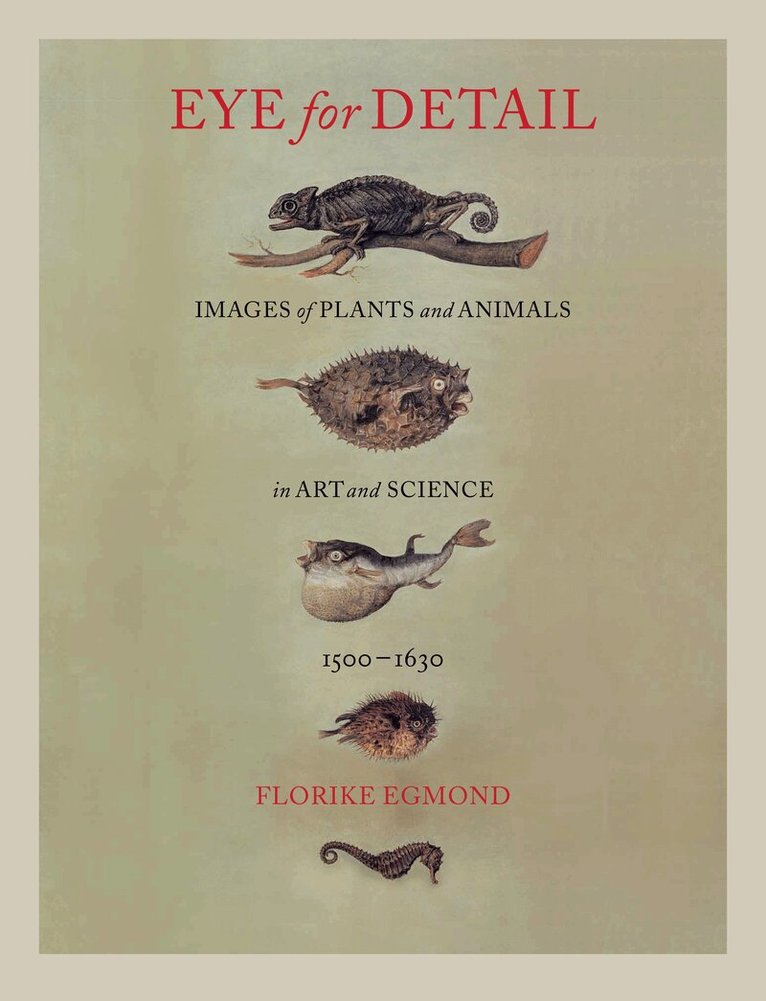
Eye for Detail
Images of Plants and Animals in Art and Science, 1500-1630
Inbunden, 2016
551 kr
Lägg i varukorg
Image-transforming techniques such as close-up, time lapse and layering are often linked to the age of photography, but they were already being used half a millennium ago for the purposes of identification and study. This is why Renaissance drawings of plants and animals are immediately …
World of Carolus Clusius
Natural History in the Making, 1550-1610
Inbunden, 2010
2586 kr
Lägg i varukorg
Egmond's study investigates horticultural techniques, fashions in the collection of rare plants, botanical experimentation and methods of scientific evaluation, as well as tracking the exchange of knowledge. Central to this activity is the figure of Carolus Clusius (1526-1609), the first truly …