Giovanni Andrea Cornia - Böcker
Visar alla böcker från författaren Giovanni Andrea Cornia. Handla med fri frakt och snabb leverans.
12 produkter
12 produkter
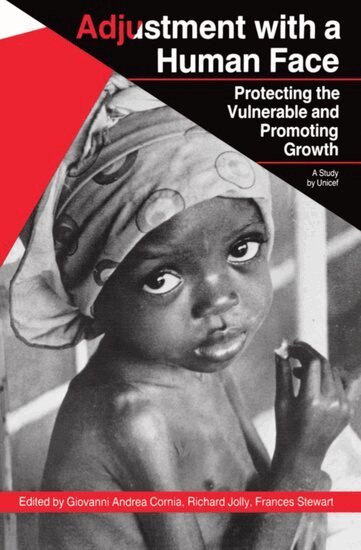
Adjustment with a Human Face
Volume 1, Protecting the Vulnerable and Promoting Growth
Häftad, Engelska, 1987
688 kr
Skickas inom 5-8 vardagar
This study draws on the experience of UNICEF to illustrate the current crisis in the welfare of children and other vulnerable groups.
2 720 kr
Skickas inom 3-6 vardagar
After three decades of remarkable progress, improvements in the welfare of children and other vulnerable groups in many parts of the world began to falter in the 1980s. This study draws on UNICEF work and experience of recent years to illustrate the extent of the current crisis and point to ways to alleviate the effects caused by economic adjustment.Volume 1, published in October, developed a strategy for protecting vulnerable populations during adjustment. The strategy, "Adjustment with a Human Face", combines the promotion of economic growth, protection of the vulnerable, and macro-economic adjustment.This volume, volume 2, examines in closer detail the experiences of the ten countries used as the basis for this strategy. The successes of governments in protecting vulnerable groups in South Korea, Botswana, Zimbabwe, and Peru are appraised and contrasted with the failures in Brazil, Ghana, Jamaica, and the Philippines. Sri Lanka and Chile are also considered.
2 890 kr
Skickas inom 5-8 vardagar
In spite of widespread expectations of improvements in living standards and health conditions, in most of the countries of the former Soviet bloc the transition to the market economy was accompanied by a sharp increase in (already high) death rates. Such an increase provoked an 'excess mortality' of some three million people over the period 1989-96 alone, an unprecedented phenomenon in peacetime. Such a crisis remains poorly explained, has generated a limited policy response in the countries concerned and international organizations, and is bound to generate important political and economic repercussions. This book is the first comprehensive assessment of the mortality crisis in transitional economies, of its causes, and of its remedies on the basis - among others - of micro data sets and quasi-panels on health trends which have never been used before. Contributions by demographers, economists, sociologists, epidemiologists, and health experts provide a rigorous analysis of the upsurge in mortality rates, with the aim of contributing to the launch of vigorous policies to tackle the crisis.
2 443 kr
Skickas inom 3-6 vardagar
The volume aims to document and explain the sizeable decline of income inequality that has taken place in Latin America during the 2000s. It does so through an exploration of inequality changes in six representative countries, and ten policy chapters dealing with macroeconomics, foreign trade, taxation, labour market, human capital formation, and social assistance, which point to the emergence of a 'new policy model'. The volume addresses a major issue in economic development with profound implications for many developing regions and those OECD countries mired in a long-lasting financial crisis and economic stagnation. For at least the last quarter of the twentieth century, Latin America suffered from low growth, rising inequality, and frequent financial crises. However, since the turn of the century, growth accelerated, inequality declined, poverty fell, and macroeconomic stability improved, all this in parallel to the spread of centre-left political regimes in three quarters of the region. This inequality decline has taken many by surprise as, for a long time, the region has been a symbol of a deeply entrenched unequal distribution of assets, incomes, and opportunities, limited or no state redistribution, and a deeply embedded authoritarianism enforcing an unjust status quo. The recent Latin American experience is particularly valuable as inequality was reduced under open economy conditions and in a period of intensifying global integration, which have often been considered as a source of rising inequality. In this sense, however imperfect, the recent Latin American experience may be of interest to countries completing their transition to the market and liberal democracy (as in the former socialist countries of Europe), facing a political transition (as those affected by the Arab Spring, Myanmar and countries in sub-Saharan Africa), or recording rises in inequality and social tensions in spite of rapid economic growth (as in China and India).Until recently there was not much agreement on the drivers of the inequality decline in the region, which was attributed to changes in the supply/demand of skilled workers, improvements in terms of trade, the spread of social assistance schemes, or 'luck'. In this respect, the volume offers the first scholarly and systematic exploration of this unexpected change. As income inequality has been rising and is currently rising in many parts of the world, a good understanding of the Latin American experience over the 2000s is a topic that will inform and generate a lot of attention.
1 682 kr
Skickas inom 7-10 vardagar
Human Development is widely recognised as the overriding goal of development, yet its realization is challenged by growing inequality, macro-economic fluctuations, and recurrent financial crises. This edited collection reflects on the work of Richard Jolly and includes contributions from leading scholars of development, all of whom have worked with Richard Jolly at varying points in his distinguished career. The volume advances thinking in the area of Human Development by discussing the evolution of its conceptualization and the policy implications, and the achievements in related key areas such as education, social protection, and employment. It juxtaposes these theoretical and (at times) real life improvements with disturbing developments in terms of growing inequality and macro-economic instability. It documents the growing income inequality which has characterized both developing and developed countries. It shows that there has been a decline in some countries and identifies the policies adopted in these exceptional cases. It also shows also where and how public expenditure on Human Development in developing countries has been affected by the 2008 financial crisis and presents a new framework for a pro-growth pro-Human Development macro-economics, including suggestions for the countercyclical regulation of financial flows. The book also argues that a series of disruptive factors are nudging the innovation trajectory in new potentially pro-poor and pro-Human Development directions, especially if policies speed-up the diffusion of new efficient appropriate technologies in low and middle income economies
600 kr
Skickas
Human Development is widely recognised as the overriding goal of development, yet its realization is challenged by growing inequality, macro-economic fluctuations, and recurrent financial crises. This edited collection reflects on the work of Richard Jolly and includes contributions from leading scholars of development, all of whom have worked with Richard Jolly at varying points in his distinguished career. The volume advances thinking in the area of Human Development by discussing the evolution of its conceptualization and the policy implications, and the achievements in related key areas such as education, social protection, and employment. It juxtaposes these theoretical and (at times) real life improvements with disturbing developments in terms of growing inequality and macro-economic instability. It documents the growing income inequality which has characterized both developing and developed countries. It shows that there has been a decline in some countries and identifies the policies adopted in these exceptional cases. It also shows also where and how public expenditure on Human Development in developing countries has been affected by the 2008 financial crisis and presents a new framework for a pro-growth pro-Human Development macro-economics, including suggestions for the countercyclical regulation of financial flows. The book also argues that a series of disruptive factors are nudging the innovation trajectory in new potentially pro-poor and pro-Human Development directions, especially if policies speed-up the diffusion of new efficient appropriate technologies in low and middle income economies.
1 370 kr
Skickas inom 3-6 vardagar
The Macroeconomics of Developing Countries provides a comprehensive discussion of the exogenous factors and macroeconomic policies that affect the business cycle, long term growth, and distribution of income in developing countries. It examines countries dependent on natural resources and affected by supply rigidities in agriculture. They also feature dualistic markets, a large informal sector, rapid population growth, a vulnerable export sector, and chronic dependence on a volatile global finance. The Macroeconomics of Developing Countries uses these examples to analyse the impact of stablization and adjustment politices on growth, inequality, and poverty.Despite the launch of the Sustainable Development Goals there is little consensus on how macroeconomic policies can be consistent with these objectives. The Macroeconomics of Developing Countries demonstrates that a critical application of standard models to developing countries can generate erroneous results and induce the adoption of incorrect policy. In order to address this, it discusses the key structural differences between advanced and developing countries in order to justify the construction of alternative models.
1 146 kr
Skickas inom 5-8 vardagar
The gradual introduction of market reforms in China since 1978 and their subsequent massive and rapid adoption in the former Soviet bloc triggered an intense debate on the factors and policies which promote a smooth transition to a market economy. Particularly during its initial phase, such debate has focused on liberalization, privatization, and the macroeconomy of the countries of Central and Eastern Europe, and Russia. Other reforming economies and aspects increasingly recognized as key to a successful transition have received less attention in the academic literature.This volume attempts to fill the gap by reviewing the often- neglected role of initial structural and institutional conditions and their subsequent development during the course of the transition. The volume focuses in particular on China, Russia, and the often-ignored countries of Central Asia, Vietnam, and those economies - such as Cuba and North Korea - which are in the very early phases of the reform process.
Inequality, Growth, and Poverty in an Era of Liberalization and Globalization
Inbunden, Engelska, 2004
1 372 kr
Skickas inom 3-6 vardagar
Within-country income inequality has risen since the early 1980s in most of the OECD, all transitional, and many developing countries. More recently, inequality has risen also in India and nations affected by the Asian crisis. Altogether, over the last twenty years, inequality worsened in 70 per cent of the 73 countries analysed in this volume, with the Gini index rising by over five points in half of them. In several cases, the Gini index follows a U-shaped pattern, with the turn-around point located between the late 1970s and early 1990s. Where the shift towards liberalization and globalization was concluded, the right arm of the U stabilized at the 'steady state level of inequality' typical of the new policy regime, as observed in the UK after 1990.Mainstream theory focusing on rises in wage differentials by skill caused by either North-South trade, migration, or technological change poorly explains the recent rise in income inequality. Likewise, while the traditional causes of income polarization-high land concentration, unequal access to education, the urban bias, the 'curse of natural resources'-still account for much of cross-country variation in income inequality, they cannot explain its recent rise.This volume suggests that the recent rise in income inequality was caused to a considerable extent by a policy-driven worsening in factorial income distribution, wage spread and spatial inequality. In this regard, the volume discusses the distributive impact of reforms in trade and financial liberalization, taxation, public expenditure, safety nets, and labour markets. The volume thus represents one of the first attempts to analyse systematically the relation between policy changes inspired by liberalization and globalization and income inequality. It suggests that capital account liberalization appears to have had-on average-the strongest disequalizing effect, followed by domestic financial liberalization, labour market deregulation, and tax reform. Trade liberalization had unclear effects, while public expenditure reform often had positive effects.
1 113 kr
Skickas inom 5-8 vardagar
Within-country income inequality has risen since the early 1980s in most of the OECD, all transitional, and many developing countries. More recently, inequality has risen also in India and nations affected by the Asian crisis. Altogether, over the last twenty years, inequality worsened in 70 per cent of the 73 countries analysed in this volume, with the Gini index rising by over five points in half of them. In several cases, the Gini index follows a U-shaped pattern, with the turn-around point located between the late 1970s and early 1990s. Where the shift towards liberalization and globalization was concluded, the right arm of the U stabilized at the 'steady state level of inequality' typical of the new policy regime, as observed in the UK after 1990. Mainstream theory focusing on rises in wage differentials by skill caused by either North-South trade, migration, or technological change poorly explains the recent rise in income inequality. Likewise, while the traditional causes of income polarization-high land concentration, unequal access to education, the urban bias, the 'curse of natural resources'-still account for much of cross-country variation in income inequality, they cannot explain its recent rise. This volume suggests that the recent rise in income inequality was caused to a considerable extent by a policy-driven worsening in factorial income distribution, wage spread and spatial inequality. In this regard, the volume discusses the distributive impact of reforms in trade and financial liberalization, taxation, public expenditure, safety nets, and labour markets. The volume thus represents one of the first attempts to analyse systematically the relation between policy changes inspired by liberalization and globalization and income inequality. It suggests that capital account liberalization appears to have had-on average-the strongest disequalizing effect, followed by domestic financial liberalization, labour market deregulation, and tax reform. Trade liberalization had unclear effects, while public expenditure reform often had positive effects.
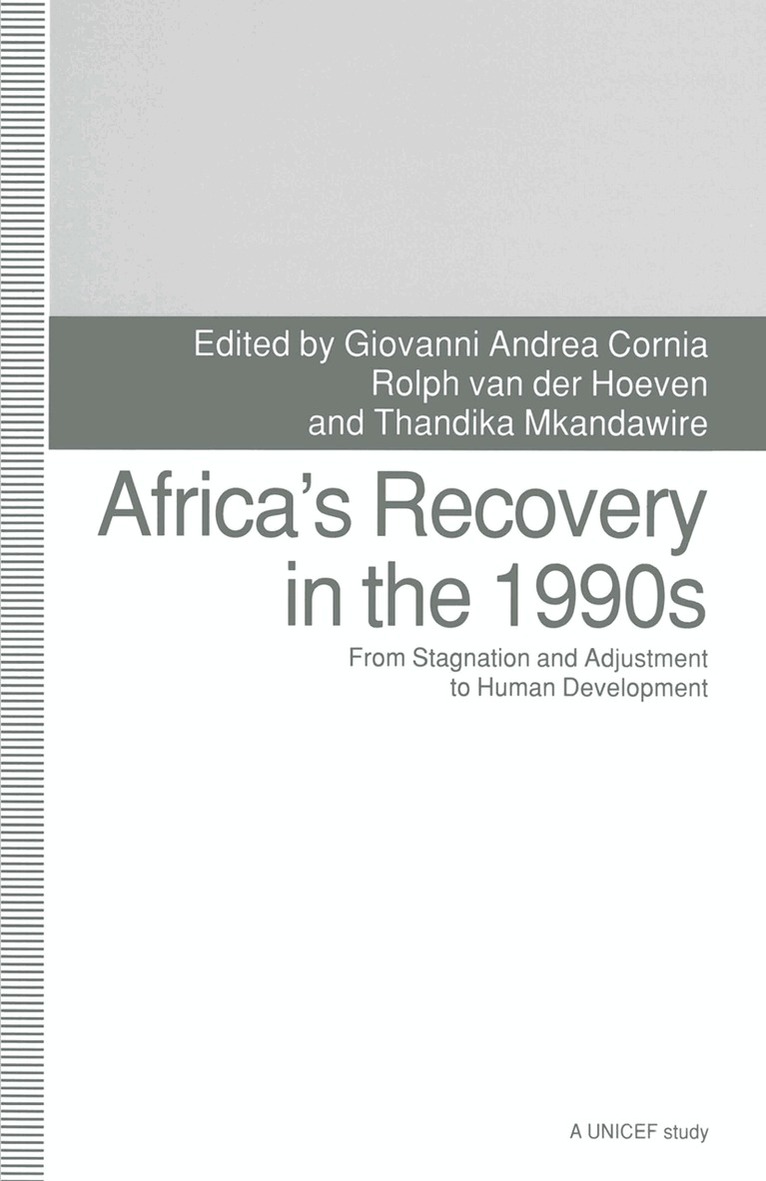
Africa’s Recovery in the 1990s
From Stagnation and Adjustment to Human Development
Inbunden, Engelska, 1992
1 096 kr
Skickas inom 10-15 vardagar
Arguing that several orthodox adjustment policies are still incongruent with long-term development in Africa, this book goes on to discuss a development strategy which could lead to a much awaited economic recovery and improvement in social conditions in Africa in the 1990s drawing its conclusions from a general theoretical discussion of the matter and the results of five specific national case studies carried out in Burkina Faso, Niger, Tanzania, Zambia and Zimbabwe. Giovanni Andrea Cornia is the co-author or co-editor of "The Impact of World Recession on Children", "Adjustment With a Human Face" and "Children and the Transition to the Market Economy". Rolph Van der Hoeven is the author of "Planning for Basic Needs: A Soft Option or a Solid Policy?", co-author of "Basic Needs in Development Planning" and co-editor of "World Recession and Global Interdependence".
Africa’s Recovery in the 1990s
From Stagnation and Adjustment to Human Development
Häftad, Engelska, 1992
1 096 kr
Skickas inom 10-15 vardagar
Arguing that several orthodox adjustment policies are still incongruent with long-term development in Africa, this book goes on to discuss a development strategy which could lead to a much awaited economic recovery and improvement in social conditions in Africa in the 1990s drawing its conclusions from a general theoretical discussion of the matter and the results of five specific national case studies carried out in Burkina Faso, Niger, Tanzania, Zambia and Zimbabwe. Giovanni Andrea Cornia is the co-author or co-editor of "The Impact of World Recession on Children", "Adjustment With a Human Face" and "Children and the Transition to the Market Economy". Rolph Van der Hoeven is the author of "Planning for Basic Needs: A Soft Option or a Solid Policy?", co-author of "Basic Needs in Development Planning" and co-editor of "World Recession and Global Interdependence".