• Fri frakt över 249 kr
  • •
  • Snabba leveranser
  • •
  • Billiga böcker
Kundservice

Du är på sajten för privatpersoner.

Företag, bibliotek eller offentlig verksamhet?

Du handlar på classic.bokus.com, där alla dina funktioner finns intakta.
Till classic.bokus.com
Bokus logotyp. Gå till startsidan.
  • Erbjudanden
  • Nyheter
  • Student
  • Topplistor
  • Barn & ungdom
  • Bokus Play
  • E-böcker
  • Pocketböcker
  • Spel & pussel

10% rabatt på allt med kod: NYSTART10 →

Sidfot

Mina sidor

    Hjälp

    • Kundservice
    • Vanliga frågor och svar
    • Frakt och leverans
    • Retur vid ångerrätt
    • Reklamera vara
    • Betalning
    • Köpvillkor
    • Allmänna villkor
    • Information om webbplatsens tillgänglighet

    Om Bokus

    • Om oss
    • Pressrum
    • För studenter
    • För företag
    • För bibliotek och offentlig verksamhet
    • För leverantörer
    • Hållbarhet

    Populärt

    • Aktuella erbjudanden
    • Presentkort
    • Studentlitteratur
    • Nya böcker
    • Topplistor
    • Signerade böcker
    • Engelska böcker

    Inspiration

    • Boktips
    • BookTok
    • Populära bokserier
    • Barnbokskaraktärer
    • Populära författare
    Logotyp för Bokus
    Följ oss på Facebook (extern länk)Följ oss på Instagram (extern länk)Följ oss på YouTube (extern länk)Följ oss på TikTok (extern länk)
    bokus @ CookiesAnpassa cookiesIntegritetspolicyKöpvillkor
    Till Citymail hemsida (extern länk)Till Budbee hemsida (extern länk)Till Postnord hemsida (extern länk)Till Schenker hemsida (extern länk)Till Early Bird hemsida (extern länk)Till Walleys hemsida (extern länk)
    1. Ekonomi och Ledarskap
    2. Nationalekonomi
    3. Mikroekonomi

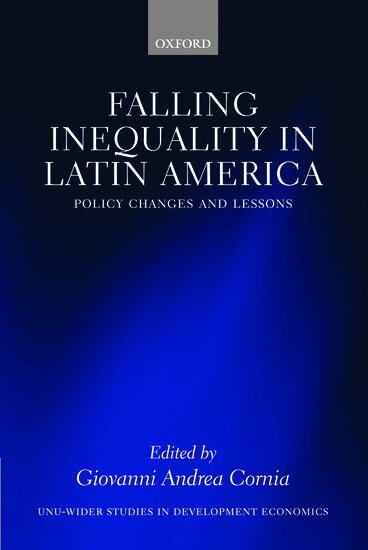
    Falling Inequality in Latin America

    Policy Changes and Lessons

    AvGiovanni Andrea Cornia,Giovanni Andrea Cornia

    Inbunden, Engelska, 2014

    Del i serien WIDER Studies in Development Economics

    2 599 kr

    Beställningsvara. Skickas inom 3-6 vardagar. Fri frakt över 249 kr.

    Beskrivning

    The volume aims to document and explain the sizeable decline of income inequality that has taken place in Latin America during the 2000s. It does so through an exploration of inequality changes in six representative countries, and ten policy chapters dealing with macroeconomics, foreign trade, taxation, labour market, human capital formation, and social assistance, which point to the emergence of a 'new policy model'. The volume addresses a major issue in economic development with profound implications for many developing regions and those OECD countries mired in a long-lasting financial crisis and economic stagnation. For at least the last quarter of the twentieth century, Latin America suffered from low growth, rising inequality, and frequent financial crises. However, since the turn of the century, growth accelerated, inequality declined, poverty fell, and macroeconomic stability improved, all this in parallel to the spread of centre-left political regimes in three quarters of the region. This inequality decline has taken many by surprise as, for a long time, the region has been a symbol of a deeply entrenched unequal distribution of assets, incomes, and opportunities, limited or no state redistribution, and a deeply embedded authoritarianism enforcing an unjust status quo. The recent Latin American experience is particularly valuable as inequality was reduced under open economy conditions and in a period of intensifying global integration, which have often been considered as a source of rising inequality. In this sense, however imperfect, the recent Latin American experience may be of interest to countries completing their transition to the market and liberal democracy (as in the former socialist countries of Europe), facing a political transition (as those affected by the Arab Spring, Myanmar and countries in sub-Saharan Africa), or recording rises in inequality and social tensions in spite of rapid economic growth (as in China and India).Until recently there was not much agreement on the drivers of the inequality decline in the region, which was attributed to changes in the supply/demand of skilled workers, improvements in terms of trade, the spread of social assistance schemes, or 'luck'. In this respect, the volume offers the first scholarly and systematic exploration of this unexpected change. As income inequality has been rising and is currently rising in many parts of the world, a good understanding of the Latin American experience over the 2000s is a topic that will inform and generate a lot of attention.

    Produktinformation

    • Utgivningsdatum:2014-01-16
    • Mått:162 x 241 x 27 mm
    • Vikt:762 g
    • Format:Inbunden
    • Språk:Engelska
    • Serie:WIDER Studies in Development Economics
    • Antal sidor:398
    • Förlag:OUP OXFORD
    • ISBN:9780198701804

    Utforska kategorier

    • Mikroekonomi inom Ekonomi och Ledarskap
    • Internationell ekonomi inom Ekonomi och Ledarskap

    Mer om författaren

    Since 2000, Giovanni Andrea Cornia has taught economics at the University of Florence. Prior to that he was the Director of UNU-WIDER and held research positions in various UN agencies. He has lectured in several Italian and foreign universities in both developing and developed countries and has been visiting professors or visiting scholars in six universities. Since 2010 he has been a member of Committee for Development Policies of the United Nations. His main research interests are in the field of development economics, and in particular in the fields of macroeconomics, inequality, poverty, and, political economy as well as food security, famines, and child wellbeing. In all these areas he has published extensively.

    Innehållsförteckning

    • PART I: INEQUALITY CHANGES AND THE SURFACING OF NEW POLICY APPROACHES ; 1. Recent Distributive Changes in Latin America: An Overview ; 2. Inequality Trends and their Determinants: Latin America over 1990-2010 ; 3. The Politics of Inequality and Redistribution in Latin America's Post-Adjustment Era ; PART II: RECENT INEQUALITY CHANGES IN SIX REPRESENTATIVE LATIN AMERICAN COUNTRIES ; 4. Redistribution without Structural Change in Ecuador: Rising and Falling Income Inequality in the 1990s and 2000s ; 5. Policy Regimes, Inequality, Poverty and Growth: The Chilean Experience, 1973-2010 ; 6. Uruguay's Income Inequality and Political Regimes over 1981-2010 ; 7. The Rise and Fall of Income Inequality in Mexico, 1989-2010 ; 8. Social Policies or Private Solidarity? The Equalizing Role of Migration and Remittances in El Salvador ; 9. The Dynamics of Inequality Change in a Highly Dualistic Economy ; PART III: MAIN POLICY CHANGES AND INEQUALITY DURING THE LAST DECADE ; 10. Macroeconomic Policies, Growth, Employment, Poverty, and Inequality in Latin America ; 11. Trade and Income Distribution in Latin America: Is There Anything New to Say? ; 12. Changes in Labour Market Conditions and Policies and their Impact on Wage Inequality during the Last Decade ; 13. What Can Latin America Learn from China's Labour Market Reforms? ; 14. Tax Policy and Income Distribution during the Last Decade ; 15. Inequality in Education: Evidence for Latin America ; 16. On the Distributional Implications of Social Protection Reforms in Latin America