• Fri frakt över 249 kr
  • •
  • Snabba leveranser
  • •
  • Billiga böcker
Kundservice

Du är på sajten för privatpersoner.

Företag, bibliotek eller offentlig verksamhet?

Du handlar på classic.bokus.com, där alla dina funktioner finns intakta.
Till classic.bokus.com
Bokus logotyp. Gå till startsidan.
  • Erbjudanden
  • Nyheter
  • Student
  • Topplistor
  • Barn & ungdom
  • Bokus Play
  • E-böcker
  • Pocketböcker
  • Spel & pussel

Må bättre, för mindre! Upp till 50% rabatt på hälsoböcker

Sidfot

Mina sidor

    Hjälp

    • Kundservice
    • Vanliga frågor och svar
    • Frakt och leverans
    • Retur vid ångerrätt
    • Reklamera vara
    • Betalning
    • Köpvillkor
    • Allmänna villkor
    • Information om webbplatsens tillgänglighet

    Om Bokus

    • Om oss
    • Pressrum
    • För studenter
    • För företag
    • För bibliotek och offentlig verksamhet
    • För leverantörer
    • Hållbarhet

    Populärt

    • Aktuella erbjudanden
    • Presentkort
    • Studentlitteratur
    • Nya böcker
    • Topplistor
    • Signerade böcker
    • Engelska böcker

    Inspiration

    • Boktips
    • BookTok
    • Populära bokserier
    • Barnbokskaraktärer
    • Populära författare
    Logotyp för Bokus
    Följ oss på Facebook (extern länk)Följ oss på Instagram (extern länk)Följ oss på YouTube (extern länk)Följ oss på TikTok (extern länk)
    bokus @ CookiesAnpassa cookiesIntegritetspolicyKöpvillkor
    Till Citymail hemsida (extern länk)Till Budbee hemsida (extern länk)Till Postnord hemsida (extern länk)Till Schenker hemsida (extern länk)Till Early Bird hemsida (extern länk)Till Walleys hemsida (extern länk)
    1. Ekonomi och Ledarskap
    2. Nationalekonomi
    3. Internationell ekonomi

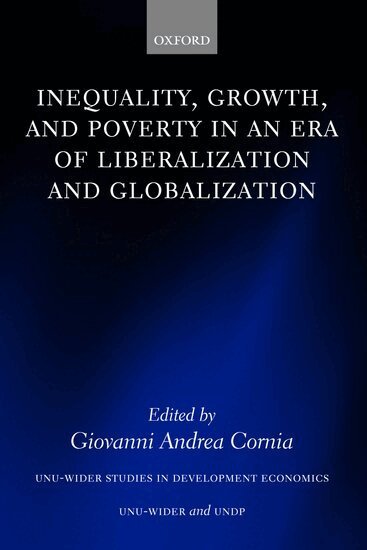
    Inequality, Growth, and Poverty in an Era of Liberalization and Globalization

    AvGiovanni Andrea Cornia

    Inbunden, Engelska, 2004

    Del i serien WIDER Studies in Development Economics

    1 399 kr

    Beställningsvara. Skickas inom 5-8 vardagar. Fri frakt över 249 kr.

    Beskrivning

    Within-country income inequality has risen since the early 1980s in most of the OECD, all transitional, and many developing countries. More recently, inequality has risen also in India and nations affected by the Asian crisis. Altogether, over the last twenty years, inequality worsened in 70 per cent of the 73 countries analysed in this volume, with the Gini index rising by over five points in half of them. In several cases, the Gini index follows a U-shaped pattern, with the turn-around point located between the late 1970s and early 1990s. Where the shift towards liberalization and globalization was concluded, the right arm of the U stabilized at the 'steady state level of inequality' typical of the new policy regime, as observed in the UK after 1990.Mainstream theory focusing on rises in wage differentials by skill caused by either North-South trade, migration, or technological change poorly explains the recent rise in income inequality. Likewise, while the traditional causes of income polarization-high land concentration, unequal access to education, the urban bias, the 'curse of natural resources'-still account for much of cross-country variation in income inequality, they cannot explain its recent rise.This volume suggests that the recent rise in income inequality was caused to a considerable extent by a policy-driven worsening in factorial income distribution, wage spread and spatial inequality. In this regard, the volume discusses the distributive impact of reforms in trade and financial liberalization, taxation, public expenditure, safety nets, and labour markets. The volume thus represents one of the first attempts to analyse systematically the relation between policy changes inspired by liberalization and globalization and income inequality. It suggests that capital account liberalization appears to have had-on average-the strongest disequalizing effect, followed by domestic financial liberalization, labour market deregulation, and tax reform. Trade liberalization had unclear effects, while public expenditure reform often had positive effects.

    Produktinformation

    • Utgivningsdatum:2004-03-18
    • Mått:163 x 242 x 30 mm
    • Vikt:837 g
    • Format:Inbunden
    • Språk:Engelska
    • Serie:WIDER Studies in Development Economics
    • Antal sidor:462
    • Förlag:OUP OXFORD
    • ISBN:9780199271412

    Utforska kategorier

    • Internationell ekonomi inom Ekonomi och Ledarskap
    • Sociala och etiska frågor inom Samhälle och politik

    Mer om författaren

    Giovanni Andrea Cornia is currently professor of economics at the University of Florence. Before this, he was the Director of the World Institute for Development Economics Research (UNU/WIDER) in Helsinki (1995-2000), and Director of the Economic and Social Policy Research Programme at the International Child Development Centre (the world-wide research centre of UNICEF) in Florence (1989-95). He was also the Chief Economist at UNICEF Headquarters in New York (1981-89) and held research positions at UNCTAD, UNECE (with a long spell at ECLAC in Santiago) and the Economic Studies Centre of FIAT.

    Recensioner i media

    ... provides a systematic analysis of the changes in within-country income inequality over the last twenty years.

    Innehållsförteckning

    • PART I: INCOME DISTRIBUTION TRENDS,THEORIES AND POLICIES ; 1. Inequality, Growth and Poverty: An Overview of Changes over the Last Two Decades ; 2. Income Distribution Changes and Their Impact in the Post-World War II period ; PART II: TRADITIONAL CAUSES OF INEQUALITY: STILL RELEVANT FOR EXPLAINING ITS RISE IN THE 1980S-90S? ; 3. Land Ownership Inequality and the Income Distribution Consequences of Economic Growth ; 4. Does Educational Achievement Help Explain Income Inequality? ; 5. Rural and Urban Income and Poverty: Does Convergence Between Sectors Offset Divergence within Them? ; PART III. RECENT FACTORS INFLUENCING THE DISTRIBUTION OF INCOME ; 6. Globalization, Technology and Income Inequality: A Critical Analysis ; 7. External Liberalization, Economic Performance and Distribution in Latin America and Elsewhere ; 8. Labour Market Institutions and Income Inequality: What are the New Insights after the Washington Consensus? ; 9. Increased Income Inequality in OECD Countries and the Redistributive Impact of the Government Budget ; 10. Income Distribution and Tax and Government Social Spending Policies in Developing Countries ; 11. The Impact of Adjustment Related Social Funds on Income Distribution and Poverty ; PART IV. COUNTRY CASE STUDIES ; 12. Reducing Poverty and Inequality in India: Has Liberalization Helped? ; 13. Factor Shares and Resource Booms: Accounting for the Evolution of Venezuelan Inequality ; 14. The Impact of Financial Liberalization and the Rise of Financial Rents on Income Inequality: The Case of Turkey ; 15. The Changing Nature of Inequality in South Africa ; 16. Growth, Structural Change and Inequality: The Experience of Thailand ; Index