H. Nowotny - Böcker
Visar alla böcker från författaren H. Nowotny. Handla med fri frakt och snabb leverans.
8 produkter
8 produkter
1 577 kr
Skickas inom 10-15 vardagar
may be complex without being able to be replaced by something »still more simple«. This became evident with the help of computer models of deterministic-recursive systems in which simple mathematical equation systems provide an extremely complex behavior. (2) Irregularity of nature is not treated as an anomaly but becomes the focus of research and thus is declared to be normal. One looks for regularity within irregularity. Non-equilibrium processes are recognized as the source of order and the search for equilibrium is replaced by the search for the dynamics of processes. (3) The classical system-environment model, according to which the adaptation of a system to its environment is controlled externally and according to which the adaptation of the system occurs in the course of a learning process, is replaced by a model of systemic closure. This closure is operational in so far as the effects produced by the system are the causes for the maintenance of systemic organization. If there is sufficient complexity, the systems perform internal self-observation and exert self-control (»Cognition« as understood by Maturana as self-perception and self-limitation, e. g. , that of a cell vis-a. -vis its environment). 22 But any information a system provides on its environment is a system-internal construct. The »reference to the other« is merely a special case of »self-reference«. The social sciences frequently have suffered from the careless way in which scientific ideas and models have been transferred.
Del 23 - Sociology of the Sciences Yearbook
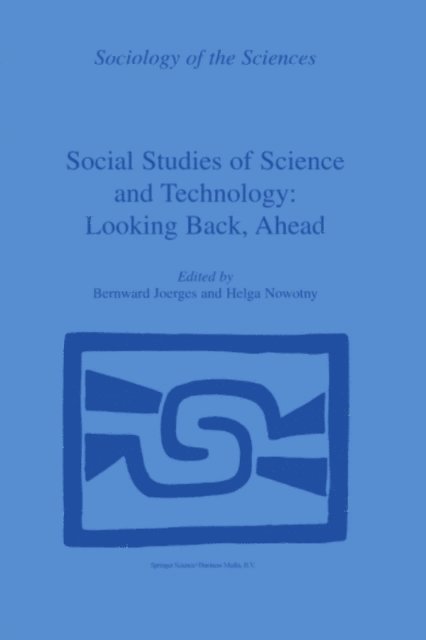
Social Studies of Science and Technology: Looking Back, Ahead
Inbunden, Engelska, 2003
1 577 kr
Skickas inom 10-15 vardagar
BERNW ARD JOERGES AND HELGA NOWOTNY YET ANOTHER TURN The thing that doesn't fit is the thing that's most interesting. Richard Fcynman This volume was originally conceived as a contribution to yet another 'tum', not cap tured by one of the many adjectives that have served to describe the collective meander ing of the scholarly community in search of direction, It was meant to mark the millen nial turn, a seemingly purely chronological event, but one in search for great meanings and invested with loaded significances. The editors wanted to seize the opportunity of the moment in order to pause and reflect on the sociology and history of social studies of science and technology. The moment came and went and the new millennium, barely nine months later, thrust its historical marker upon the world through a horrendous and cruel shock in an unforeseen and unforeseeable way. Since then, the world appears more vulnerable and volatile, fragmented and fraught with uncertainty. The universal values as bequeathed by the Enlightenment are either refused or appear refuted. The dream of a universal civilization which has accompanied the unfolding of the existing multiple modernities in their historically unique trajectories, has been discarded and its promises in tatters.
1 577 kr
Skickas inom 10-15 vardagar
BERNW ARD JOERGES AND HELGA NOWOTNY YET ANOTHER TURN The thing that doesn't fit is the thing that's most interesting. Richard Fcynman This volume was originally conceived as a contribution to yet another 'tum', not cap tured by one of the many adjectives that have served to describe the collective meander ing of the scholarly community in search of direction, It was meant to mark the millen nial turn, a seemingly purely chronological event, but one in search for great meanings and invested with loaded significances. The editors wanted to seize the opportunity of the moment in order to pause and reflect on the sociology and history of social studies of science and technology. The moment came and went and the new millennium, barely nine months later, thrust its historical marker upon the world through a horrendous and cruel shock in an unforeseen and unforeseeable way. Since then, the world appears more vulnerable and volatile, fragmented and fraught with uncertainty. The universal values as bequeathed by the Enlightenment are either refused or appear refuted. The dream of a universal civilization which has accompanied the unfolding of the existing multiple modernities in their historically unique trajectories, has been discarded and its promises in tatters.
Counter-Movements in the Sciences
The Sociology of the Alternatives to Big Science
Inbunden, Engelska, 1979
1 577 kr
Skickas inom 10-15 vardagar
Heretical thoughts in an orthodox series on sociology of the sciences? Devils and science between the covers of one book? Games with ambivalence to mask collective uncertainty? We anticipate similar future reactions from readers or reviewers when assessing the way in which this volume has been assembled. But writings on counter-science, like the history of colonialism, are usually written by the winners, therefore unequivocally partial and only too often lacking in social imagination. In seeking to redress the balance, we admit to having been fully receptive to the latter, of having displayed an un measured degree of sympathy with heretics and outsiders, including practising scientists, and to letting science defend itself. The antithetical relationship implied in the volume's title - Counter-movements in the Sciences - stands for what we regard as an ongoing, open-ended process. In collecting material for this volume, we have brought together voices speaking from different quarters: there are those who, although modestly claiming to speak only for them selves, have set out to question sacred assumptions of scientific faith or to cast doubt on well-known claims scientific knowledge holds over other forms of knowledge; others have undertaken to demonstrate the fragility, ifnot untenability of attempts at demarcation between science and other systems of belief or practice or shown that demarcations between different forms of rationality rest on other than methodological grounds; finally, those who wish to re-arrange, by mapping out some meta-point of surveillance, familiar territory, showing the need for rearrangement and
Counter-Movements in the Sciences
The Sociology of the Alternatives to Big Science
Häftad, Engelska, 1979
1 577 kr
Skickas inom 10-15 vardagar
Heretical thoughts in an orthodox series on sociology of the sciences? Devils and science between the covers of one book? Games with ambivalence to mask collective uncertainty? We anticipate similar future reactions from readers or reviewers when assessing the way in which this volume has been assembled. But writings on counter-science, like the history of colonialism, are usually written by the winners, therefore unequivocally partial and only too often lacking in social imagination. In seeking to redress the balance, we admit to having been fully receptive to the latter, of having displayed an un measured degree of sympathy with heretics and outsiders, including practising scientists, and to letting science defend itself. The antithetical relationship implied in the volume's title - Counter-movements in the Sciences - stands for what we regard as an ongoing, open-ended process. In collecting material for this volume, we have brought together voices speaking from different quarters: there are those who, although modestly claiming to speak only for them selves, have set out to question sacred assumptions of scientific faith or to cast doubt on well-known claims scientific knowledge holds over other forms of knowledge; others have undertaken to demonstrate the fragility, ifnot untenability of attempts at demarcation between science and other systems of belief or practice or shown that demarcations between different forms of rationality rest on other than methodological grounds; finally, those who wish to re-arrange, by mapping out some meta-point of surveillance, familiar territory, showing the need for rearrangement and
1 577 kr
Skickas inom 10-15 vardagar
Just fifty years ago Julian Huxley, the biologist grandson of Thomas Henry Huxley, published a book which easily could be seen to represent the prevail ing outlook among young scientists of the day: If I were a Dictator (1934). The outlook is optimistic, the tone playfully rational, the intent clear - allow science a free hand and through rational planning it could bring order out of the surrounding social chaos. He complained, however: At the moment, science is for most part either an intellectual luxury or the paid servant of capitalist industry or the nationalist state. When it and its results cannot be fitted into the existing framework, it and they are ignored; and furthermore the structure of scientific research is grossly lopsided, with over-emphasis on some kinds of science and partial or entire neglect of others. (pp. 83-84) All this the scientist dictator would set right. A new era of scientific human ism would provide alternative visions to the traditional religions with their Gods and the civic religions such as Nazism and fascism. Science in Huxley's version carries in it the twin impulses of the utopian imagination - Power and Order. Of course, it was exactly this vision of science which led that other grand son of Thomas Henry Huxley, the writer Aldous Huxley, to portray scientific discovery as potentially subversive and scientific practice as ultimately en slaving.
1 577 kr
Skickas inom 10-15 vardagar
Just fifty years ago Julian Huxley, the biologist grandson of Thomas Henry Huxley, published a book which easily could be seen to represent the prevail ing outlook among young scientists of the day: If I were a Dictator (1934). The outlook is optimistic, the tone playfully rational, the intent clear - allow science a free hand and through rational planning it could bring order out of the surrounding social chaos. He complained, however: At the moment, science is for most part either an intellectual luxury or the paid servant of capitalist industry or the nationalist state. When it and its results cannot be fitted into the existing framework, it and they are ignored; and furthermore the structure of scientific research is grossly lopsided, with over-emphasis on some kinds of science and partial or entire neglect of others. (pp. 83-84) All this the scientist dictator would set right. A new era of scientific human ism would provide alternative visions to the traditional religions with their Gods and the civic religions such as Nazism and fascism. Science in Huxley's version carries in it the twin impulses of the utopian imagination - Power and Order. Of course, it was exactly this vision of science which led that other grand son of Thomas Henry Huxley, the writer Aldous Huxley, to portray scientific discovery as potentially subversive and scientific practice as ultimately en slaving.
1 577 kr
Skickas inom 10-15 vardagar
may be complex without being able to be replaced by something »still more simple«. This became evident with the help of computer models of deterministic-recursive systems in which simple mathematical equation systems provide an extremely complex behavior. (2) Irregularity of nature is not treated as an anomaly but becomes the focus of research and thus is declared to be normal. One looks for regularity within irregularity. Non-equilibrium processes are recognized as the source of order and the search for equilibrium is replaced by the search for the dynamics of processes. (3) The classical system-environment model, according to which the adaptation of a system to its environment is controlled externally and according to which the adaptation of the system occurs in the course of a learning process, is replaced by a model of systemic closure. This closure is operational in so far as the effects produced by the system are the causes for the maintenance of systemic organization. If there is sufficient complexity, the systems perform internal self-observation and exert self-control (»Cognition« as understood by Maturana as self-perception and self-limitation, e. g. , that of a cell vis-a. -vis its environment). 22 But any information a system provides on its environment is a system-internal construct. The »reference to the other« is merely a special case of »self-reference«. The social sciences frequently have suffered from the careless way in which scientific ideas and models have been transferred.