Jacqueline I. Stone - Böcker
Visar alla böcker från författaren Jacqueline I. Stone. Handla med fri frakt och snabb leverans.
9 produkter
9 produkter
1 981 kr
Skickas inom 3-6 vardagar
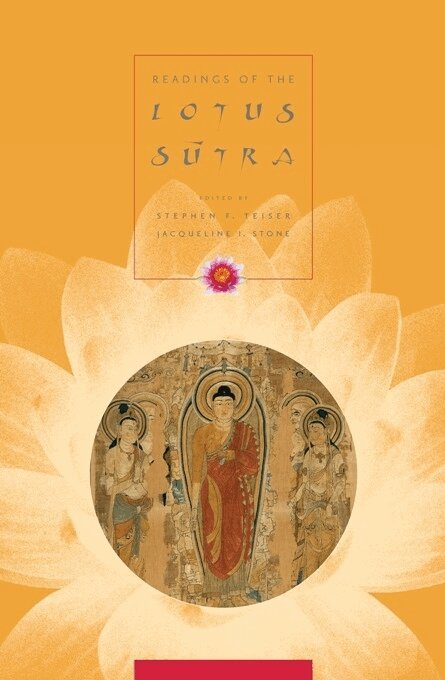
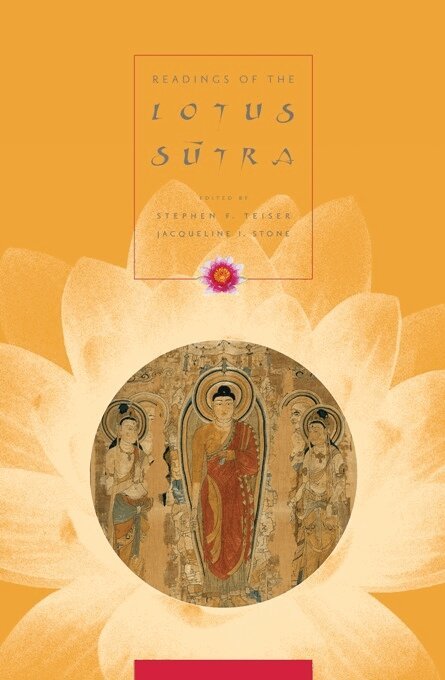
The Lotus Sutra proclaims that a unitary intent underlies the diversity of Buddhist teachings and promises that all people without exception can achieve supreme awakening. Establishing the definitive guide to this profound text, specialists in Buddhist philosophy, art, and history of religion address the major ideas and controversies surrounding the Lotus Sutra and its manifestations in ritual performance, ascetic practice, visual representations, and social action across history. Essays survey the Indian context in which the sutra was produced, its compilation and translation history, and its influence across China and Japan, among many other issues. The volume also includes a Chinese and Japanese character glossary, notes on Western translations of the text, and a synoptic bibliography.
258 kr
Skickas inom 7-10 vardagar
The Lotus Sutra proclaims that a unitary intent underlies the diversity of Buddhist teachings and promises that all people without exception can achieve supreme awakening. Establishing the definitive guide to this profound text, specialists in Buddhist philosophy, art, and history of religion address the major ideas and controversies surrounding the Lotus Sutra and its manifestations in ritual performance, ascetic practice, visual representations, and social action across history. Essays survey the Indian context in which the sutra was produced, its compilation and translation history, and its influence across China and Japan, among many other issues. The volume also includes a Chinese and Japanese character glossary, notes on Western translations of the text, and a synoptic bibliography.
242 kr
Skickas inom 7-10 vardagar
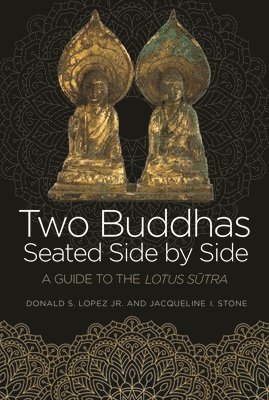
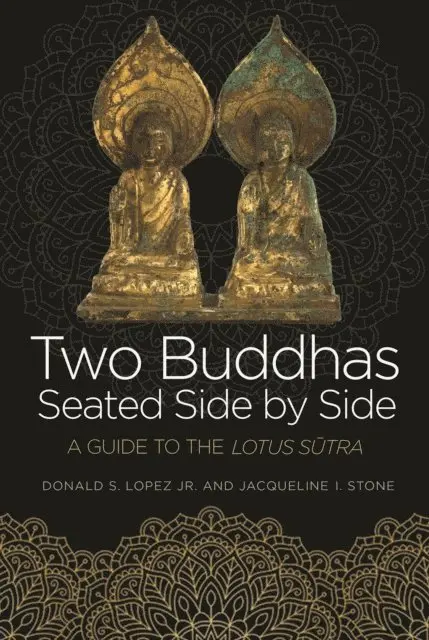
An essential companion to a timeless spiritual classicThe Lotus Sūtra is among the most venerated scriptures of Buddhism. Composed in India some two millennia ago, it asserts the potential for all beings to attain supreme enlightenment. Donald Lopez and Jacqueline Stone provide an essential reading companion to this inspiring yet enigmatic masterpiece, explaining how it was understood by its compilers in India and, centuries later in medieval Japan, by one of its most influential proponents.In this illuminating chapter-by-chapter guide, Lopez and Stone show how the sūtra's anonymous authors skillfully reframed the mainstream Buddhist tradition in light of a new vision of the path and the person of the Buddha himself, and examine how the sūtra's metaphors, parables, and other literary devices worked to legitimate that vision. They go on to explore how the Lotus was interpreted by the Japanese Buddhist master Nichiren (1222–1282), whose inspired reading of the book helped to redefine modern Buddhism. In doing so, Lopez and Stone demonstrate how readers of sacred works continually reinterpret them in light of their own unique circumstances.An invaluable guide to an incomparable spiritual classic, this book unlocks the teachings of the Lotus for modern readers while providing insights into the central importance of commentary as the vehicle by which ancient writings are given contemporary meaning.
203 kr
Skickas inom 7-10 vardagar
An essential companion to a timeless spiritual classicThe Lotus Sūtra is among the most venerated scriptures of Buddhism. Composed in India some two millennia ago, it asserts the potential for all beings to attain supreme enlightenment. Donald Lopez and Jacqueline Stone provide an essential reading companion to this inspiring yet enigmatic masterpiece, explaining how it was understood by its compilers in India and, centuries later in medieval Japan, by one of its most influential proponents.In this illuminating chapter-by-chapter guide, Lopez and Stone show how the sūtra's anonymous authors skillfully reframed the mainstream Buddhist tradition in light of a new vision of the path and the person of the Buddha himself, and examine how the sūtra's metaphors, parables, and other literary devices worked to legitimate that vision. They go on to explore how the Lotus was interpreted by the Japanese Buddhist master Nichiren (1222–1282), whose inspired reading of the book helped to redefine modern Buddhism. In doing so, Lopez and Stone demonstrate how readers of sacred works continually reinterpret them in light of their own unique circumstances.An invaluable guide to an incomparable spiritual classic, this book unlocks the teachings of the Lotus for modern readers while providing insights into the central importance of commentary as the vehicle by which ancient writings are given contemporary meaning.
208 kr
Skickas inom 10-15 vardagar
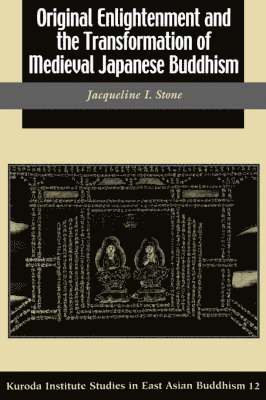
Original enlightenment thought (hongaku shiso) dominated Buddhist intellectual circles throughout Japan’s medieval period. Enlightenment, this discourse claims, is neither a goal to be achieved nor a potential to be realized but the true status of all things. Every animate and inanimate object manifests the primordially enlightened Buddha just as it is. Seen in its true aspect, every activity of daily life—eating, sleeping, even one’s deluded thinking—is the Buddha’s conduct. Emerging from within the powerful Tendai School, ideas of original enlightenment were appropriated by a number of Buddhist traditions and influenced nascent theories about the kami (local deities) as well as medieval aesthetics and the literary and performing arts.Scholars and commentators have long recognized the historical importance of original enlightenment thought but differ heatedly over how it is to be understood. Some tout it as the pinnacle of the Buddhist philosophy of absolute non-dualism. Others claim to find in it the paradigmatic expression of a timeless Japanese spirituality. According other readings, it represents a dangerous anti-nomianism that undermined observance of moral precepts, precipitated a decline in Buddhist scholarship, and denied the need for religious discipline. Still others denounce it as an authoritarian ideology that, by sacralizing the given order, has in effect legitimized hierarchy and discriminative social practices. Often the acceptance or rejection of original enlightenment thought is seen as the fault line along which traditional Buddhist institutions are to be differentiated from the new Buddhist movements (Zen, Pure Land, and Nichiren) that arose during Japan’s medieval period.Jacqueline Stone’s groundbreaking study moves beyond the treatment of the original enlightenment doctrine as abstract philosophy to explore its historical dimension. Drawing on a wealth of medieval primary sources and modern Japanese scholarship, it places this discourse in its ritual, institutional, and social contexts, illuminating its importance to the maintenance of traditions of lineage and the secret transmission of knowledge that characterized several medieval Japanese elite culture. It sheds new light on interpretive strategies employed in pre-modern Japanese Buddhist texts, an area that hitherto has received a little attention. Through these and other lines of investigation, Stone problematizes entrenched notions of “corruption” in the medieval Buddhist establishment. Using the examples of Tendai and Nichiren Buddhism and their interactions throughout the medieval period, she calls into question both overly facile distinctions between “old” and “new” Buddhism and the long-standing scholarly assumptions that have perpetuated them. This study marks a significant contribution to ongoing debates over definitions of Buddhism in the Kamakura era (1185–1333), long regarded as a formative period in Japanese religion and culture. Stone argues that “original enlightenment thought” represents a substantial rethinking of Buddhist enlightenment that cuts across the distinction between “old” and “new” institutions and was particularly characteristic of the medieval period.
196 kr
Skickas inom 11-20 vardagar
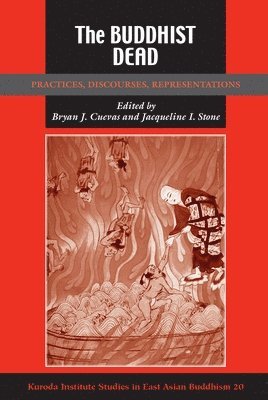
In its teachings, practices, and institutions, Buddhism in its varied Asian forms has been--and continues to be--centrally concerned with death and the dead. Yet surprisingly "death in Buddhism" has received little sustained scholarly attention. The Buddhist Dead offers the first comparative investigation of this topic across the major Buddhist cultures of India, Sri Lanka, China, Japan, Tibet, and Burma. Its individual essays, representing a range of methods, shed light on a rich array of traditional Buddhist practices for the dead and dying; the sophisticated but often paradoxical discourses about death and the dead in Buddhist texts; and the varied representations of the dead and the afterlife found in Buddhist funerary art and popular literature. This important collection moves beyond the largely text--and doctrine--centered approaches characterizing an earlier generation of Buddhist scholarship and expands its treatment of death to include ritual, devotional, and material culture.
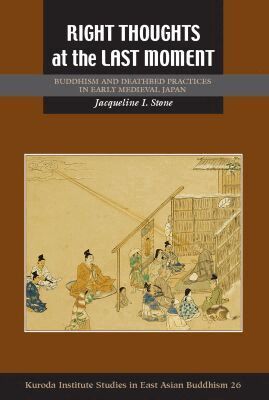
Right Thoughts at the Last Moment
Buddhism and Deathbed Practices in Early Medieval Japan
Inbunden, Engelska, 2016
218 kr
Skickas inom 7-10 vardagar
Buddhists across Asia have often aspired to die with a clear and focused mind, as the historical Buddha himself is said to have done. This book explores how the ideal of dying with right mindfulness was appropriated, disseminated, and transformed in premodern Japan, focusing on the late tenth through early fourteenth centuries. By concentrating one’s thoughts on the Buddha in one’s last moments, it was said even an ignorant and sinful person could escape the cycle of deluded rebirth and achieve birth in a buddha’s pure land, where liberation would be assured. Conversely, the slightest mental distraction at that final juncture could send even a devout practitioner tumbling down into the hells or other miserable rebirth realms. The ideal of mindful death thus generated both hope and anxiety and created a demand for ritual specialists who could act as religious guides at the deathbed. Buddhist death management in Japan has been studied chiefly from the standpoint of funerals and mortuary rites. Right Thoughts at the Last Moment investigates a largely untold side of that story: how early medieval Japanese prepared for death, and how desire for ritual assistance in one’s last hours contributed to Buddhist preeminence in death-related matters. It represents the first book-length study in a Western language to examine how the Buddhist ideal of mindful death was appropriated in a specific historical context.Practice for one’s last hours occupied the intersections of multiple, often disparate approaches that Buddhism offered for coping with death. Because they crossed sectarian lines and eventually permeated all social levels, deathbed practices afford insights into broader issues in medieval Japanese religion, including intellectual developments, devotional practices, pollution concerns, ritual performance, and divisions of labor among religious professionals. They also allow us to see beyond the categories of “old” versus “new” Buddhism, or establishment Buddhism versus marginal heterodoxies, which have characterized much scholarship to date. Enlivened by cogent examples, this study draws on a wealth of sources including ritual instructions, hagiographies, doctrinal writings, didactic tales, courtier diaries, historical records, letters, and relevant art historical material to explore the interplay of doctrinal ideals and on-the-ground practice.
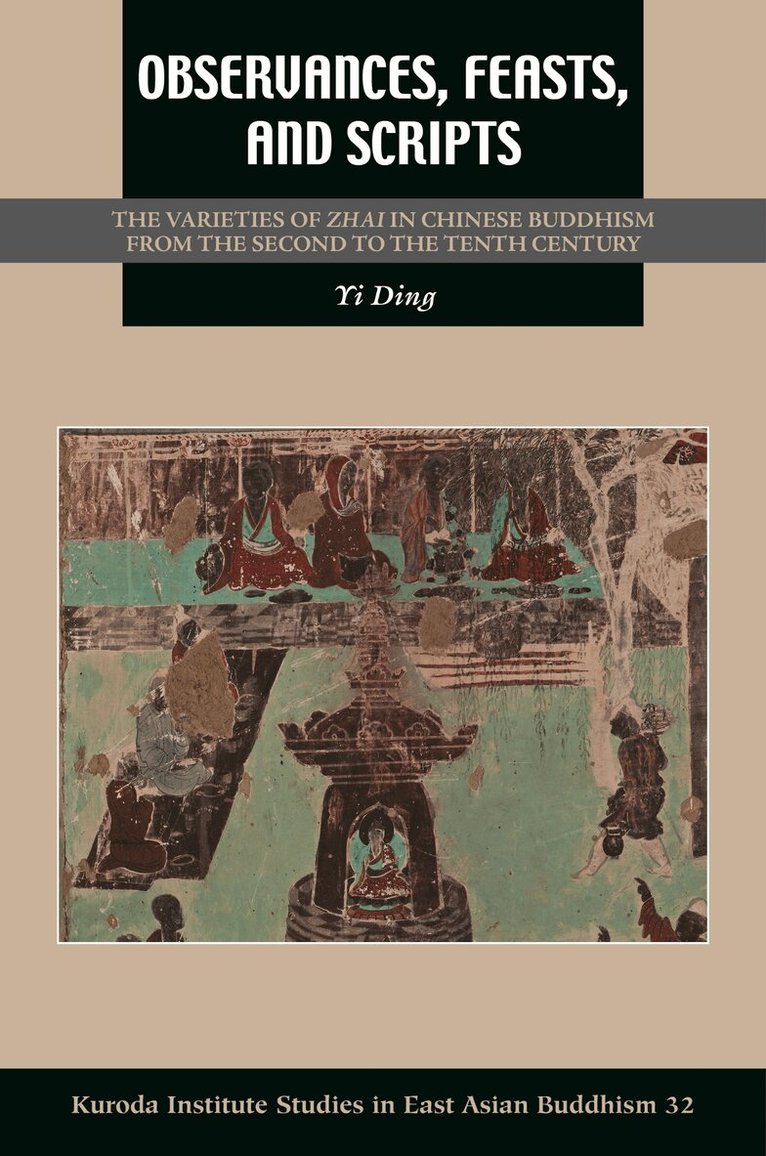
Observances, Feasts, and Scripts
The Varieties of Zhai in Chinese Buddhism from the Second to the Tenth Century
Inbunden, Engelska, 2026
730 kr
Skickas inom 7-10 vardagar
Observances, Feasts, and Scripts is the first monograph written in English to offer a comprehensive analysis of the varieties of zhai, a multifaceted term with deep historical and religious significance in Chinese Buddhism. Drawing on a wide array of sources—including canonical texts, apocryphal writings, hagiographies, and ritual documents—this book unveils zhai as a ritual complex encompassing temporary observances, communal feasts, and modes of interaction between the seen and unseen realms. These practices, rooted in both lay and monastic traditions, illustrate the intricate interplay between food, community, and ritual in Indian and Chinese Buddhism. Part I traces how Indian Buddhist temporary observances were adapted, debated, and reimagined in the Chinese context. Part II explains the sponsored feast as a mechanism for lay-monastic interaction and merit-making. It also examines how Buddhists engaged with deities and spirit saints through remote invitations and ritual offerings. Part III focuses on "scripts" used for receiving the Eightfold Observance and conducting sponsored feasts, thus revealing their evolution from simple master-disciple interactions to complex communal events. Observances, Feasts, and Scripts is an essential resource for scholars interested in food-related religious practices and the history of Buddhism. Through its meticulous examination of Chinese, Pāli, Sanskrit, and Tibetan materials, the book offers a fresh perspective on Chinese Buddhism as an intercultural endeavor. It sheds light on relevant scholastic debates, the creation of apocrypha, translation strategies, and ritual innovations in medieval China. By moving beyond teleological frameworks such as Sinicization, it emphasizes the agency of cultural, doctrinal, and social factors in shaping these practices. Additionally, it engages with the cognitive dimensions of ritual and highlights ritual logic as a cross-cultural analytical lens.
657 kr
Kommande
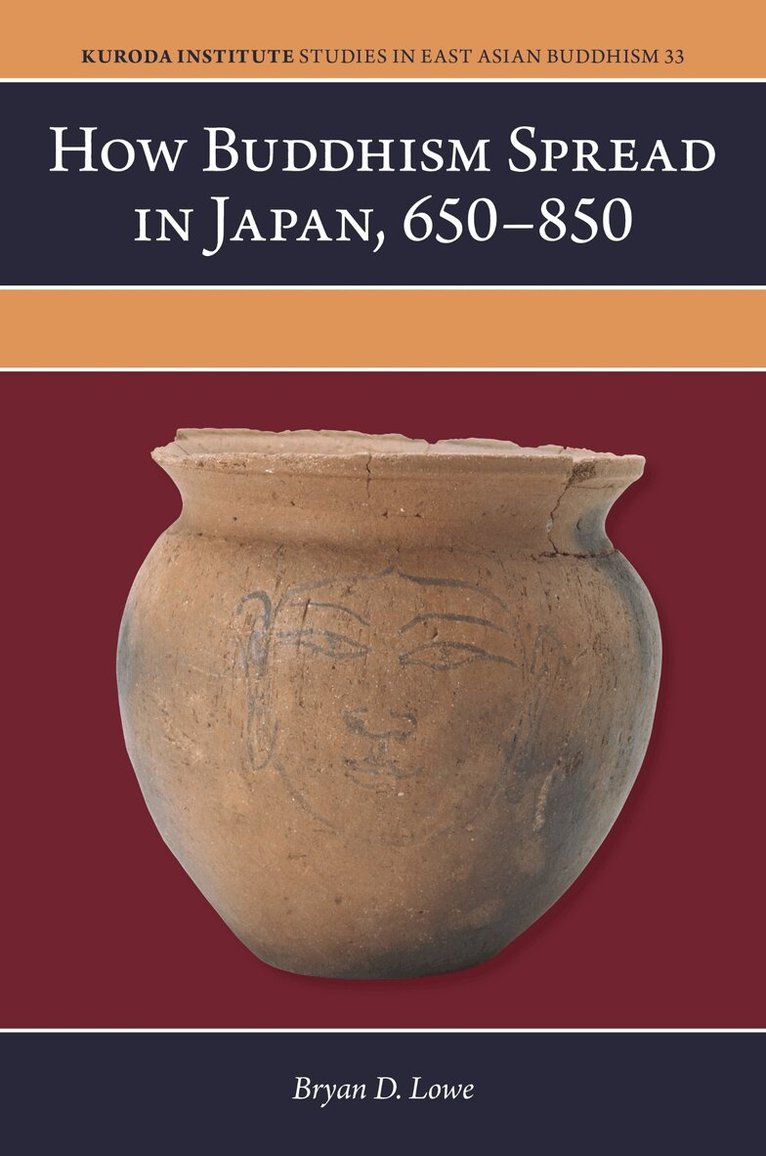
Between the late seventh and early ninth centuries, Japan changed from a land largely without Buddhism to a country where Buddhist ideas, images, and practices were everywhere. The introduction of Buddhism transformed the social and intellectual life of the provinces. Regions that once lacked temples suddenly had so many that virtually every village had a place of worship nearby. People began to understand their world in new ways, imagining previously inconceivable possibilities for themselves in this life and the next. This was arguably the most dramatic religious transformation in the history of Japan. How Buddhism Spread in Japan is the first book to tell the story of this religious revolution in the Japanese provinces. Bryan D. Lowe, a leading expert on Japanese religions, argues against the standard view that Buddhism first reached ordinary people in the provinces in the twelfth and thirteenth centuries. This bold study offers a new narrative for the history of Japanese religions, one that dates Buddhism’s spread centuries earlier than standard accounts. Lowe highlights the agency of provincial patrons, mobile monks, female preachers, and rural villagers, who worked together to bring Buddhism to the Japanese countryside. How Buddhism Spread in Japan also introduces new methods for reading archaeological and textual materials in tandem. Drawing upon an archive of hundreds of thousands of pieces of inscribed pottery, roof tiles, and wooden slips, it uses material culture to uncover the religious lives of villagers on the geographic and social margins of Japan. Lowe reads this corpus alongside Buddhist tales and previously untranslated preaching notes to reconstruct the worldview and practices of provincial villagers. He combines archaeological and preaching materials to access this otherwise invisible world. Written in accessible and engaging prose, How Buddhism Spread in Japan undermines long-cherished narratives in the field of Japanese Buddhism and makes a methodological intervention of interest to scholars of classical and medieval studies more broadly.