Luciana Brandli – författare
1 523 kr
Skickas inom 10-15 vardagar
1 825 kr
Läs direkt efter köp
In order to yield the expected benefits, sustainability initiatives need to be undertaken by means of a close cooperation between universities on the one hand, and societal partners on the others. The principle of co-creation and co-execution of sustainability initiatives increases the value for all by mutual learning, and the sharing of expertise and resources. But pursuing sustainability initiatives with a community and societal involvement is not simple. There is a perceived need for a better understanding of how universities can interact with society, in order to support the implementation of the UN Sustainable Development Goals.
This book is an attempt to address this need, by a novel approach which focuses on current potentials and challenges, across a wide range of fields and expertise. The book focuses on how the theory and practice of sustainable development interact and shows the need for a continuation of the dialogue among sustainability academics and practitioners, so as to address the issues, matters and problems at hand. The spectrum of themes addressed on this book also entails how environmental values and ethics are applied and the relationship between social, biological and cultural diversity. It also includes a broad disciplinary approach to sustainability, including education, research and case studies, and the links with human–environment relations in a sustainable development context.
1 523 kr
Skickas inom 10-15 vardagar
1 740 kr
Skickas inom 10-15 vardagar
2 194 kr
Läs direkt efter köp
This book offers a comprehensive review of life cycle assessment (LCA), circular economy (CE), and sustainable development, exploring their achievements and progress across the world. The book also emphasizes the significant contribution of LCA and CE to achieving the Sustainable Development Goals (SDGs), demonstrating how these frameworks can drive progress toward global sustainability targets. The main topics covered include the environmental and economic assessment of building materials, the life cycle of agricultural and bio-based products, the role of venture businesses in promoting CE, and the impact of CE on sustainable development. Additionally, the book discusses energy optimization in supply chains, the nexus between comparative advantage and the bio-based economy, and the use of CE frameworks in energy management for educational institutions. Key chapters highlight the valorization of waste materials for bioethanol production, the evolution of LCA studies on electric vehicle batteries, and the implementation of EDGE certification in Brazilian public schools. The book also explores the integration of LCA and CE in architectural education, the challenges and barriers to CE adoption in Nigeria, and the role of public policy in advancing CE in Brazil. These topics are critically important as they address the pressing need for sustainable practices in various industries. The integration of LCA and CE principles is crucial for minimizing environmental impacts, optimizing resource use, and fostering innovation in sustainable development. The book aims to solve the problem of how to effectively incorporate these principles into practice, providing methodological approaches, case studies, and policy perspectives that illustrate successful implementations and identify areas for improvement. The target audience for this book includes researchers, policymakers, industry professionals, and students interested in sustainability, environmental science, and circular economy practices. By offering in-depth analysis and practical insights, this book serves as a valuable resource for anyone seeking to understand and apply LCA and CE principles to achieve sustainable development goals.
1 631 kr
Skickas inom 10-15 vardagar
1 977 kr
Läs direkt efter köp
This book documents and compares the experiences of a wide range of universities across the five continents with regard to sustainable development, making it of special interest to sustainability researchers and practitioners. By showcasing how integrative approaches to sustainable development at the university level can be successfully employed to bridge the gaps between disciplines, the book provides a timely contribution to the literature on sustainability and offers a valuable resource for all those interested in sustainability in a higher education context.
1 090 kr
Skickas inom 10-15 vardagar
1 379 kr
Läs direkt efter köp
1 631 kr
Skickas inom 10-15 vardagar
2 389 kr
Skickas inom 10-15 vardagar
2 130 kr
Läs direkt efter köp
This Handbook approaches sustainable development in higher education from an integrated perspective, addressing the dearth of publications on the subject. It offers a unique overview of what universities around the world are doing to implement sustainable development (i.e. via curriculum innovation, research, activities, or practical projects) and how their efforts relate to education for sustainable development at the university level.
The Handbook gathers a wealth of information, ideas, best practices and lessons learned in the context of executing concrete projects, and assesses methodological approaches to integrating the topic of sustainable development in university curricula. Lastly, it documents and disseminates the veritable treasure trove of practical experience currently available on sustainability in higher education.
1 090 kr
Skickas inom 10-15 vardagar
1 685 kr
Skickas inom 10-15 vardagar
6 504 kr
Skickas inom 10-15 vardagar
8 396 kr
Läs direkt efter köp
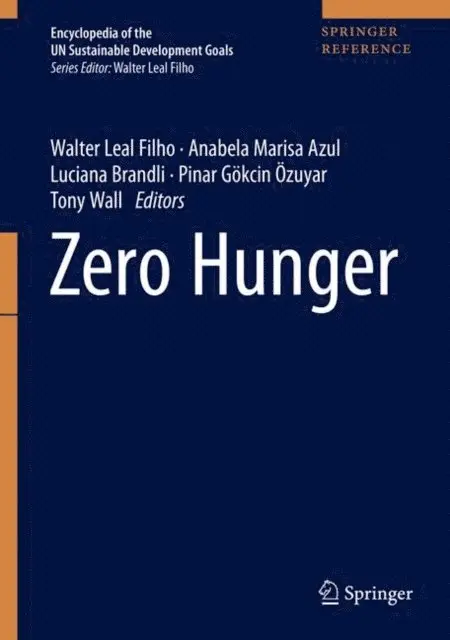
The problems related to the process of industrialisation such as biodiversity depletion, climate change and a worsening of health and living conditions, especially but not only in developing countries, intensify. Therefore, there is an increasing need to search for integrated solutions to make development more sustainable. The United Nations has acknowledged the problem and approved the “2030 Agenda for Sustainable Development”. On 1st January 2016, the 17 Sustainable Development Goals (SDGs) of the Agenda officially came into force. These goals cover the three dimensions of sustainable development: economic growth, social inclusion and environmental protection.
The Encyclopedia of the UN Sustainable Development Goals comprehensively addresses the SDGs in an integrated way. It encompasses 17 volumes, each devoted to one of the 17 SDGs. This volume addresses SDG 2, namely "End hunger, achieve food security and improved nutrition and promote sustainable agriculture" and contains the description of a range of related terms, to allow for a better understanding and foster knowledge. Our planet produces enough food to feed everyone. Malnutrition and hunger are the result of inappropriate food production processes, bad governance and injustice. SDG 2 seeks to guarantee quality and nutritious food to ensure healthy life by adopting a holistic approach that involves various actions targeting different actors, technologies, policies and programs. These initiatives have to face challenges coming from extensive environmental degradation, loss of biodiversity and the interrelated effects of climate change.Concretely, the defined targets are:End hunger and ensure access by all people, in particular the poor and people in vulnerable situations, including infants, to safe, nutritious and sufficient food all year roundEnd all forms of malnutrition, including achieving the internationally agreed targets on stunting and wasting in children under 5 years of age, and address the nutritional needs of adolescent girls, pregnant and lactating women and older personsDouble the agricultural productivity and incomes of small-scale food producers, in particular women, indigenous peoples, family farmers, pastoralists and fishers, including through secure and equal access to land, other productive resources and inputs, knowledge, financial services, markets and opportunities for value addition and non-farm employmentEnsure sustainable food production systems and implement resilient agricultural practices that increase productivity and production, that help maintain ecosystems, that strengthen capacity for adaptation to climate change, extreme weather, drought, flooding and other disasters and that progressively improve land and soil qualityMaintain the genetic diversity of seeds, cultivated plants and farmedand domesticated animals and their related wild species, including through soundly managed and diversified seed and plant banks at the national, regional and international levels, and promote access to and fair and equitable sharing of benefits arising from the utilization of genetic resources and associated traditional knowledge, as internationally agreedIncrease investment, including through enhanced international cooperation, in rural infrastructure, agricultural research and extension services, technology development and plant and livestock gene banks in order to enhance agricultural productive capacity in developing countries, in particular least developed countriesCorrect and prevent trade restrictions and distortions in world agricultural markets, including through the parallel elimination of all forms of agricultural export subsidies and all export measures with equivalent effect, in accordance with the mandate of the Doha Development RoundAdopt measures to ensure the proper functioning of food commodity markets and their derivatives and facilitate timely access to market information, including on food reserves, in order to help limit extreme food price volatilityEditorial BoardDatu Buyung Agusdinata, Mohammad Sadegh Allahyari, Usama Awan, Nerise Johnson, Paschal Arsein Mugabe, Vincent Onguso Oeba, Tony Wall7 814 kr
Skickas inom 10-15 vardagar
9 433 kr
Läs direkt efter köp
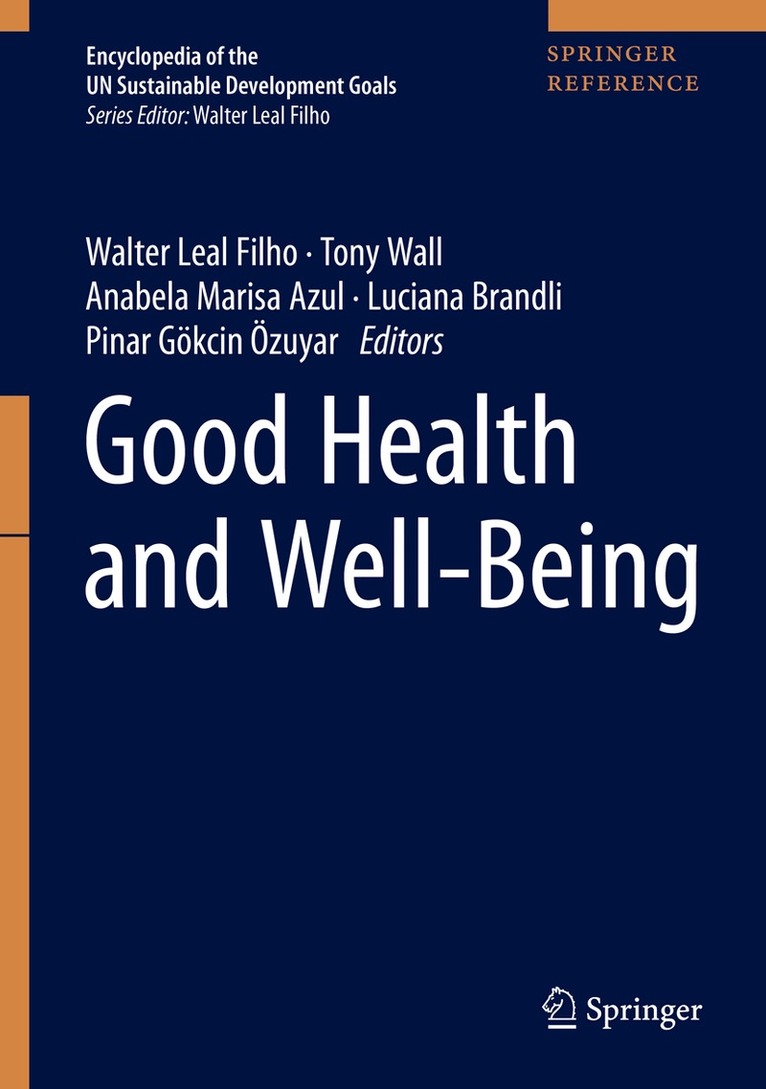
The problems related to the process of industrialisation such as biodiversity depletion, climate change and a worsening of health and living conditions, especially but not only in developing countries, intensify. Therefore, there is an increasing need to search for integrated solutions to make development more sustainable. The United Nations has acknowledged the problem and approved the “2030 Agenda for Sustainable Development”. On 1st January 2016, the 17 Sustainable Development Goals (SDGs) of the Agenda officially came into force. These goals cover the three dimensions of sustainable development: economic growth, social inclusion and environmental protection.
The Encyclopedia of the UN Sustainable Development Goals comprehensively addresses the SDGs in an integrated way. The Encyclopedia encompasses 17 volumes, each one devoted to one of the 17 SDGs. This volume addresses SDG 3, namely "Ensure healthy lives and promotewell-being for all at all ages" and contains the description of a range of terms, to grow a better understanding and foster knowledge. Ensuring healthy lives and promoting the well-being for all at all ages is essential to sustainable development. Significant strides have been made in increasing life expectancy and reducing some of the common killers associated with child and maternal mortality. Major progress has been made on increasing access to clean water and sanitation, reducing malaria, tuberculosis, polio and the spread of HIV/AIDS. However, many more efforts are needed to fully eradicate a wide range of diseases and address many different persistent and emerging health issues.Concretely, the defined targets are:Reduce the global maternal mortality ratio to less than 70 per 100,000 live birthsEnd preventable deaths of newborns and children under 5 years of age, with all countries aiming to reduce neonatal mortality to at least as low as 12 per 1,000 live births and under-5 mortality to at least as low as 25 per 1,000 live birthsEnd the epidemics of AIDS, tuberculosis, malaria and neglected tropical diseases and combat hepatitis, water-borne diseases and other communicable diseasesReduce by one third premature mortality from non-communicable diseases through prevention and treatment and promote mental health and wellbeingStrengthen the prevention and treatment of substance abuse, including narcotic drug abuse and harmful use of alcoholHalve the number of global deaths and injuries from road traffic accidentsEnsure universal access to sexual and reproductive health-care services, including for family planning, information and education, and the integration of reproductive health into national strategies and programmesAchieve universal health coverage, including financial risk protection, access to quality essential health-care services and access to safe, effective, quality and affordable essential medicines and vaccines for allSubstantially reduce the number of deaths and illnesses from hazardous chemicals and air, water and soil pollution and contaminationStrengthen the implementation of the World Health Organization Framework Convention on Tobacco Control in all countries, as appropriateSupport the research and development of vaccines and medicines for the communicable and non-communicable diseases that primarily affect developing countries, provide access to affordable essential medicines and vaccines, in accordance with the Doha Declaration on the TRIPS Agreement and Public Health, which affirms the right of developing countries to use to the full the provisions in the Agreement on Trade-Related Aspects of Intellectual Property Rights regarding flexibilities to protect public health, and, in particular, provide access to medicines for allSubstantially increase health financing and the recruitment, development, training and retention of the health workforce in developing countries, especially in least developed countries and small island developing statesStrengthen the capacity of all countries, in particular developing countries, for early warning, risk reduction and management of national and global health risksEditorial BoardMohamed Walid AbdullahMeherun AhmedMonica de AndradeMasoud MozafariGiorgi PkhakadzeTony WallCatherine Zeman7 057 kr
Skickas inom 10-15 vardagar
8 471 kr
Läs direkt efter köp
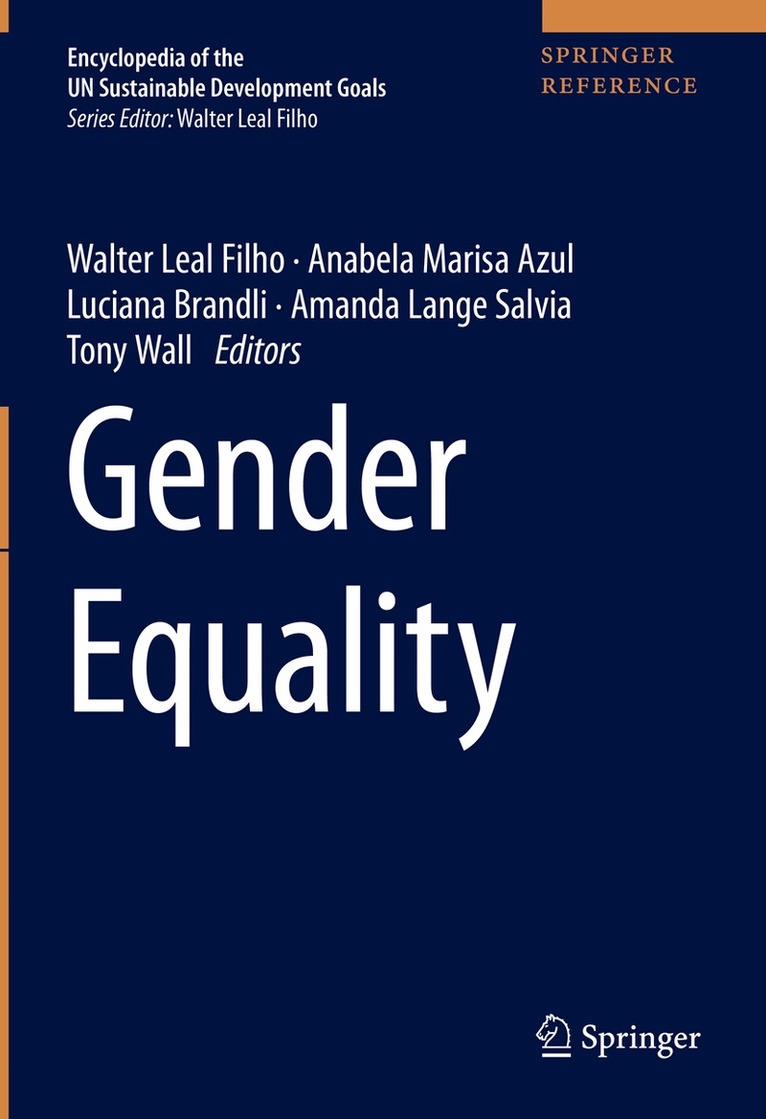
The problems related to the process of industrialisation such as biodiversity depletion, climate change and a worsening of health and living conditions, especially but not only in developing countries, intensify. Therefore, there is an increasing need to search for integrated solutions to make development more sustainable. The United Nations has acknowledged the problem and approved the “2030 Agenda for Sustainable Development”. On 1st January 2016, the 17 Sustainable Development Goals (SDGs) of the Agenda officially came into force. These goals cover the three dimensions of sustainable development: economic growth, social inclusion and environmental protection.
The Encyclopedia of the UN Sustainable Development Goals comprehensively addresses the SDGs in an integrated way. It encompasses 17 volumes, each devoted to one of the 17 SDGs. This volume addresses SDG 5, namely "Achieve gender equality and empower all women and girls" and contains the description of a range of terms, which allows a better understanding and fosters knowledge. This SDG is considered by many as a pivotal goal since the significant role of women in achieving sustainable development has always been acknowledged in several official UN declarations. Yet gender disparity is still rampant under various guises in various countries. Women’s rights need to be strongly safeguarded through legislation to ensure equal opportunities.
Concretely, the defined targets are:
End all forms of discrimination against all women and girls everywhereEliminate all forms of violence against all women and girls in the public and private spheres, including trafficking and sexual and other types of exploitationEliminate all harmful practices, such as child, early and forced marriage and female genital mutilationRecognize and value unpaid care and domestic work through the provision of public services, infrastructure and social protection policies and the promotion of shared responsibility within the household and the family as nationally appropriateEnsure women’s full and effective participation and equal opportunities for leadership at all levels of decision-making in political, economic and public lifeEnsure universal access to sexual and reproductive health and reproductive rights as agreed in accordance with the Programme of Action of the International Conference on Population and Development and the Beijing Platform for Action and the outcome documents of their review conferencesUndertake reforms to give women equal rights to economic resources, as well as access to ownership and control over land and other forms of property, financial services, inheritance and natural resources, in accordance with national laws Enhance the use of enabling technology, in particular information and communications technology, to promote the empowerment of womenAdopt and strengthensound policies and enforceable legislation for the promotion of gender equality and the empowerment of all women and girls at all levelsEditorial BoardKatarzyna Cichos, Vijaya Deshmukh, Melissa Haeffner, Sandra Hopkins, Tamara Hunt, Nerise Johnson, Chhabi Kumar, Julia Mambo, Anagha Paul, Andréia Faraoni Freitas Setti, Tony Wall6 504 kr
Skickas inom 10-15 vardagar
8 396 kr
Läs direkt efter köp
The problems related to the process of industrialisation such as biodiversity depletion, climate change and a worsening of health and living conditions, especially but not only in developing countries, intensify. Therefore, there is an increasing need to search for integrated solutions to make development more sustainable. The United Nations has acknowledged the problem and approved the “2030 Agenda for Sustainable Development”. On 1st January 2016, the 17 Sustainable Development Goals (SDGs) of the Agenda officially came into force. These goals cover the three dimensions of sustainable development: economic growth, social inclusion and environmental protection.
The Encyclopedia of the UN Sustainable Development Goals comprehensively addresses the SDGs in an integrated way. It encompasses 17 volumes, each devoted to one of the 17 SDGs. This volume addresses SDG 1, namely "End poverty in all its forms everywhere" and contains the description of a range of terms, which allows for a better understanding and fosters knowledge about it.
Concretely, the defined targets are:
Eradicate extreme poverty for all people everywhere, currently measured as people living on less than $1.25 a day Reduce at least by half the proportion of men, women and children of all ages living in poverty in all its dimensions according to national definitionsImplement nationally appropriate social protection systems and measures for all, including floors, and achieve substantial coverage of the poor and the vulnerableEnsure that all men and women, in particular the poor and the vulnerable, have equal rights to economic resources, as well as access to basic services, ownership and control over land and other forms of property, inheritance, natural resources, appropriate new technology and financial services, including microfinanceBuild the resilience of the poor and those in vulnerablesituations and reduce their exposure and vulnerability to climate-related extreme events and other economic, social and environmental shocks and disastersEnsure significant mobilization of resources from a variety of sources, including through enhanced development cooperation, in order to provide adequate and predictable means for developing countries, in particular least developed countries, to implement programmes and policies to end poverty in all its dimensionsCreate sound policy frameworks at the national, regional and international levels, based on pro-poor and gender-sensitive development strategies, to support accelerated investment in poverty eradication actionsEditorial BoardSarah Ahmed, Bankole Osita Awuzie, Katarzyna Cichos, Fernanda Frankenberger, Usha Iyer-Raniga, Amanda Lange Salvia, Pinar Gökçin Özuyar, Kalterina Shulla, Ranjit Voola7 587 kr
Skickas inom 10-15 vardagar
9 241 kr
Läs direkt efter köp
The problems related to the process of industrialisation such as biodiversity depletion, climate change and a worsening of health and living conditions, especially but not only in developing countries, intensify. Therefore, there is an increasing need to search for integrated solutions to make development more sustainable. The United Nations has acknowledged the problem and approved the “2030 Agenda for Sustainable Development”. On 1st January 2016, the 17 Sustainable Development Goals (SDGs) of the Agenda officially came into force. These goals cover the three dimensions of sustainable development: economic growth, social inclusion and environmental protection.
The Encyclopedia of the UN Sustainable Development Goals comprehensively addresses the SDGs in an integrated way. The Encyclopedia encompasses 17 volumes, each one devoted to one of the 17 SDGs. This volume addresses SDG 11, namely “Make cities and human settlements inclusive, safe, resilient and sustainable” and contains the description of a range of terms, which allows a better understanding and fosters knowledge. This book presents a set of papers on the state of the art of knowledge and practices about the numerous challenges for cities, solutions and opportunities for the future.
Concretely, the defined targets are:Ensure access for all to adequate, safe and affordable housing and basic services and upgrade slumsProvide access to safe, affordable, accessible and sustainable transport systems for all, improving road safety, notably by expanding public transport, with special attention to the needs of those in vulnerable situations, women, children, persons with disabilities and older personsEnhance inclusive and sustainable urbanization and capacity for participatory, integrated and sustainable human settlement planning and management in all countries Strengthen efforts to protect and safeguard the world’s cultural and natural heritageSignificantly reduce the number of deaths and the number of people affected and substantially decrease the direct economic losses relative to global gross domestic product caused by disasters, including water-related disasters, with a focus on protecting the poor and people in vulnerable situationsReduce the adverse per capita environmental impact of cities, including by paying special attention to air quality and municipal and other waste managementProvide universal access to safe, inclusive and accessible, green and public spaces, in particular for women and children, older persons and persons with disabilities Support positive economic, social and environmental links between urban, peri-urban and rural areas by strengthening national and regional development planningSubstantially increase the number of cities and human settlements adopting and implementing integrated policies and plans towards inclusion, resource efficiency, mitigation and adaptation to climate change, resilience to disasters, and develop and implement, in line with the Sendai Framework for Disaster Risk Reduction 2015–2030, holistic disaster risk management at all levels Support least developed countries, including through financial and technical assistance, in building sustainable and resilient buildings utilizing local materialsEditorial BoardSamuel Borges Barbosa, Luciana Londero Brandli, Elisa Conticelli, Erin A. Hopkins, Olga Kuznetsova, Astrid Skjerven, Hari Srinivas7 587 kr
Skickas inom 10-15 vardagar
9 160 kr
Läs direkt efter köp
The problems related to the process of industrialisation such as biodiversity depletion, climate change and a worsening of health and living conditions, especially but not only in developing countries, intensify. Therefore, there is an increasing need to search for integrated solutions to make development more sustainable. The United Nations has acknowledged the problem and approved the “2030 Agenda for Sustainable Development”. On 1st January 2016, the 17 Sustainable Development Goals (SDGs) of the Agenda officially came into force. These goals cover the three dimensions of sustainable development: economic growth, social inclusion and environmental protection.
The Encyclopedia of the UN Sustainable Development Goals comprehensively addresses the SDGs in an integrated way. It encompasses 17 volumes, each one devoted to one of the 17 SDGs. This volume addresses SDG 12, namely "Ensure sustainable consumption and production patterns" and contains the description of a range of terms, which allows a better understanding and fosters knowledge.
Concretely, the defined targets are:Implement the 10-Year Framework of Programmes on Sustainable Consumption and Production Patterns, all countries taking action, with developed countries taking the lead, taking into account the development and capabilities of developing countriesAchieve the sustainable management and efficient use of natural resourcesHalve per capita global food waste at the retail and consumer levels and reduce food losses along production and supply chains, including post-harvest lossesAchieve the environmentally sound management of chemicals and all wastes throughout their life cycle, in accordance with agreed international frameworks, and significantly reduce their release to air, water and soil in order to minimize their adverse impacts on human health and the environmentSubstantially reduce waste generation through prevention, reduction, recycling and reuseEncourage companies, especially large and transnational companies, to adopt sustainable practices and to integrate sustainability information into their reporting cyclePromote public procurement practices that are sustainable, in accordance with national policies and priorities Ensure that people everywhere have the relevant information and awareness for sustainable development and lifestyles in harmony with nature Support developing countries to strengthen their scientific and technological capacity to move towards more sustainable patterns of consumption and productionDevelop and implement tools to monitor sustainable development impacts for sustainable tourism that creates jobs and promotes local culture and productsRationalize inefficient fossil-fuel subsidies that encourage wasteful consumption by removing market distortions, in accordance with national circumstances, including by restructuring taxation and phasing out those harmful subsidies, where they exist, to reflect their environmental impacts, taking fully into account the specific needs and conditions of developing countries and minimizing the possible adverse impacts on their development in a manner that protects the poor and the affected communitiesEditorial BoardMedani P. Bhandari, Luciana Londero Brandli, Morgane M. C. Fritz, Ulla A. Saari, Leonardo L. Sta Romana6 504 kr
Skickas inom 10-15 vardagar
8 471 kr
Läs direkt efter köp
The problems related to the process of industrialisation such as biodiversity depletion, climate change and a worsening of health and living conditions, especially but not only in developing countries, intensify. Therefore, there is an increasing need to search for integrated solutions to make development more sustainable. The United Nations has acknowledged the problem and approved the “2030 Agenda for Sustainable Development”. On 1st January 2016, the 17 Sustainable Development Goals (SDGs) of the Agenda officially came into force. These goals cover the three dimensions of sustainable development: economic growth, social inclusion and environmental protection.
The Encyclopedia of the UN Sustainable Development Goals comprehensively addresses the SDGs in an integrated way. It encompasses 17 volumes, each devoted to one of the 17 SDGs. This volume is dedicated to SDG 6 "Ensure availability and sustainable management of water andsanitation for all". Water and sanitation are fundamental to human well-being. Integrated water resources management is essential to ensure availability and sustainable management of water and sanitation for all and to the realization of Sustainable Development.
Concretely, the defined targets are:
Achieve universal and equitable access to safe and affordable drinking water for allAchieve access to adequate and equitable sanitation and hygiene for all and end open defecation, paying special attention to the needs of women and girls and those in vulnerable situationsImprove water quality by reducing pollution, eliminating dumping and minimizing release of hazardous chemicals and materials, halving the proportion of untreated wastewater and substantially increasing recycling and safe reuse globallySubstantially increase water-use efficiency across all sectors and ensure sustainable withdrawals and supply of freshwater to address water scarcity and substantially reduce the number of people suffering from water scarcity Implement integrated water resources management at all levels, including through transboundary cooperation as appropriateProtect and restore water-related ecosystems, including mountains, forests, wetlands, rivers, aquifers and lakes Expand international cooperation and capacity-building support to developing countries in water- and sanitation-related activities and programmes, including water harvesting, desalination, water efficiency, wastewater treatment, recycling and reuse technologiesSupport and strengthen the participation of local communities in improving Uwater and sanitation managementEditorial BoardUlisses M. Azeiteiro, Anabela Marisa Azul, Luciana Brandli, Dominique Darmendrail, Despo Fatta–Kassinos, Walter Leal Filho, Susan Hegarty, Amanda Lange Salvia, Albert Llausàs, Paula Duarte Lopes,Javier Marugán, Fernando Morgado, Wilkister Nyaora Moturi, Karel F. Mulder, Alesia Dedaa Ofori, Sandra Ricart7 670 kr
Skickas inom 10-15 vardagar
8 396 kr
Läs direkt efter köp
The problems related to the process of industrialisation such as biodiversity depletion, climate change and a worsening of health and living conditions, especially but not only in developing countries, intensify. Therefore, there is an increasing need to search for integrated solutions to make development more sustainable. The United Nations has acknowledged the problem and approved the “2030 Agenda for Sustainable Development”. On 1st January 2016, the 17 Sustainable Development Goals (SDGs) of the Agenda officially came into force. These goals cover the three dimensions of sustainable development: economic growth, social inclusion and environmental protection.
The Encyclopedia of the UN Sustainable Development Goals comprehensively addresses the SDGs in an integrated way. The Encyclopedia encompasses 17 volumes, each one devoted to one of the 17 SDGs. This volume addresses SDG 7, namely "Ensure access to affordable, reliable, sustainable and modern energy for all” and contains the description of a range of terms, which allow a better understanding and foster knowledge. Energy is crucial for achieving almost all others SDGs, from its role in the eradication of poverty through advancements in health, education, water supply and industrialization, to combating climate change. This book presents a set of papers on the state-of-the-art of knowledge and practices about energy sustainable, in terms of generation and demand energy, considering aspects of innovation, management, sources of energy, performance, society behavior, and infrastructure, among others.
Concretely, the defined targets are:
Ensure universal access to affordable, reliable and modern energy servicesIncrease substantially the share of renewable energy in the global energy mixDouble the global rate of improvement in energy efficiencyEnhance international cooperation to facilitate access to clean energy research and technology, including renewable energy, energy efficiency and advanced and cleaner fossil-fuel technology, and promote investment in energy infrastructure and clean energy technologyExpand infrastructure and upgrade technology for supplying modern and sustainable energy services for all in developing countries, in particular least developed countries, small island developing states and landlocked developing countries, in accordance with their respective programmes of supportEditorial BoardMd. Mahmudul Alam, Justin Bishop, Luciana Londero Brandli, Elisa Conticelli, Marcos Antonio Leite Frandoloso, Haruna Musa Moda, Matti Sommarberg