• Fri frakt över 249 kr
  • •
  • Snabba leveranser
  • •
  • Billiga böcker
Kundservice

Du är på sajten för privatpersoner.

Företag, bibliotek eller offentlig verksamhet?

Du handlar på classic.bokus.com, där alla dina funktioner finns intakta.
Till classic.bokus.com
Bokus logotyp. Gå till startsidan.
  • Erbjudanden
  • Nyheter
  • Student
  • Topplistor
  • Barn & ungdom
  • Bokus Play
  • E-böcker
  • Pocketböcker
  • Spel & pussel

10% rabatt på allt med kod NYSTART10 →

Sidfot

Mina sidor

    Hjälp

    • Kundservice
    • Vanliga frågor och svar
    • Frakt och leverans
    • Retur vid ångerrätt
    • Reklamera vara
    • Betalning
    • Köpvillkor
    • Allmänna villkor
    • Information om webbplatsens tillgänglighet

    Om Bokus

    • Om oss
    • Pressrum
    • För studenter
    • För företag
    • För bibliotek och offentlig verksamhet
    • För leverantörer
    • Hållbarhet

    Populärt

    • Aktuella erbjudanden
    • Presentkort
    • Studentlitteratur
    • Nya böcker
    • Topplistor
    • Signerade böcker
    • Engelska böcker

    Inspiration

    • Boktips
    • BookTok
    • Populära bokserier
    • Barnbokskaraktärer
    • Populära författare
    Logotyp för Bokus
    Följ oss på Facebook (extern länk)Följ oss på Instagram (extern länk)Följ oss på YouTube (extern länk)Följ oss på TikTok (extern länk)
    bokus @ CookiesAnpassa cookiesIntegritetspolicyKöpvillkor
    Till Citymail hemsida (extern länk)Till Budbee hemsida (extern länk)Till Postnord hemsida (extern länk)Till Schenker hemsida (extern länk)Till Early Bird hemsida (extern länk)Till Walleys hemsida (extern länk)
    1. Samhälle och politik
    2. Politik och statsskick
    3. Centralt styre och förvaltning

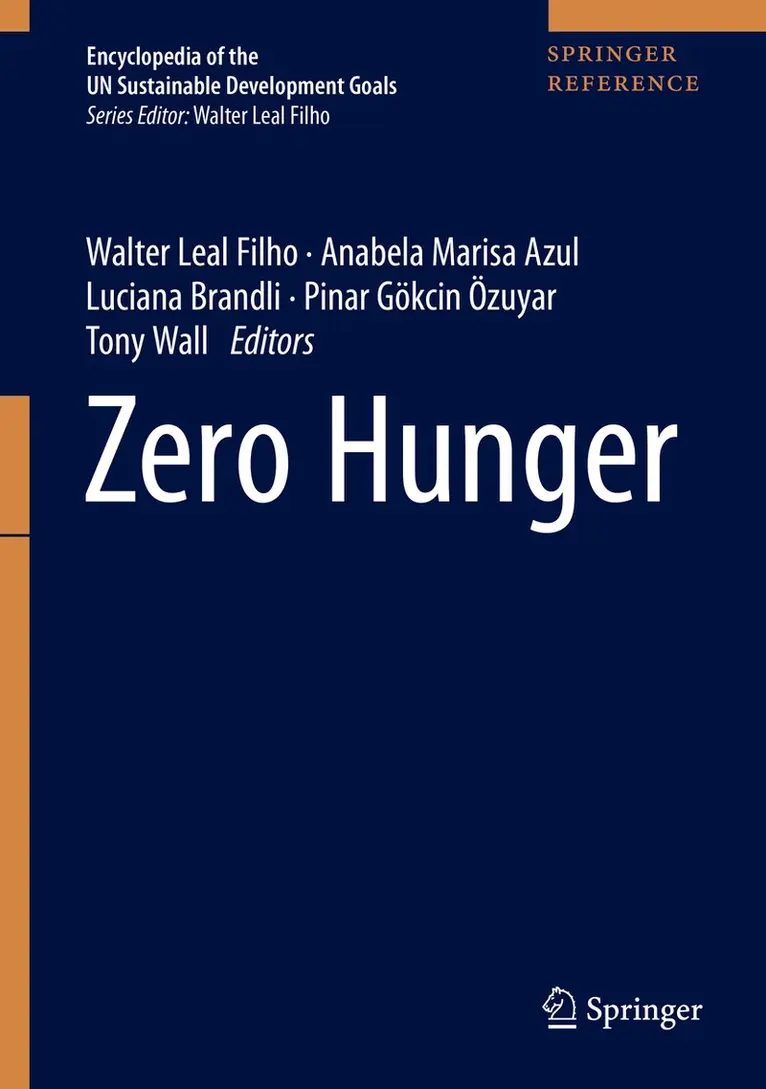
    Zero Hunger

    AvWalter Leal Filho,Anabela Marisa Azul

    Inbunden, Engelska, 2020

    Del i serien Encyclopedia of the UN Sustainable Development Goals

    6 480 kr

    Beställningsvara. Skickas inom 10-15 vardagar. Fri frakt över 249 kr.

    Beskrivning

    The problems related to the process of industrialisation such as biodiversity depletion, climate change and a worsening of health and living conditions, especially but not only in developing countries, intensify. Therefore, there is an increasing need to search for integrated solutions to make development more sustainable. The United Nations has acknowledged the problem and approved the “2030 Agenda for Sustainable Development”. On 1st January 2016, the 17 Sustainable Development Goals (SDGs) of the Agenda officially came into force. These goals cover the three dimensions of sustainable development: economic growth, social inclusion and environmental protection.  The Encyclopedia of the UN Sustainable Development Goals comprehensively addresses the SDGs in an integrated way. It encompasses 17 volumes, each devoted to one of the 17 SDGs. This volume addresses SDG  2, namely "End hunger, achieve food security and improved nutrition and promote sustainable agriculture" and contains the description of a range of related terms, to allow for a better understanding and foster knowledge. Our planet produces enough food to feed everyone. Malnutrition and hunger are the result of inappropriate food production processes, bad governance and injustice. SDG 2 seeks to guarantee quality and nutritious food to ensure healthy life by adopting a holistic approach that involves various actions targeting different actors, technologies, policies and programs. These initiatives have to face challenges coming from extensive environmental degradation, loss of biodiversity and the interrelated effects of climate change.Concretely, the defined targets are:End hunger and ensure access by all people, in particular the poor and people in vulnerable situations, including infants, to safe, nutritious and sufficient food all year roundEnd all forms of malnutrition, including achieving the internationally agreed targets on stunting and wasting in children under 5 years of age, and address the nutritional needs of adolescent girls, pregnant and lactating women and older personsDouble the agricultural productivity and incomes of small-scale food producers, in particular women, indigenous peoples, family farmers, pastoralists and fishers, including through secure and equal access to land, other productive resources and inputs, knowledge, financial services, markets and opportunities for value addition and non-farm employmentEnsure sustainable food production systems and implement resilient agricultural practices that increase productivity and production, that help maintain ecosystems, that strengthen capacity for adaptation to climate change, extreme weather, drought, flooding and other disasters and that progressively improve land and soil qualityMaintain the genetic diversity of seeds, cultivated plants and farmedand domesticated animals and their related wild species, including through soundly managed and diversified seed and plant banks at the national, regional and international levels, and promote access to and fair and equitable sharing of benefits arising from the utilization of genetic resources and associated traditional knowledge, as internationally agreedIncrease investment, including through enhanced international cooperation, in rural infrastructure, agricultural research and extension services, technology development and plant and livestock gene banks in order to enhance agricultural productive capacity in developing countries, in particular least developed countriesCorrect and prevent trade restrictions and distortions in world agricultural markets, including through the parallel elimination of all forms of agricultural export subsidies and all export measures with equivalent effect, in accordance with the mandate of the Doha Development RoundAdopt measures to ensure the proper functioning of food commodity markets and their derivatives and facilitate timely access to market information, including on food reserves, in order to help limit extreme food price volatilityEditorial BoardDatu Buyung Agusdinata, Mohammad Sadegh Allahyari, Usama Awan, Nerise Johnson, Paschal Arsein Mugabe, Vincent Onguso Oeba, Tony Wall

    Produktinformation

    • Utgivningsdatum:2020-05-03
    • Mått:178 x 254 x 56 mm
    • Vikt:2 295 g
    • Format:Inbunden
    • Språk:Engelska
    • Serie:Encyclopedia of the UN Sustainable Development Goals
    • Antal sidor:990
    • Förlag:Springer International Publishing AG
    • ISBN:9783319956749

    Utforska kategorier

    • Centralt styre och förvaltning inom Samhälle och politik
    • Sociologi inom Samhälle och politik
    • Filosofiska discipliner inom Filosofi och religion

    Mer om författaren

    Walter Leal Filho (BSc, PhD, DSc, DPhil, DEd, DL, DLitt) is a Senior Professor and Head of the Research and Transfer Centre "Sustainable Development and Climate Change Management” at Hamburg University of Applied Sciences in Germany, and Chair of Environment and Technology at Manchester Metropolitan University, UK. He is the initiator of the Word Sustainable Development Symposia (WSSD-U) series, and chairs the Inter-University Sustainable Development Research Programme. Professor Leal Filho has written, co-written, edited or co-edited more than 400 publications, including books, book chapters and papers in refereed journals.Anabela Marisa Azul is a Researcher at the Center for Neuroscience and Cell Biology (CNC) and the Institute for Interdisciplinary Research of the University of Coimbra (UC, Portugal). She holds a Ph.D. in Biological Sciences, specializing in Ecology (2002, UC), and pursued her investigation on biology and ecology of fungi to pinpoint the role of mycorrhizal symbiosis for sustainability of Mediterranean forests under different land use scenarios at the Centre for Functional Ecology (CFE-UC), where she became an Associate Researcher (from 2009 to 2014). At CFE-UC, Marisa Azul developed a holistic approach that combined innovation in food production with sustainable development and public scientific awareness to multiple actors. At CNC, from 2014 on, Marisa Azul focuses her investigation on basic research and participatory research dynamics to pinpoint links between metabolism, health/disease, and sustainability. She has broad academic experience as a researcher working in participatory research and interdisciplinary that link biomedical and life/environmental sciences, social sciences, science education, science communication, and artistic forms. Her research interests also lie in bringing together the academy and social/economical players. She has been successful in attracting national and international funding, coordinating projects, and mentoring young researchers on the topics mentioned. She has co-authored over 40 scientific publications and book chapters, co-edited 4 books on Climate Change Management Series and 1 onWorld Sustainability Series published by Springer, co-authored 4 books for children and 2 comics, and co-produced 1 animation.Luciana Brandli, Ph.D., is an Associate Professor in the University of Passo Fundo, Brazil, working in the Ph.D. Program in Civil and Environment Engineering. Her current research interests include sustainability in higher education and green campus, management of urban infrastructure and sustainable cities, and the Agenda 2030 for sustainable development. She supervises a number of Master’s and Doctoral students on engineering and environment and sustainability issues and has in excess of 300 publications, including books, book chapters, and papers in refereed journals.Pinar Gökçin Özuyar is a Faculty Member of Faculty of Economics, Administrative and Social Sciences at Istinye University, Istanbul, Turkey. She received her B.S. degree in Environmental Engineering from Istanbul Technical University in 1992 and M.S. and Ph.D. degrees from BogaziciUniversity Institute of Environmental Sciences, Istanbul, Turkey. Her Ph.D. thesis was based on the “Thermodynamic Analysis of Treatment Plants for Producing Energy from SolidWaste” which she conducted in Germany with a joint scholarship from Forschungzentrum Jülich and TUBITAK (NationalScience Foundation of Turkey). Defining herself as a pracademic, she has more than 25 years of experience not only in academia but also in the private sector working on environment and sector-specific activities in Turkey and Dubai (UAE). She has extensive expertise specifically in environmental auditing according to World Bank Standards which is required for international financing especially during company mergers and acquisitions (M&As) and greenfield projects. Working over the years in projects involving different stakeholder groups with different priorities, she has the proven capacity for establishing a dialogue between such stakeholder groups. Although coming from a technical background, her academic work focuses on involving sustainable development into the strategiesof corporations including higher academic institutions. Currently, she teaches and leads funded research on sustainability/sustainable development especially focusing on industrial ecology and regional development.Tony Wall (BSc Hons, PGDip, PGCHE, MA, MSc, EdD, MCIPD, NTFHEA) is a Professor, Founder and Director of the International Thriving at Work Research Group in the United Kingdom where he is the institutional lead for the Inter-University Sustainable Development Research Programme. His research impact work has won multiple Santander International Research Excellence Awards and a National Fellowship of the Higher Education Academy. Apart from being a visiting scholar in the US and Australia, his change work includes co-founding of the Washington Ethical Leadership Summit and the TS Eliot Foundation’s International Creative Practice for Wellbeing Framework.

    Innehållsförteckning

    • Nutritious and sufficient food all year round.- Increase of small-scale food producers: women, indigenous peoples, family farmers, pastoralists and fishers.- Access to land and financial services.- Resilient agricultural practices.- Maintainance of ecosystems.- Adaptation to climate change, extreme weather, drought, flooding and other disasters.- Improvement of land and soil quality.- Genetic diversity of seed.- Enhanced international cooperation.- Investment in agricultural research, technology development, plant and livestock gene banks.- Enhance agricultural capacity in developing countries.- Prevention of trade restrictions, Doha Development Round.- Access to market information on food reserves.- Limitation of extreme food price volatility.