Marco Pagano - Böcker
Visar alla böcker från författaren Marco Pagano. Handla med fri frakt och snabb leverans.
11 produkter
11 produkter
559 kr
Skickas inom 5-8 vardagar
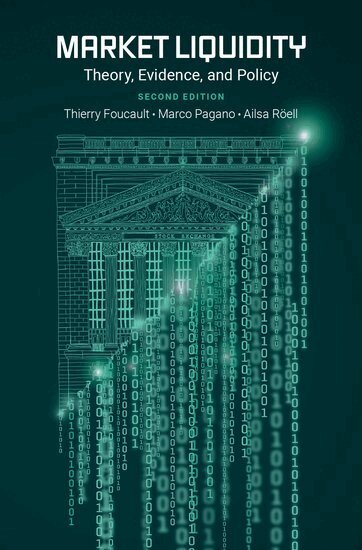
The way in which securities are traded is very different from the idealized picture of a frictionless and self-equilibrating market offered by the typical finance textbook. In Market Liquidity, Thierry Foucault, Marco Pagano, and Ailsa Röell offer a more accurate take on the liquidity of securities markets, its determinants, and its effects. They start from the assumption that not everyone is present at all times simultaneously on the market, and that even the limited number of participants who are have quite diverse information about the security's fundamentals. As a result, the order flow is a complex mix of information and noise, and a consensus price only emerges gradually over time as the trading process evolves and the participants interpret the actions of other traders. Thus, a security's actual transaction price may deviate from its fundamental value, as it would be assessed by a fully informed set of investors. Market Liquidity takes these deviations seriously, and explains why and how they emerge in the trading process and are eventually eliminated. Drawing on the analytical tools and empirical methods from a well-defined field within financial economics--market microstructure--the authors confront many striking phenomena in securities markets, from liquidity changes over time to temporary deviations from asset fair values. In the fully revised second edition of Market Liquidity, Foucault, Pagano, and Röell bring readers up to speed on recent changes in market structures and financial regulation. New chapters cover the relationship between financial instability and market liquidity, as well as the role and effects of algorithmic and high-frequency trading. Including new illustrative examples of market malfunction and novel insights from recent research on security markets, Market Liquidity provides a comprehensive and authoritative account on market microstructure.To access the companion website, which includes student and instructor resources, please visit https://global.oup.com/us/companion.websites/9780199936243/
1 717 kr
Skickas inom 7-10 vardagar
Low growth, low investment, insufficient spend on infrastructure, weak bank lending to the corporate sector, and funding deficiencies of small and medium-sized enterprises are all causes of concern in Europe. To many, they point to fundamental problems in the financing of European companies and in Europe's financial systems. Are these concerns valid and do the structure and performance of the financial system lie at their heart? If so, what should be done to address them, and have the right policy prescriptions been identified to date?A product of the Restarting European Investment Finance research programme, Finance and Investment: The European Case brings together leading researchers to consider the causes of the persistently low level of investment in Europe. It examines the extent to which the financial system is a contributory factor and identifies possible remedies, considering the relation of finance to corporate sector investment, the lending behaviour of banks, the provision of equity financing, and the role of public sector institutions, regulation, and taxation. Finance and Investment provides one of the most comprehensive and thorough analyses of any financial system undertaken to date. It reflects a large body of research using new and existing data sets, employing advanced empirical tools, and exploiting the unique insights provided by the tumultuous events of financial and sovereign debt crises. Together, they comprise an exceptional body of knowledge to advance academic thinking and guide policy formulation.
538 kr
Skickas inom 7-10 vardagar
Low growth, low investment, insufficient spend on infrastructure, weak bank lending to the corporate sector, and funding deficiencies of small and medium-sized enterprises are all causes of concern in Europe. To many, they point to fundamental problems in the financing of European companies and in Europe's financial systems. Are these concerns valid and do the structure and performance of the financial system lie at their heart? If so, what should be done to address them, and have the right policy prescriptions been identified to date?A product of the Restarting European Investment Finance research programme, Finance and Investment: The European Case brings together leading researchers to consider the causes of the persistently low level of investment in Europe. It examines the extent to which the financial system is a contributory factor and identifies possible remedies, considering the relation of finance to corporate sector investment, the lending behaviour of banks, the provision of equity financing, and the role of public sector institutions, regulation, and taxation. Finance and Investment provides one of the most comprehensive and thorough analyses of any financial system undertaken to date. It reflects a large body of research using new and existing data sets, employing advanced empirical tools, and exploiting the unique insights provided by the tumultuous events of financial and sovereign debt crises. Together, they comprise an exceptional body of knowledge to advance academic thinking and guide policy formulation.
855 kr
Skickas inom 3-6 vardagar
In recent years, European financial economists have been brought together, via research projects and conferences, by the Centre for Economic Policy Research (CEPR). These fruitful interactions have contributed to the development of financial economics in Europe, and have generated a strong flow of interesting writing---both theoretical and empirical---in the fields of financial markets and corporate finance.The chapters in this volume and its companion volume, "Corporate Finance and Baking: A Reader", reflect the depth and breadth of the research interests of European scholars in financial economics. The analysis of financial markets presented in this collection enhances our understanding of asset pricing, both in the context of perfect markets and in the context of market imperfections, such as asymmetric information. Those chapters that appear in "Corporate Finance and Banking" further our understanding of the interaction between business cycle and financial imperfections, IPOs, takeover bids, and the interplay between banks and financial markets. Together, these two volumes comprise an authoritative and invaluable reference tool for scholars and others working in the fields of finance, corporate finance, and monetary economics.
512 kr
Skickas inom 3-6 vardagar
In recent years, European financial economists have been brought together, via research projects and conferences, by the Centre for Economic Policy Research (CEPR). These fruitful interactions have contributed to the development of financial economics in Europe, and have generated a strong flow of interesting writing---both theoretical and empirical. The chapters in this volume reflect the depth and breadth of the research interests of European scholars in financial economics.The first section uses empirical analysis of financial market data to test the robustness of the pricing kernel model. The second section is on market microstructure, which is based on the observation of high frequency data. It explores the implications of asymmetric information and market imperfections. The third section points to how the study of speculation may link both the pricing kernel and the microstructure approaches. The final section on corporate finance suggests that contractual and agency problems have a significant impact on the pricing of financial assets.
1 098 kr
Skickas inom 3-6 vardagar
In recent years, European financial economists have been brought together, via research projects and bubble01ces, by the Centre for Economic Policy Research (CEPR). These fruitful interactions have contributed to the development of financial economics in Europe, and have generated a strong flow of interesting writing---both theoretical and empirical---in the fields of financial markets and corporate finance.The chapters in this volume and its companion volume, "Financial Markets: A Reader", reflect the depth and breadth of the research interests of European scholars in financial economics. The chapters that appear in this volume further our understanding of the interaction between business cycle and financial imperfections, IPOs, takeover bids, and the interplay between banks and financial markets. The analysis presented in "Financial Markets" enhances our understanding of asset pricing, both in the context of perfect markets and in the context of market imperfections, such as asymmetric information. Together, these two volumes comprise an authoritative and invaluable reference tool for scholars and others working in the fields of finance, corporate finance, and monetary economics.
272 kr
Skickas inom 7-10 vardagar
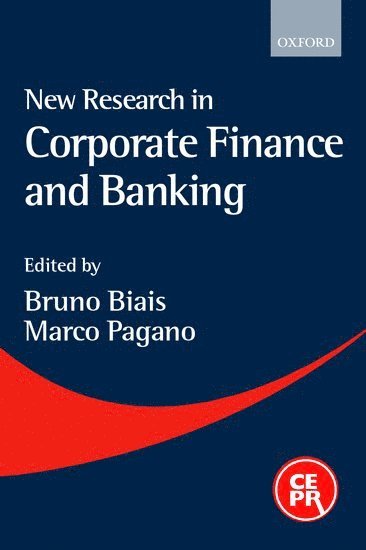
In recent years, European financial economists have been brought together, via research projects and bubble01ces, by the Centre for Economic Policy Research (CEPR). These fruitful interactions have contributed to the development of financial economics in Europe, and have generated a strong flow of interesting writing---both theoretical and empirical---in the fields of financial markets and corporate finance.One of the common questions posed by researchers in this field is why security markets have such different roles and importance relative to banks in different countries. A related issue is whether these different financial arrangements matter for the functioning of the real economy. The first section of this volume approaches these issues by focusing on the functioning of the primary equity market, or the process by which companies 'go public', which marks the transition from complete reliance on bank financing to partial reliance on security markets. The second section approaches these issues at a 'systemic' level, attempting to identify the comparative advantages of banks and security markets in solving the information problems involved in financing companies. The third section explores the variety in the design of credit contracts and institutions, asking questions like: Why do some companies borrow from a single bank and others from several banks? Why do some banks share information about their customers? The final section illustrates that the same informational frictions that explain the design of credit contracts and institutions can also affect real economic activity.
1 281 kr
Skickas inom 5-8 vardagar
The way in which securities are traded is very different from the idealized picture of a frictionless and self-equilibrating market offered by the typical finance textbook. Market Liquidity offers a more accurate and authoritative take on liquidity and price discovery. The authors start from the assumption that not everyone is present at all times simultaneously on the market, and that even the limited number of participants who are have quite diverse information about the security's fundamentals. As a result, the order flow is a complex mix of information and noise, and a consensus price only emerges gradually over time as the trading process evolves and the participants interpret the actions of other traders. Thus a security's actual transaction price may deviate from its fundamental value, as it would be assessed by a fully informed set of investors. This book takes these deviations seriously, and explains why and how they emerge in the trading process and are eventually eliminated. The authors draw on a vast body of theoretical insights and empirical findings on security price formation that have accumulated in the last thirty years, and have come to form a well-defined field within financial economics known as 'market microstructure.' Focusing on liquidity and price discovery, they analyze the tension between the two, pointing out that when price-relevant information reaches the market through trading pressure rather than through a public announcement, liquidity suffers. The book also confronts many puzzling phenomena in securities markets and uses the analytical tools and empirical methods of market microstructure to understand them. These include issues such as why liquidity changes over time, why large trades move prices up or down, and why these price changes are subsequently reversed, why we see concentration of securities trading, why some traders willingly disclose their intended trades while others hide them, and why we observe temporary deviations from arbitrage prices.
197 kr
Skickas inom 3-6 vardagar
319 kr
Skickas
Det har gått tio år sedan EU:s monetära union bildades. 2009 års Konjunkturråds-rapport analyserar den ekonomiska utvecklingen i de länder som vid starten anslöt sig till den monetära unionen och hur de har påverkats av den gemen-samma valutan och penningpolitiken. De områden som behandlas är penning-politiken, finanspolitiken, den finansiella integrationen, samt utrikeshandeln och direktinvesteringarna. Danmark, Sverige och Storbritannien har valt att stå utanför den monetära unionen. Rapporten analyserar också hur deras ekonomier har utvecklats jämfört med euroländernas, och bedömer om utvecklingen hade varit annorlunda ifall de tre länderna hade deltagit i den monetära unionen från början. Författare är professorerna Harry Flam (Konjunkturrådets ordförande), Antonio Fatás, Steinar Holden, Tullio Jappelli, Ilian Mihov, Marco Pagano och Charles Wyplosz.
Del 1 - SNS Economic Policy Group Report
EMU at Ten : should Denmark, Sweden and the UK join?
Häftad, Engelska, 2009
305 kr
Skickas
Ten years have passed since the start of the monetary union. The 2009 report of the Economic Policy Group analyses the economic record of the countries that joined at the start and how it has been affected by the common currency and common monetary policy. The areas covered are monetary policy, fiscal policy, financial integration, foreign trade and foreign direct investment. Denmark, Sweden and the UK have chosen not to join the monetary union. The report also compares their economic record to that of the euro countries, and assesses if the record would have been different had the three outsiders joined the monetary union from the start. The authors are professors Harry Flam (chairman), Antonio Fatás, Steinar Holden, Tullio Jappelli, Ilian Mihov, Marco Pagano and Charles Wyplosz.