Rabbi Jonathan Sacks - Böcker
Visar alla böcker från författaren Rabbi Jonathan Sacks. Handla med fri frakt och snabb leverans.
4 produkter
4 produkter
268 kr
Skickas inom 3-6 vardagar
100 kr
Skickas inom 5-8 vardagar
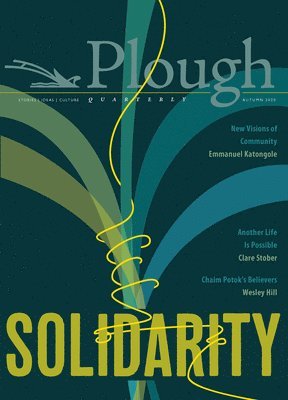
The summer of 2020 has shown us how much we all depend on one another.Whatever else they do, pandemics show us we are not alone. Covid-19 is proof that, yes, there is such a thing as society; the disease has spread precisely because we aren’t autonomous individuals disconnected from each other, but rather all belong to one great body of humanity. The pain inflicted by the pandemic is far from equally distributed. Yet it reveals ever more clearly how much we all depend on one another, and how urgently necessary it is for us to bear one another’s burdens.It’s a good time, then, to talk about solidarity. The more so because it’s a theme that’s also raised by this year’s other major development, the international protests for racial justice following George Floyd’s death. The protests, too, raised the question of solidarity in guilt, even guilt across generations. By taking up our common guilt with all humanity, we come into solidarity with the one who bears it and redeems it all. In Christ, sins are forgiven, guilt abolished, and a new way of living together becomes possible. This solidarity in forgiveness gives rise to a life of love.This issue of Plough explores what solidarity means, and what it looks like to live it out today, whether in Uganda, Bolivia, or South Korea, in an urban church, a Bruderhof, or a convent.
292 kr
Skickas inom 3-6 vardagar
100 kr
Tillfälligt slut
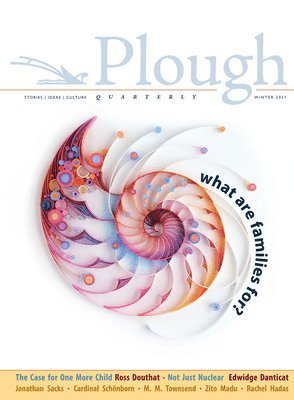
What is a family and what is it good for?Story 1: Families are in crisis, and the cause is moral breakdown. We urgently need a deep renewal of our family culture, supported by public policies that strengthen traditional marriage and encourage childbearing.Story 2: Families are in crisis, and the cause is capitalism. We need structural changes in society so that all families can flourish: parental leave, guaranteed healthcare, flexible work hours for parents, restorative justice.What if both these stories are true? This issue of Plough reflects on what a family is and what it is for, so that the transformations needed to solve the crisis of the family start from a firm basis, not a nostalgic ideal or progressive theorizing. As always, we take as a starting point the teachings of Jesus. It turns out his idea of family values might not be what people think. He calls us to extend our natural love for our biological family to a vast new throng of siblings – a family of many ethnicities and cultures that includes the widowed, the unmarried, the outsider, and the stranger. In this issue: - Ross Douthat asks what is stopping people from having the one more child they desire.- Edwidge Danticat says families are not nuclear.- Gina Dalfonzo reveals what singles know best about the church as family.- Norann Voll remembers a Jewish woman who escaped the Holocaust and married a German.- W. Bradford Wilcox and Alysse ElHage report on how the Covid pandemic has impacted the family.- Noah Van Niel asks whether masculinity is OK anymore.- Cardinal Christoph Schönborn reflects the burden of family history, celibacy, and monument toppling.- Sarah C. Williams pinpoints the source of feminist pioneer Josephine Butler’s daring.- Rabbi Jonathan Sacks begins the story of marriage 385 million years ago in a lake in Scotland.- Zito Madu recalls how his father’s amazing storytelling saved the past from oblivion.You’ll also find:- M. M. Townsend on what Louisa May Alcott and Simone de Beauvoir had in common- A special announcement about Plough’s new poetry contest: the Rhina Espaillat Poetry Award- A reading from G. K. Chesterton- Two new poems by Rachel Hadas- Reviews of Eric Edstrom’s Un-American, Maya Schenwar and Victoria Law’s Prison by Any Other Name, Brian Doyle’s One Long River of Song, and Martín Caparrós’s HungerPlough Quarterly features stories, ideas, and culture for people eager to put their faith into action. Each issue brings you in-depth articles, interviews, poetry, book reviews, and art to help you put Jesus’ message into practice and find common cause with others.