Ross Douthat - Böcker
Visar alla böcker från författaren Ross Douthat. Handla med fri frakt och snabb leverans.
10 produkter
10 produkter
240 kr
Skickas
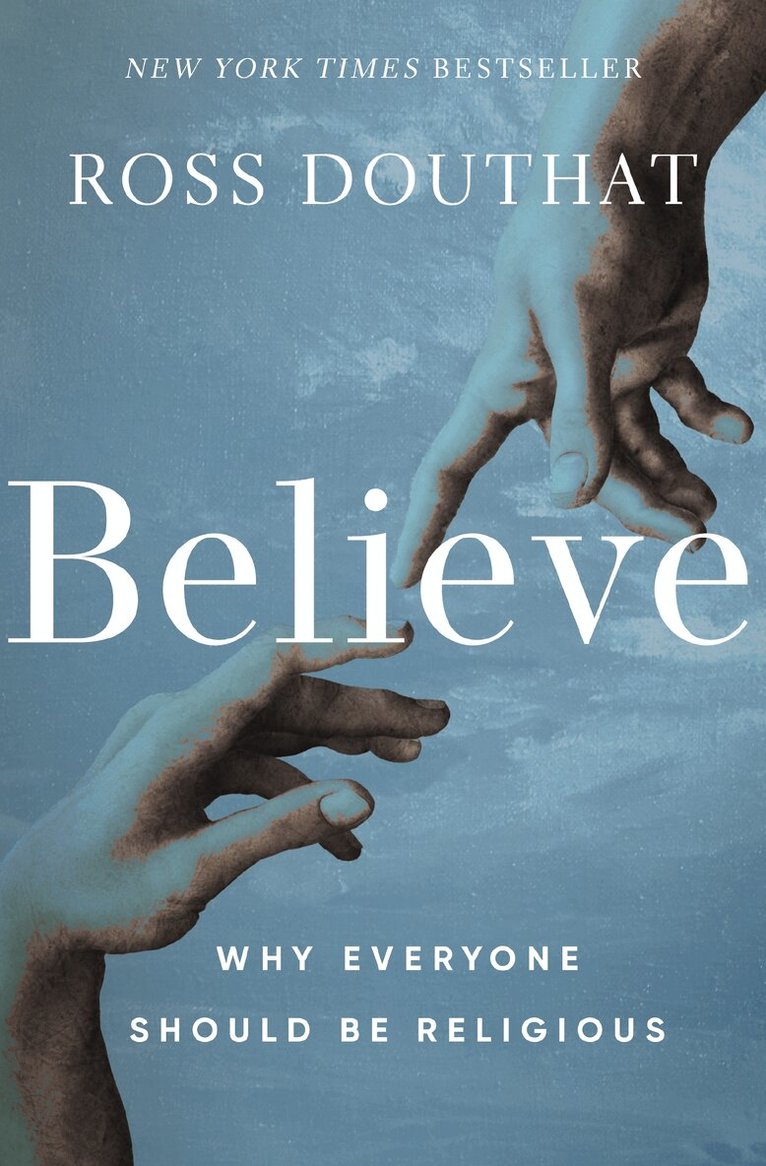
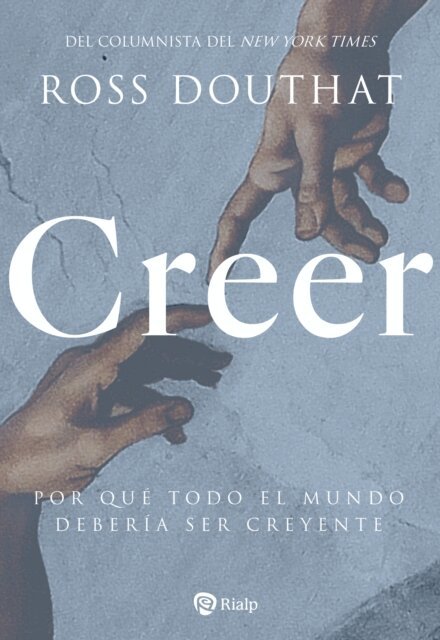
An Instant New York Times Bestseller"Truly a Mere Christianity for the 21st century"--World magazineFrom the host of the Interesting Times podcastDo you ever wish you had more faith? Here is a blueprint for thinking your way from doubt to belief.As a columnist for the New York Times who writes often about spiritual topics for a skeptical audience, Ross Douthat understands that many of us want to have more faith than we do. Douthat argues that in light of what we know today it should be harder to not have faith than to have it.With empathy, clarity, and rigor, Douthat explores:Why nonbelief requires ignoring what our reasoning faculties tell us about the worldHow modern scientific developments make a religious worldview more credible, not lessWhy it's entirely reasonable to believe in mystical and supernatural realitiesHow an open-minded religious quest should proceed amid the diversity of religious faithsHow Douthat's own Christianity is informed by his blueprint for belief With clear and straightforward arguments, Believe shows how religious belief makes sense of the order of the cosmos and our place within it, illuminates the mystery of consciousness, and explains the persistent reality of encounters with the supernatural. Highly relevant for our current moment, Believe offers a pathway for thinking your way from doubt into belief, from uncertainty about our place in the universe into a confidence that we are here for a reason.
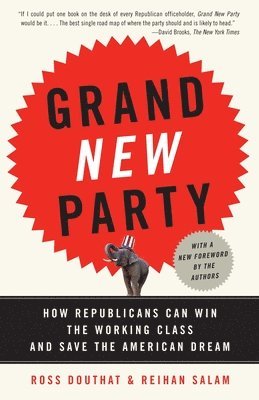
Grand New Party: How Republicans Can Win the Working Class and Save the American Dream
Häftad, Engelska, 2009
249 kr
Skickas inom 3-6 vardagar
342 kr
Skickas inom 5-8 vardagar
100 kr
Skickas inom 5-8 vardagar
In an age of distraction, this issue of Plough Quarterly looks at inwardness – how sustainable human community and social activism must be rooted in the spiritual life.How much of your day is spent in reality, and how much in a fake world? We’ve learned that screen time is bad for you, too much media consumption damages your heart, and Facebook can make you mentally ill. We’re aware of the mind-altering power of advertising, the dehumanizing passions of our polarized politics, and the fact that millions of us have learned to multitask while watching footage of refugees drowning.But what are we to do about it? If this fake world is invading our souls, it’s in our souls that we must find the cure. Only a return to inwardness can bring distracted moderns back to Jesus and to constructive work for his kingdom.Here activists may object: Isn’t it the height of selfishness to retreat into our interior life when we ought to be out saving starving children? Yet Christians through the ages have insisted that inwardness is crucial to the life of discipleship. It’s what keeps us from falling for demagogues and false gospels, from wasting life on superficialities, and from ignoring our neighbor. In fact, throughout history it has often been the mystics who were most active in serving others. In true Plough fashion, this issue brings together a colorful cast of examples: from medieval Beguines and Benedictines to Gerard Manley Hopkins, Simone Weil, and Fannie Lou Hamer, to contemporary voices like Robert Cardinal Sarah, Johann Christoph Arnold, and three persecuted Syrian priests. These lives offer us glimpses of the real world from which our fake world seeks to distract us, and can guide us in our own refusal to conform.Also in this issue:• Poetry from Gerard Manley Hopkins and Malcolm Guite• Insights on inwardness from Meister Eckhart, Eberhard Arnold, Marguerite Porete, Simone Weil, and Isaac Penington• A forum on the Benedict Option with Rod Dreher, Ross Douthat, Jacqueline C. Rivers, and Randall Gauger• Artwork by Jason Landsel, Bruce Herman, Jane Chapin, Graham Berry, Fra Angelico, Francisco de Zurbarán, Eleanor Fortescue-Brickdale, Matthew J. Cutter, John August Swanson, Vittorio Matteo Corcos, and Leon DaboPlough Quarterly features stories, ideas, and culture for people eager to put their faith into action. Each issue brings you in-depth articles, interviews, poetry, book reviews, and art to help you put Jesus’ message into practice and find common cause with others.
242 kr
Skickas inom 3-6 vardagar
207 kr
Tillfälligt slut
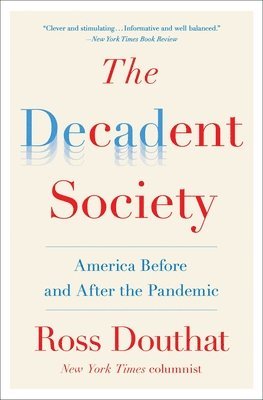
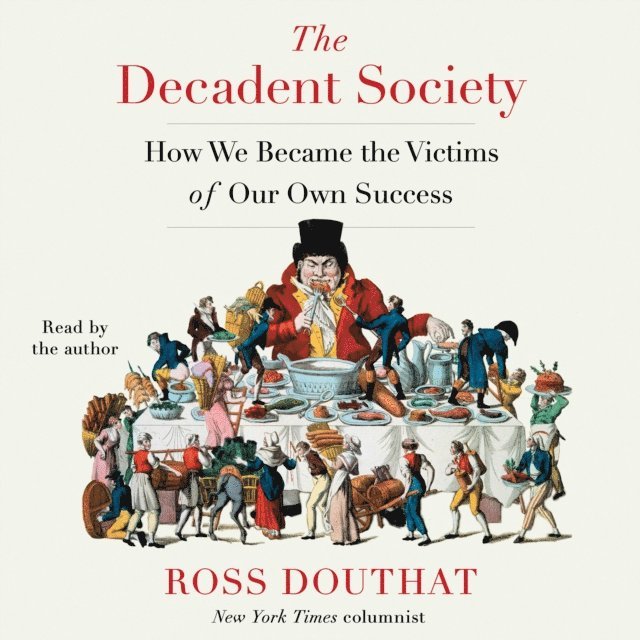
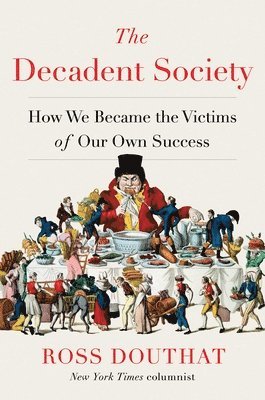
A powerful portrait of how our turbulent age is defined by dark forces seemingly beyond our control from the New York Times columnist and bestselling author of Bad Religion.The Decadent Society explains what happens when a rich and powerful society ceases advancing—how the combination of wealth and technological proficiency with economic stagnation, political stalemates, cultural exhaustion, and demographic decline creates a strange kind of “sustainable decadence,” a civilizational malaise that could endure for longer than we think.Ranging from the chaos of Trump-era Washington to the gridlock of the European Union; from our empty cradles to our lonely pathways through middle and old age; from the lost promise of the Space Age and early internet to today’s earthbound surveillance state; from the recycling of Baby Boomer pop culture to the Brave New World we’re making with drugs and virtual reality escapes, Douthat provides an enlightening diagnosis of the modern condition – how we got here, how long our malaise might last, and how, whether in renaissance or catastrophe, our decadence might ultimately end.
231 kr
Skickas inom 3-6 vardagar
From the New York Times columnist and bestselling author of Bad Religion, a powerful portrait of how our wealthy, successful society has passed into an age of gridlock, stalemate, public failure and private despair. The era of the coronavirus has tested America, and our leaders and institutions have conspicuously failed. That failure shouldn’t be surprising: Beneath social-media frenzy and reality-television politics, our era’s deep truths are elite incompetence, cultural exhaustion, and the flight from reality into fantasy. Casting a cold eye on these trends, The Decadent Society explains what happens when a powerful society ceases advancing—how the combination of wealth and technological proficiency with economic stagnation, political stalemate, and demographic decline creates a unique civilizational crisis. Ranging from the futility of our ideological debates to the repetitions of our pop culture, from the decline of sex and childbearing to the escapism of drug use, Ross Douthat argues that our age is defined by disappointment—by the feeling that all the frontiers are closed, that the paths forward lead only to the grave. Correcting both optimism and despair, Douthat provides an enlightening explanation of how we got here, how long our frustrations might last, and how, in renaissance or catastrophe, our decadence might ultimately end.
238 kr
Skickas inom 3-6 vardagar
100 kr
Tillfälligt slut
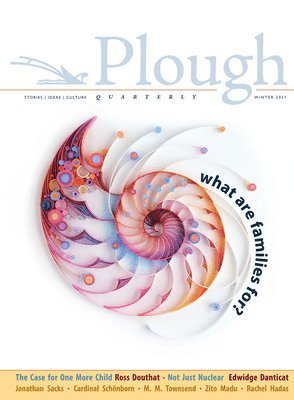
What is a family and what is it good for?Story 1: Families are in crisis, and the cause is moral breakdown. We urgently need a deep renewal of our family culture, supported by public policies that strengthen traditional marriage and encourage childbearing.Story 2: Families are in crisis, and the cause is capitalism. We need structural changes in society so that all families can flourish: parental leave, guaranteed healthcare, flexible work hours for parents, restorative justice.What if both these stories are true? This issue of Plough reflects on what a family is and what it is for, so that the transformations needed to solve the crisis of the family start from a firm basis, not a nostalgic ideal or progressive theorizing. As always, we take as a starting point the teachings of Jesus. It turns out his idea of family values might not be what people think. He calls us to extend our natural love for our biological family to a vast new throng of siblings – a family of many ethnicities and cultures that includes the widowed, the unmarried, the outsider, and the stranger. In this issue: - Ross Douthat asks what is stopping people from having the one more child they desire.- Edwidge Danticat says families are not nuclear.- Gina Dalfonzo reveals what singles know best about the church as family.- Norann Voll remembers a Jewish woman who escaped the Holocaust and married a German.- W. Bradford Wilcox and Alysse ElHage report on how the Covid pandemic has impacted the family.- Noah Van Niel asks whether masculinity is OK anymore.- Cardinal Christoph Schönborn reflects the burden of family history, celibacy, and monument toppling.- Sarah C. Williams pinpoints the source of feminist pioneer Josephine Butler’s daring.- Rabbi Jonathan Sacks begins the story of marriage 385 million years ago in a lake in Scotland.- Zito Madu recalls how his father’s amazing storytelling saved the past from oblivion.You’ll also find:- M. M. Townsend on what Louisa May Alcott and Simone de Beauvoir had in common- A special announcement about Plough’s new poetry contest: the Rhina Espaillat Poetry Award- A reading from G. K. Chesterton- Two new poems by Rachel Hadas- Reviews of Eric Edstrom’s Un-American, Maya Schenwar and Victoria Law’s Prison by Any Other Name, Brian Doyle’s One Long River of Song, and Martín Caparrós’s HungerPlough Quarterly features stories, ideas, and culture for people eager to put their faith into action. Each issue brings you in-depth articles, interviews, poetry, book reviews, and art to help you put Jesus’ message into practice and find common cause with others.
117 kr
Skickas inom 5-8 vardagar
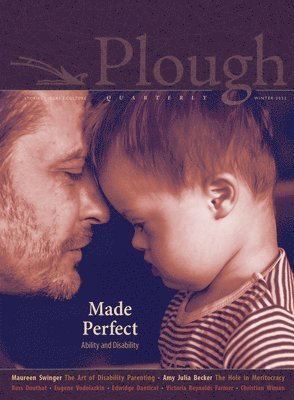
Whose lives count as fully human? The answer matters for everyone, disabled or not.The ancient Greek ideal linked physical wholeness to moral wholeness – the virtuous citizen was “beautiful and good.” It’s an ideal that has all too often turned deadly, casting those who do not measure up as less than human. In the pre-Christian era, infants with disabilities were left on the rocks; in modern times, they have been targeted by eugenics.Much has changed, thanks to the tenacious advocacy of the disability rights movement. Yesteryear’s hellish institutions have given way to customized educational programs and assisted living centers. Public spaces have been reconfigured to improve access. Therapies and medical technology have advanced rapidly in sophistication and effectiveness. Protections for people with disabilities have been enshrined in many countries’ antidiscrimination laws.But these victories, impressive as they are, mask other realities that collide awkwardly with society’s avowals of equality. Why are parents choosing to abort a baby likely to have a disability? Why does Belgian law allow for euthanasia in cases of disability, even absent a terminal diagnosis or physical pain? Why, when ventilators were in short supply during the first Covid wave, did some states list disability as a reason to deny care?On this theme: - Heonju Lee tells how his son with Down syndrome saved another child’s life.- Molly McCully Brown and Victoria Reynolds Farmer recount their personal experiences with disability.- Amy Julia Becker says meritocracies fail because they value the wrong things.- Maureen Swinger asks six mothers around the world about raising a child with disabilities.- Joe Keiderling documents the unfinished struggle for disability rights.- Isaac T. Soon wonders if Saint Paul’s “thorn in the flesh” was a disability.- Leah Libresco Sargeant reviews What Can a Body Do? and Making Disability Modern.- Sarah C. Williams says testing for fetal abnormalities is not a neutral practice.Also in the issue: - Ross Douthat is brought low by intractable Lyme disease.- Edwidge Danticat flees an active shooter in a packed mall.- Eugene Vodolazkin finds comic relief at funerals, including his own father’s.- Kelsey Osgood discovers that being an Orthodox Jew is strange, even in Brooklyn.- Christian Wiman pens three new poems.- Susannah Black profiles Flannery O’Conner.- Our writers review Eyal Press’s Dirty Work, Steve Coll’s Directorate S, and Millennial Nuns by the Daughters of Saint Paul.Plough Quarterly features stories, ideas, and culture for people eager to apply their faith to the challenges we face. Each issue includes in-depth articles, interviews, poetry, book reviews, and art.