Ralf Poscher – författare
Visar alla böcker från författaren . Handla med fri frakt och snabb leverans.
20 produkter
20 produkter
E-bok
PDF, Engelska, 20161 228 kr
Läs direkt efter köp
Vague expressions are omnipresent in natural language. As such, their use in legal texts is virtually inevitable. If a law contains vague terms, the question whether it applies to a particular case often lacks a clear answer. One of the fundamental pillars of the rule of law is legal certainty. The determinacy of the law enables people to use it as a guide and places judges in the position to decide impartially. Vagueness poses a threat to these ideals. In borderlinecases, the law seems to be indeterminate and thus incapable of serving its core rule of law value.In the philosophy of language, vagueness has become one of the hottest topics of the last two decades. Linguists and philosophers have investigated what distinguishes "soritical " vagueness from other kinds of linguistic indeterminacy, such as ambiguity, generality, open texture, and family resemblance concepts. There is a vast literature that discusses the logical, semantic, pragmatic, and epistemic aspects of these phenomena. Legal theory has hitherto paid little attention to the differencesbetween the various kinds of linguistic indeterminacy that are grouped under the heading of "vagueness ", let alone to the various theories that try to account for these phenomena.Bringing together leading scholars working on the topic of vagueness in philosophy and in law, this book fosters a dialogue between philosophers and legal scholars by examining how philosophers conceive vagueness in law from their theoretical perspective and how legal theorists make use of philosophical theories of vagueness. The chapters of the book are organized into three parts. The first part addresses the import of different theories of vagueness for the law, referring to a wide range oftheories from supervaluationist to contextualist and semantic realist accounts in order to address the question of whether the law can learn from engaging with philosophical discussions of vagueness. The second part of the book examines different vagueness phenomena. The contributions in part 2suggest that the greater awareness to different vagueness phenomena can make lawyers aware of specific issues and solutions so far overlooked. The third part deals with the pragmatic aspects of vagueness in law, providing answers to the question of how to deal with vagueness in law and with the professional, political, moral, and ethical issues such vagueness gives rise to.
E-bok
Engelska, 20161 228 kr
Läs direkt efter köp
Vague expressions are omnipresent in natural language. As such, their use in legal texts is virtually inevitable. If a law contains vague terms, the question whether it applies to a particular case often lacks a clear answer. One of the fundamental pillars of the rule of law is legal certainty. The determinacy of the law enables people to use it as a guide and places judges in the position to decide impartially. Vagueness poses a threat to these ideals. In borderlinecases, the law seems to be indeterminate and thus incapable of serving its core rule of law value.In the philosophy of language, vagueness has become one of the hottest topics of the last two decades. Linguists and philosophers have investigated what distinguishes "soritical " vagueness from other kinds of linguistic indeterminacy, such as ambiguity, generality, open texture, and family resemblance concepts. There is a vast literature that discusses the logical, semantic, pragmatic, and epistemic aspects of these phenomena. Legal theory has hitherto paid little attention to the differencesbetween the various kinds of linguistic indeterminacy that are grouped under the heading of "vagueness ", let alone to the various theories that try to account for these phenomena.Bringing together leading scholars working on the topic of vagueness in philosophy and in law, this book fosters a dialogue between philosophers and legal scholars by examining how philosophers conceive vagueness in law from their theoretical perspective and how legal theorists make use of philosophical theories of vagueness. The chapters of the book are organized into three parts. The first part addresses the import of different theories of vagueness for the law, referring to a wide range oftheories from supervaluationist to contextualist and semantic realist accounts in order to address the question of whether the law can learn from engaging with philosophical discussions of vagueness. The second part of the book examines different vagueness phenomena. The contributions in part 2suggest that the greater awareness to different vagueness phenomena can make lawyers aware of specific issues and solutions so far overlooked. The third part deals with the pragmatic aspects of vagueness in law, providing answers to the question of how to deal with vagueness in law and with the professional, political, moral, and ethical issues such vagueness gives rise to.
Inbunden, Engelska, 2016
1 928 kr
Skickas inom 3-6 vardagar
Vague expressions are omnipresent in natural language. As such, their use in legal texts is virtually inevitable. If a law contains vague terms, the question whether it applies to a particular case often lacks a clear answer. One of the fundamental pillars of the rule of law is legal certainty. The determinacy of the law enables people to use it as a guide and places judges in the position to decide impartially. Vagueness poses a threat to these ideals. In borderline cases, the law seems to be indeterminate and thus incapable of serving its core rule of law value.In the philosophy of language, vagueness has become one of the hottest topics of the last two decades. Linguists and philosophers have investigated what distinguishes "soritical " vagueness from other kinds of linguistic indeterminacy, such as ambiguity, generality, open texture, and family resemblance concepts. There is a vast literature that discusses the logical, semantic, pragmatic, and epistemic aspects of these phenomena. Legal theory has hitherto paid little attention to the differences between the various kinds of linguistic indeterminacy that are grouped under the heading of "vagueness ", let alone to the various theories that try to account for these phenomena.Bringing together leading scholars working on the topic of vagueness in philosophy and in law, this book fosters a dialogue between philosophers and legal scholars by examining how philosophers conceive vagueness in law from their theoretical perspective and how legal theorists make use of philosophical theories of vagueness. The chapters of the book are organized into three parts. The first part addresses the import of different theories of vagueness for the law, referring to a wide range of theories from supervaluationist to contextualist and semantic realist accounts in order to address the question of whether the law can learn from engaging with philosophical discussions of vagueness. The second part of the book examines different vagueness phenomena. The contributions in part 2 suggest that the greater awareness to different vagueness phenomena can make lawyers aware of specific issues and solutions so far overlooked. The third part deals with the pragmatic aspects of vagueness in law, providing answers to the question of how to deal with vagueness in law and with the professional, political, moral, and ethical issues such vagueness gives rise to.
Häftad, Engelska, 2026
702 kr
Kommande
This collective work provides a chronological and up-to-date reconstruction of the three-round debate between Robert Alexy and Ralf Poscher.The debate represents the German development of an enduring jurisprudential controversy over the concept and adjudicatory role of legal principles, classically addressed by HLA Hart and Ronald Dworkin. Alexy’s principles theory, which has initially defined ‘legal principles’ as optimisation requirements, currently argues that they express an ‘ideal ought’. Poscher’s critique challenges the soundness of Alexy’s principles theory by questioning its ontological and epistemological commitments. As legal principles are directly related to constitutional rights, the Alexy-Poscher debate has significant implications for constitutional adjudication. For instance, proportionality analysis – which incorporates a highly controversial balancing test – and the legitimate boundaries of judicial power, hinge on the debate's two opposing views. Yet despite the centrality and pervasiveness of this topic, German contributions to the theoretical and practical impact of legal principles remain generally overlooked by English-speaking scholars. Concluding with David Duarte’s critical and meticulous assessment of the debate, this collection bridges that important scholarly gap. Whether or not conversant in the debate on legal principles, legal researchers and advanced law students with interdisciplinary interests in jurisprudence and constitutional law will find in this book a timely and distinctive introduction to leading developments in German legal thinking.
E-bok
PDF, Engelska, 20251 253 kr
Läs direkt efter köp
This collective work provides a chronological and up-to-date reconstruction of the three-round debate between Robert Alexy and Ralf Poscher.The debate represents the German development of an enduring jurisprudential controversy over the concept and adjudicatory role of legal principles, classically addressed by HLA Hart and Ronald Dworkin. Alexy''s principles theory, which has initially defined ''legal principles'' as optimisation requirements, currently argues that they express an ''ideal ought''. Poscher''s critique challenges the soundness of Alexy''s principles theory by questioning its ontological and epistemological commitments. As legal principles are directly related to constitutional rights, the Alexy-Poscher debate has significant implications for constitutional adjudication. For instance, proportionality analysis – which incorporates a highly controversial balancing test – and the legitimate boundaries of judicial power, hinge on the debate''s two opposing views. Yet despite the centrality and pervasiveness of this topic, German contributions to the theoretical and practical impact of legal principles remain generally overlooked by English-speaking scholars. Concluding with David Duarte''s critical and meticulous assessment of the debate, this collection bridges that important scholarly gap. Whether or not conversant in the debate on legal principles, legal researchers and advanced law students with interdisciplinary interests in jurisprudence and constitutional law will find in this book a timely and distinctive introduction to leading developments in German legal thinking.
E-bok
Engelska, 20251 253 kr
Läs direkt efter köp
This collective work provides a chronological and up-to-date reconstruction of the three-round debate between Robert Alexy and Ralf Poscher.The debate represents the German development of an enduring jurisprudential controversy over the concept and adjudicatory role of legal principles, classically addressed by HLA Hart and Ronald Dworkin. Alexy''s principles theory, which has initially defined ''legal principles'' as optimisation requirements, currently argues that they express an ''ideal ought''. Poscher''s critique challenges the soundness of Alexy''s principles theory by questioning its ontological and epistemological commitments. As legal principles are directly related to constitutional rights, the Alexy-Poscher debate has significant implications for constitutional adjudication. For instance, proportionality analysis – which incorporates a highly controversial balancing test – and the legitimate boundaries of judicial power, hinge on the debate''s two opposing views. Yet despite the centrality and pervasiveness of this topic, German contributions to the theoretical and practical impact of legal principles remain generally overlooked by English-speaking scholars. Concluding with David Duarte''s critical and meticulous assessment of the debate, this collection bridges that important scholarly gap. Whether or not conversant in the debate on legal principles, legal researchers and advanced law students with interdisciplinary interests in jurisprudence and constitutional law will find in this book a timely and distinctive introduction to leading developments in German legal thinking.
Inbunden, Engelska, 2025
1 157 kr
Skickas inom 10-15 vardagar
This collective work provides a chronological and up-to-date reconstruction of the three-round debate between Robert Alexy and Ralf Poscher.The debate represents the German development of an enduring jurisprudential controversy over the concept and adjudicatory role of legal principles, classically addressed by HLA Hart and Ronald Dworkin. Alexy’s principles theory, which has initially defined ‘legal principles’ as optimisation requirements, currently argues that they express an ‘ideal ought’. Poscher’s critique challenges the soundness of Alexy’s principles theory by questioning its ontological and epistemological commitments. As legal principles are directly related to constitutional rights, the Alexy-Poscher debate has significant implications for constitutional adjudication. For instance, proportionality analysis – which incorporates a highly controversial balancing test – and the legitimate boundaries of judicial power, hinge on the debate's two opposing views. Yet despite the centrality and pervasiveness of this topic, German contributions to the theoretical and practical impact of legal principles remain generally overlooked by English-speaking scholars. Concluding with David Duarte’s critical and meticulous assessment of the debate, this collection bridges that important scholarly gap. Whether or not conversant in the debate on legal principles, legal researchers and advanced law students with interdisciplinary interests in jurisprudence and constitutional law will find in this book a timely and distinctive introduction to leading developments in German legal thinking.
Inbunden, Engelska, 2026
1 285 kr
Skickas inom 10-15 vardagar
This open access book offers a clear and concise overview of leading conceptions of data protection and privacy, exploring their social value through philosophical theorisations and European and US-American legal perspectives.Featuring prominent experts and emerging scholars, the book presents diverse understandings to showcase the multifaceted interests and values embedded in the concepts of data protection and privacy. It links philosophical and legal perspectives on privacy to historical and contemporary rights struggles. The book also addresses privacy challenges posed by the digital revolution, including advances in AI, and recent efforts to safeguard privacy.Aimed at scholars, researchers, and students in law and philosophy, the book covers key theoretical and legal positions on privacy and data protection. Legal practitioners will find insights into landmark EU and US constitutional decisions, such as the German Constitutional Court’s Census Decision and Carpenter v United States. Additionally, it is valuable for anyone seeking to understand the legal and philosophical foundations of globally influential regulations like the GDPR and the AI Act.The ebook editions of this book are available open access under a CC BY NC ND 4.0 licence on bloomsburycollections.com. Open access was funded by the Max Planck Institute for the Study of Crime, Security and Law.
Inbunden, Tyska, 2021
2 796 kr
Skickas inom 3-6 vardagar
Inbunden, Engelska, 2025
3 131 kr
Skickas inom 3-6 vardagar
Häftad, Tyska, 2024
348 kr
Skickas inom 3-6 vardagar
830 kr
Läs direkt efter köp
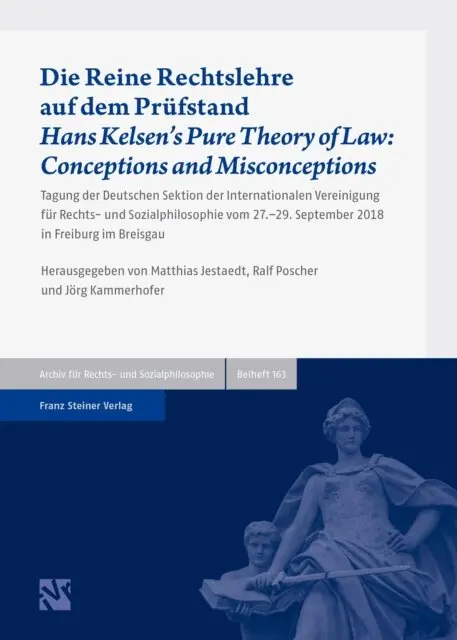
Hans Kelsens Reine Rechtslehre weckt die Aufmerksamkeit der Rechtswissenschaften auch noch nach einem Jahrhundert - in Zuspruch wie in Widerspruch. Sowohl die Aneignungs- als auch die Widerlegungsversuche sind mitunter von Missverstandnissen und Ausblendungen gepragt. Wahrend sich die Forschung recht intensiv mit bestimmten Schriften und Konzepten Kelsens auseinandersetzt, haben andere seiner Schriften, beispielsweise unubersetzte Werke, sowie die Werke weiterer wegbereitender Mitglieder der "e;Wiener rechtstheoretischen Schule"e; international wenig Beachtung gefunden. Eine Debatte um die Reine Rechtslehre in und zwischen den unterschiedlichen Kulturen und Traditionen ist daher besonders vielversprechend. Dieser Band vereint kritische, neutral-analytische und zustimmende Beitrage, die die Reine Rechtslehre aus philosophischer, rechtstheoretischer, ideengeschichtlicher und rechtsdogmatischer Perspektive durchdringen. Die Autorinnen und Autoren analysieren diesen Zugang in einem internationalen und inter- wie intradisziplinaren Rahmen; ihnen gelingt es so, die Reine Rechtslehre vorurteilsfrei und offen als Zugang sowie Forschungsfeld zu wurdigen und nach der Relevanz, die ihre Thesen heute noch beanspruchen konnen, zu fragen.
Häftad, Tyska, 2024
339 kr
Skickas inom 3-6 vardagar
Häftad, Tyska, 2025
319 kr
Skickas inom 3-6 vardagar
E-bok
Tyska, 2025285 kr
Läs direkt efter köp
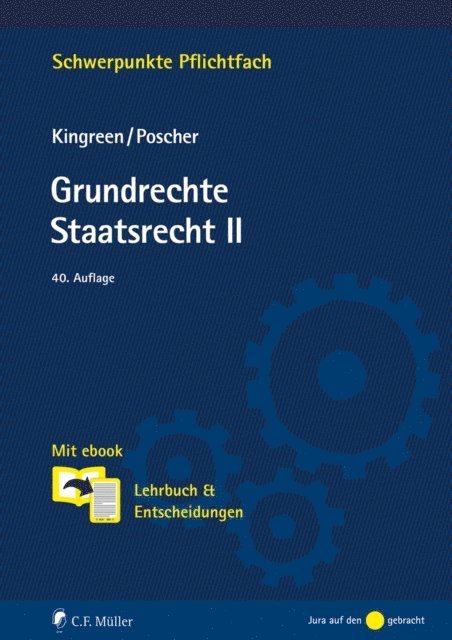
Das bewährte Konzept:In nun schon 41. Auflage lehrt der Band die Grundrechte in der Breite und Tiefe, in der sie Gegenstand der Ersten Juristischen Prüfung sind. Alle für die Falllösung in Ausbildung und Prüfung wichtigen Themen der allgemeinen Grundrechtslehren, sämtliche Grundrechte sowie die Verfassungsbeschwerde als das einschlägige Verfahrensrecht werden anhand von Fällen behandelt. Aktuelle Entwicklungen wie die wachsende Bedeutung der überstaatlichen Grundrechte und die grundrechtliche Schutzfunktion sind ebenfalls eingehend dargestellt. Im Aufbau folgen die Ausführungen sowie die Lösungen der Eingangsfälle einem einheitlichen Aufbauschema, das dem Klausurentraining dient.Das ebook enthält den vollständigen Text des Buches direkt verlinkt mit nach didaktischen Gesichtspunkten ausgewählten, für die Grundrechtsauslegung wegweisenden Entscheidungen des BVerfG. Der Leser gelangt so mit einem "Klick" aus dem Text unmittelbar zu den in dem ebook enthaltenen Urteilen.Grundrechtsrechtsprechung und -literatur wurden zudem eingehend überarbeitet und auf den Stand von Juli 2025 gebracht.
E-bok
Tyska, 2024273 kr
Läs direkt efter köp
Das bewährte Konzept:In nun schon 40. Auflage lehrt der Band die Grundrechte in der Breite und Tiefe, in der sie Gegenstand der Ersten Juristischen Prüfung sind. Alle für die Falllösung in Ausbildung und Prüfung wichtigen Themen der allgemeinen Grundrechtslehren, sämtliche Grundrechte sowie die Verfassungsbeschwerde als das einschlägige Verfahrensrecht werden anhand von Fällen behandelt. Aktuelle Entwicklungen wie die wachsende Bedeutung der überstaatlichen Grundrechte und die grundrechtliche Schutzfunktion sind ebenfalls eingehend dargestellt. Im Aufbau folgen die Ausführungen sowie die Lösungen der Eingangsfälle einem einheitlichen Aufbauschema, das dem Klausurentraining dient.Das ebook enthält den vollständigen Text des Buches direkt verlinkt mit nach didaktischen Gesichtspunkten ausgewählten, für die Grundrechtsauslegung wegweisenden Entscheidungen des BVerfG. Der Leser gelangt so mit einem "Klick" aus dem Text unmittelbar zu den in dem ebook enthaltenen Urteilen.Grundrechtsrechtsprechung und -literatur wurden zudem eingehend überarbeitet und auf den Stand von Juli 2024 gebracht.
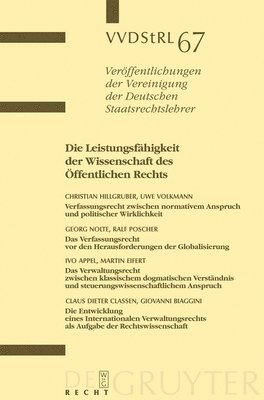
Del 67 - Veröffentlichungen Der Vereinigung Der Deutschen Staatsrecht
Leistungsfähigkeit der Wissenschaft des Öffentlichen Rechts
Inbunden, Tyska, 2008
2 515 kr
Skickas inom 5-8 vardagar
E-bok
PDF, Spanska, 2026398 kr
Läs direkt efter köp
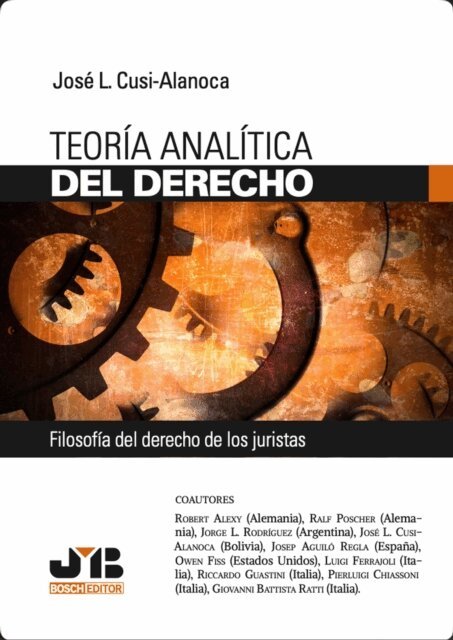
La presente obra colectiva, "Teoría Analítica del Derecho. Filosofía del derecho de los juristas", bajo mi coordinación, reúne las contribuciones de algunos de los juristas más influyentes del mundo –exceptuando, por supuesto, a mi propia persona–, quienes analizan de forma rigurosa los fundamentos del lenguaje y el razonamiento jurídico. Desde la distinción entre el lenguaje del derecho y el lenguaje sobre el derecho (Guastini), pasando por el nacimiento de la analytical jurisprudence y por el análisis del lenguaje del derecho que ofrece Cusi-Alanoca, según el cual: "Es en este sentido –según Cusi-Alanoca– que la teoría analítica del derecho revela su profundo vínculo con el positivismo jurídico, relación que explora en su recorrido histórico y conceptual. Al centrarse en el derecho positivo y en el análisis lógico-conceptual del lenguaje, la teoría analítica del Derecho ''ofrece un fundamento conceptual al positivismo jurídico'', proporcionando las herramientas metodológicas que permiten comprender el derecho desde su estructura lingüística y formal, más que desde presupuestos morales o metafísicos", este volumen reconstruye sistemáticamente los fundamentos, principios, interpretación, judicialización y el papel del juez frente a las lagunas jurídicas.A lo largo de cinco capítulos, la antología aborda la teoría formal del derecho (Ferrajoli), los límites de la lógica en los sistemas jurídicos reales (Ratti), la teoría principialista de los derechos fundamentales como normas de optimización (Alexy), la naturaleza de las presunciones entre el razonamiento práctico y la verdad procesal (Aguiló Regla), la hermenéutica y la construcción normativa de la intención legislativa (Poscher), los modelos de adjudicación y el juez como garante de la moralidad pública (Fiss), así como una tipología de las lagunas normativas y no normativas (Chiassoni). En el capítulo final, Jorge L. Rodríguez examina críticamente la justificación de las decisiones judiciales, la irrelevancia del objetivismo moral para dicha justificación y las condiciones que requiere una decisión judicial como verdaderamente justificada, junto al análisis del creacionismo judicial desde los enfoques realista y garantista (Guastini, Cusi-Alanoca).En síntesis, "Teoría Analítica del Derecho. Filosofía del derecho de los juristas" no es solo una antología o una compilación de ensayos: es una mirada sistemática que consolida el estudio del derecho como construcción racional, autónoma y dependiente del lenguaje, donde pensar desde la visión jurídica equivale a pensar con precisión sobre las formas del deber ser y del poder. Una obra imprescindible para juristas, teóricos y operadores jurídicos que buscan comprender el derecho desde su estructura lingüística y formal, y participar en la crítica y transformación del saber jurídico.José L. Cusi-Alanoca
Del 98 - Jus Publicum
Grundrechte als Abwehrrechte
Reflexive Regelung rechtlich geordneter Freiheit
Inbunden, Tyska, 2003
2 135 kr
Tillfälligt slut
Ralf Poscher entwickelt eine Theorie und Dogmatik der Grundrechte als Abwehrrechte gegen staatliche Freiheitseingriffe, die das Abwehrrecht trotz seiner konstitutionellen Ursprünge und den dunklen Seiten seiner Geschichte auch für moderne, demokratisch organisierte Gesellschaften freiheits- und staatstheoretisch anschlußfähig macht. Den Schlüssel für eine Fortentwicklung des Abwehrrechts sieht er in der Betonung seiner Reflexivität. Indem das Abwehrrecht das Staat-Bürger-Verhältnis regelt, dient es auch der staatlichen Regelung gesellschaftlicher Konflikte und durchdringt reflexiv die Rechtsbeziehung innerhalb der Gesellschaft. Das hier entfaltete Modell der Grundrechte vermag zu erklären, warum das Abwehrrecht trotz aller theoretischen Kritik weiterhin in der Praxis - auch international - die zentrale Grundrechtsfunktion ausmacht.
Häftad, Tyska, 2024
582 kr
Tillfälligt slut
Der Höhepunkt der Covid-19-Pandemie hat schonungslos offengelegt, dass man Ausnahmesituationen regeln muss, bevor sie eintreten. Vor diesem Hintergrund diskutieren in diesem Band Autorinnen und Autoren aus Rechtswissenschaft und Ethik, wie bei knappen intensivmedizinischen Ressourcen zwischen Behandlungsbedürftigen ausgewählt werden kann. Welche Auswahlkriterien sind für Triage erlaubt und angemessen, und wer soll allgemeine Regeln setzen? Für die vorliegende 2. Auflage wurde der Band um einen Beitrag zur aktuellen Rechtslage seit dem Jahr 2021 ergänzt.Aus Rezensionen zur Erstauflage"Pionierarbeit auf höchstem Niveau"Stephan Rixen MedR (2021), 679"Ein höchst informativer Band von durchgehend hohem intellektuellem Niveau, der nicht nur die Vielfalt der im Bereich der Triage-Problematik vertretbaren rechtlichen und - insbesondere - moralischen Positionen verdeutlicht ..."Ulfried Neumann Archiv für Rechts- und Sozialphilosophie (ARSP) 109 (2023), 295