Scott Frickel - Böcker
Visar alla böcker från författaren Scott Frickel. Handla med fri frakt och snabb leverans.
9 produkter
9 produkter
420 kr
Skickas inom 10-15 vardagar
In the twenty-first century, the production and use of scientific knowledge is more regulated, commercialized, and participatory than at any other time. The stakes in understanding those changes are high for scientist and nonscientist alike: they challenge traditional ideas of intellectual work and property and have the potential to remake legal and professional boundaries and transform the practice of research. A critical examination of the structures of power and inequality these changes hinge upon, this book explores the implications for human health, democratic society, and the environment.
Chemical Consequences
Environmental Mutagens, Scientist Activism, and the Rise of Genetic Toxicology
Häftad, Engelska, 2004
385 kr
Skickas inom 11-20 vardagar
Hereis the first historical and sociological account of the formation of an interdisciplinary science known as genetic toxicology, and of the scientists’ social movement that created it.After research geneticists discovered that synthetic chemicals were capable of changing the genetic structure of living organisms, scientists began to explore how these chemicals affected gene structure and function. In the late 1960s, a small group of biologists became concerned that chemical mutagens represented a serious and possibly global environmental threat.Genetic toxicology is nurtured as much by public culture as by professional practices, reflecting the interplay of genetics research and environmental politics. Drawing on a wealth of resources, Scott Frickel examines the creation of this field through the lens of social movement theory. He reveals how a committed group of scientist-activists transformed chemical mutagens into environmental problems, mobilized existing research networks, recruited scientists and politicians, secured financial resources, and developed new ways of acquiring knowledge. The result is a book that vividly illustrates how science and activism were interwoven to create a discipline that remains a defining feature of environmental health science.
Investigating Interdisciplinary Collaboration
Theory and Practice Across Disciplines
Häftad, Engelska, 2016
416 kr
Skickas inom 7-10 vardagar
Interdisciplinarity has become a buzzword in academia, as research universities funnel their financial resources toward collaborations between faculty in different disciplines. In theory, interdisciplinary collaboration breaks down artificial divisions between different departments, allowing more innovative and sophisticated research to flourish. But does it actually work this way in practice? Investigating Interdisciplinary Collaboration puts the common beliefs about such research to the test, using empirical data gathered by scholars from the United States, Canada, and Great Britain. The book’s contributors critically interrogate the assumptions underlying the fervor for interdisciplinarity. Their attentive scholarship reveals how, for all its potential benefits, interdisciplinary collaboration is neither immune to academia’s status hierarchies, nor a simple antidote to the alleged shortcomings of disciplinary study. Chapter 10 is available Open Access here (https://www.ncbi.nlm.nih.gov/books/NBK395883)
Investigating Interdisciplinary Collaboration
Theory and Practice Across Disciplines
Inbunden, Engelska, 2016
1 526 kr
Skickas inom 7-10 vardagar
Interdisciplinarity has become a buzzword in academia, as research universities funnel their financial resources toward collaborations between faculty in different disciplines. In theory, interdisciplinary collaboration breaks down artificial divisions between different departments, allowing more innovative and sophisticated research to flourish. But does it actually work this way in practice? Investigating Interdisciplinary Collaboration puts the common beliefs about such research to the test, using empirical data gathered by scholars from the United States, Canada, and Great Britain. The book’s contributors critically interrogate the assumptions underlying the fervor for interdisciplinarity. Their attentive scholarship reveals how, for all its potential benefits, interdisciplinary collaboration is neither immune to academia’s status hierarchies, nor a simple antidote to the alleged shortcomings of disciplinary study. Chapter 10 is available Open Access here (https://www.ncbi.nlm.nih.gov/books/NBK395883)
640 kr
Skickas inom 7-10 vardagar
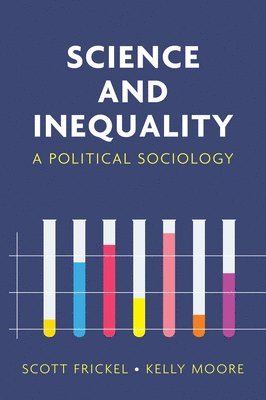
Science and technology produce a wide range of benefits in society but they also create harm, both of which are unequally distributed across social groups and geographic regions. This incisive book provides a set of analytical tools to understand how inequality relating to science and technology is produced, and how the field can be reorganized to make good on its promise to improve life for all. Using a range of evidence and examples, Frickel and Moore show that science and technology are closely bound up with social inequalities, including linked problems of poor health, environmental degradation, racism, and sexism. They use the frame of “scientific inequality formations” to investigate the technoscientific sources of unequal power relations in society, examining issues such as the underdevelopment of non-profitable technologies, how laws and markets direct scientific advances, and the exclusion of certain social groups from the creation of knowledge and solutions relevant to their lives. This timely book illuminates interventions that redirect science and technology toward more equitable ends with the potential to be more widely distributed, charting a path to a more just future.
217 kr
Skickas inom 7-10 vardagar
Science and technology produce a wide range of benefits in society but they also create harm, both of which are unequally distributed across social groups and geographic regions. This incisive book provides a set of analytical tools to understand how inequality relating to science and technology is produced, and how the field can be reorganized to make good on its promise to improve life for all. Using a range of evidence and examples, Frickel and Moore show that science and technology are closely bound up with social inequalities, including linked problems of poor health, environmental degradation, racism, and sexism. They use the frame of “scientific inequality formations” to investigate the technoscientific sources of unequal power relations in society, examining issues such as the underdevelopment of non-profitable technologies, how laws and markets direct scientific advances, and the exclusion of certain social groups from the creation of knowledge and solutions relevant to their lives. This timely book illuminates interventions that redirect science and technology toward more equitable ends with the potential to be more widely distributed, charting a path to a more just future.
Del 27 - Political Power and Social Theory
Fields of Knowledge
Science, Politics and Publics in the Neoliberal Age
Inbunden, Engelska, 2014
1 295 kr
Skickas inom 7-10 vardagar
This issue of Political Power and Social Theory explores the changes in science associated with the rise of neoliberalism since the 1970s. The neoliberalization of science has complicated interactions among states, markets, and civil society, often in ways that challenge major assumptions underlying decades of research. The articles collected here break with older Mertonian sociologies of science and constructivist microsociologies of scientific knowledge to examine the mesolevel problem of the changing institutional contexts of "the scientific field" as originally identified by Pierre Bourdieu. Papers presented in Part I extend Bourdieu's relational approach to the broader set of interactions among scientific, regulatory, industry, and social movement fields. Part II extends Bourdieu's concern with order and the scientific habitus to the changing patterns of scientific practices under neoliberalism. By reconceptualizing the central problem for the social studies of science as the political sociological problem of field and interfield dynamics, the collected papers chart an important theoretical agenda for future research in the study of sciencesociety relations.
283 kr
Skickas inom 7-10 vardagar
Winner of the 2023 Merton Award from the Science, Knowledge, and Technology section of the American Sociological Association Residues offers readers a new approach for conceptualizing the environmental impacts of chemicals production, consumption, disposal, and regulation. Environmental protection regimes tend to be highly segmented according to place, media, substance, and effect; academic scholarship often reflects this same segmented approach. Yet, in chemical substances we encounter phenomena that are at once voluminous and miniscule, singular and ubiquitous, regulated yet unruly. Inspired by recent studies of materiality and infrastructures, we introduce "residual materialism" as a framework for attending to the socio-material properties of chemicals and their world-making powers. Tracking residues through time, space, and understanding helps us see how the past has been built into our present chemical environments and future-oriented regulatory systems, why contaminants seem to always evade control, and why the Anthropocene is as inextricably harnessed to the synthesis of carbon into new molecules as it is driven by carbon's combustion.
1 570 kr
Skickas inom 7-10 vardagar
Winner of the 2023 Merton Award from the Science, Knowledge, and Technology section of the American Sociological Association Residues offers readers a new approach for conceptualizing the environmental impacts of chemicals production, consumption, disposal, and regulation. Environmental protection regimes tend to be highly segmented according to place, media, substance, and effect; academic scholarship often reflects this same segmented approach. Yet, in chemical substances we encounter phenomena that are at once voluminous and miniscule, singular and ubiquitous, regulated yet unruly. Inspired by recent studies of materiality and infrastructures, we introduce "residual materialism" as a framework for attending to the socio-material properties of chemicals and their world-making powers. Tracking residues through time, space, and understanding helps us see how the past has been built into our present chemical environments and future-oriented regulatory systems, why contaminants seem to always evade control, and why the Anthropocene is as inextricably harnessed to the synthesis of carbon into new molecules as it is driven by carbon's combustion.