Stewart J. Brown - Böcker
Visar alla böcker från författaren Stewart J. Brown. Handla med fri frakt och snabb leverans.
14 produkter
14 produkter
571 kr
Skickas inom 5-8 vardagar
W. T. Stead (1849-1912) was a newspaper editor, author, social reformer, advocate for women rights, peace campaigner, spiritualist, and one of the best-known public figures in the late Victorian and Edwardian Britain. W. T. Stead: Nonconformist and Newspaper Prophet provides a compelling religious biography of Stead, offering particular attention to his conception of journalism--in an age of growing mass literacy--as a means to communicate religious truth and morality, and his view of the editor's desk as a modern pulpit. Leading scholar, Stewart J. Brown explores how his Nonconformist Conscience and sense of divine calling infused Stead's newspaper crusades-most famously his 'Maiden Tribute' campaign against child prostitution.The biography also examines Stead's growing interest in spiritualism and the occult, as he searched for the evidence of an afterlife that might draw people in a more secular age back to faith. It discusses his imperialism and his belief in the English-speaking peoples of the British Empire and American Republic as God's new chosen people for the spread of civilisation; and it highlights how his growing understanding of other faiths and cultures--but more especially his moral revulsion over the South African War of 1899-1902--brought him to question those beliefs. Finally, it assesses the influence of religious faith on his campaigns for world peace and the arbitration of international disputes.
3 369 kr
Skickas inom 5-8 vardagar
In 1801, the United Kingdom was a semi-confessional State, and the national established Churches of England, Ireland and Scotland were vital to the constitution. They expressed the religious conscience of the State and served as guardians of the faith. Through their parish structures, they provided religious and moral instruction, and rituals for common living.This book explores the struggle to strengthen the influence of the national Churches in the first half of the nineteenth century. For many, the national Churches would help form the United Kingdom into a single Protestant nation-state, with shared beliefs, values and a sense of national mission. Between 1801 and 1825, the State invested heavily in the national Churches. But during the 1830s the growth of Catholic nationalism in Ireland and the emergence of liberalism in Britain thwarted the efforts to unify the nation around the established Churches. Within the national Churches themselves, moreover, voices began calling for independence from the State connection - leading to the Oxford Movement in England and the Disruption of the Church of Scotland.
2 106 kr
Skickas inom 5-8 vardagar
The Oxford Handbook of the Oxford Movement reflects the rich and diverse nature of scholarship on the Oxford Movement and provides pointers to further study and new lines of enquiry. Part I considers the origins and historical context of the Oxford Movement. These chapters include studies of the legacy of the seventeenth-century 'Caroline Divines' and of the nature and influence of the eighteenth and early nineteenth-century High Church movement within the Church of England. Part II focuses on the beginnings and early years of the Oxford Movement, paying particular attention to the people, the distinctive Oxford context, and the ecclesiastical controversies that inspired the birth of the Movement and its early intellectual and religious expressions. In Part III the theme shifts from early history of the Oxford Movement to its distinctive theological developments. This section analyses Tractarian views of religious knowledge and the notion of 'ethos'; the distinctive Tractarian views of tradition and development; and Tractarian ecclesiology, including ideas of the via media and the 'branch theory' of the Church. The years of crisis for the Oxford Movement between 1841 and 1845, including John Henry Newman's departure from the Church of England, are covered in Part IV. Part V then proceeds to a consideration of the broader cultural expressions and influences of the Oxford Movement. Part VI focuses on the world outside England and examines the profound impact of the Oxford Movement on Churches beyond the English heartland, as well as on the formation of a world-wide Anglicanism. In Part VII, the contributors show how the Oxford Movement remained a vital force in the twentieth century, finding expression in the Anglo-Catholic Congresses and in the Prayer Book Controversy of the 1920s within the Church of England. The Handbook draws to a close, in Part VIII, with a set of more generalised reflections on the impact of the Oxford Movement, including chapters on the judgement of the converts to Roman Catholicism over the Movement's loss of its original character, on the spiritual life and efforts of those who remained within the Anglican Church to keep Tractarian ideas alive, on the engagement of the Movement with Liberal Protestantism and Liberal Catholicism, and on the often contentious historiography of the Oxford Movement which continued to be a source of church party division as late as the centennial commemorations of the Movement in 1933. An 'Afterword' chapter assesses the continuing influence of the Oxford Movement in the world Anglican Communion today, with special references to some of the conflicts and controversies that have shaken Anglicanism since the 1960s.
535 kr
Skickas inom 3-6 vardagar
This volume, in honour of the great historian Emmet Larkin, is organized around the two themes that have shaped his work on the Catholic Church in modern Ireland—the role of the church in the creation of the modern Irish state, and the role of the church in defining a distinctive Irish national identity through the "devotional revolution". The various chapters explore different themes—political, social, ecclesiastical, and literary—but are united by their common engagement with aspects of Larkin's work on Irish culture and consciousness between the late eighteenth century and the present.
441 kr
Skickas inom 7-10 vardagar
William Robertson (1721-1793) was a leading historical figure of the eighteenth-century Enlightenment and one of the triumvirate of historians, along with David Hume and Edward Gibbon, who profoundly shaped the European consciousness. His great histories of Scotland, Europe, America and India represented a steadily expanding vision of European and world history. It was a 'grand narrative' comprising the emergence of Britain, the development of the European system of independent nation states, the growth of the European empire in the Americas, and the beginnings of the European empire in India. This book, William Robertson and the Expansion of Empire, contains contributions from a number of distinguished historians and literary scholars who explore aspects of Robertson's intellectual achievements. However, particular attention is paid to Robertson's treatment of the theme of empire and European expansion.
1 282 kr
Skickas inom 7-10 vardagar
William Robertson (1721-1793) was a leading historical figure of the eighteenth-century Enlightenment and one of the triumvirate of historians, along with David Hume and Edward Gibbon, who profoundly shaped the European consciousness. His great histories of Scotland, Europe, America and India represented a steadily expanding vision of European and world history. It was a 'grand narrative' comprising the emergence of Britain, the development of the European system of independent nation states, the growth of the European empire in the Americas, and the beginnings of the European empire in India. This book, William Robertson and the Expansion of Empire, contains contributions from a number of distinguished historians and literary scholars who explore aspects of Robertson's intellectual achievements. However, particular attention is paid to Robertson's treatment of the theme of empire and European expansion.
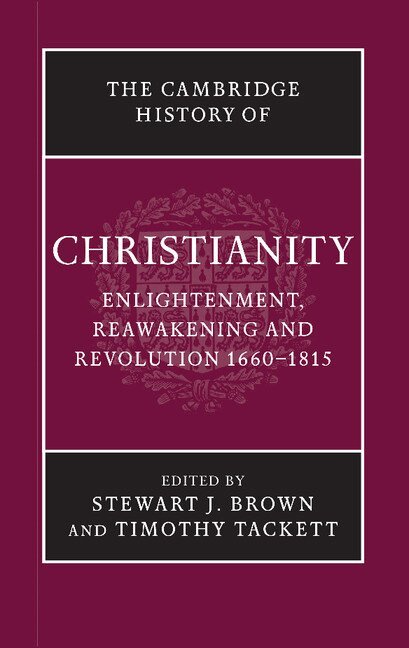
The Cambridge History of Christianity: Volume 7, Enlightenment, Reawakening and Revolution 1660-1815
Inbunden, Engelska, 2006
2 663 kr
Skickas inom 7-10 vardagar
During the tumultuous period of world history from 1660 to 1815, three complex movements combined to bring a fundamental cultural reorientation to Europe and North America, and ultimately to the wider world. The Enlightenment transformed views of nature and of the human capacity to master nature. The religious reawakenings brought a revival of heartfelt, experiential Christianity. Finally revolution, the political and social upheavals of the late eighteenth and early nineteenth centuries, challenged established ideas of divine-right monarchies and divinely ordained social hierarchies, and promoted more democratic government, notions of human rights and religious toleration. A new religious climate emerged, in which people were more likely to look to their own feelings and experiences for the basis of their faith. During this same period, Christianity spread widely around the world as a result of colonialism and missions, and responded in diverse ways to its encounters with other cultures and religious traditions.
2 648 kr
Skickas inom 5-8 vardagar
This collection of essays studies Christianity in Scotland from the 18th century to the present. Topics include varieties of unbelief, challenges to the Westminster confession, John Baillie, Queen Victoria and the Church of Scotland, the Scottish ecumenical movement, the disestablishment movement and Presbyterian-Catholic relations.
Religion, Identity and Conflict in Britain: From the Restoration to the Twentieth Century
Essays in Honour of Keith Robbins
Häftad, Engelska, 2024
596 kr
Skickas inom 10-15 vardagar
The British state between the mid-seventeenth century to the early twentieth century was essentially a Christian state. Christianity permeated society, defining the rites of passage - baptism, first communion, marriage and burial - that shaped individual lives, providing a sense of continuity between past, present and future generations, and informing social institutions and voluntary associations. Yet this religious conception of state and society was also the source of conflict. The Restoration of the monarchy in 1660 brought limited toleration for Protestant Dissenters, who felt unable to worship in the established Church, and there were challenges to faith raised by biblical and historical scholarship, science, moral questioning and social dislocations and unrest. This book brings together a distinguished team of authors who explore the interactions of religion, politics and culture that shaped and defined modern Britain. They consider expressions of civic consciousness in the expanding towns and cities, the growth of Welsh national identity, movements for popular education and temperance reform, and the influence of organised sport, popular journalism, and historical writing in defining national life. Most importantly, the contributors highlight the vital role of religious faith and religious institutions in the understanding of the modern British state.
1 245 kr
Skickas inom 7-10 vardagar
The Oxford Movement transformed the nineteenth-century Church of England with a renewed conception of itself as a spiritual body. Initiated in the early 1830s by members of the University of Oxford, it was a response to threats to the established Church posed by British Dissenters, Irish Catholics, Whig and Radical politicians, and the predominant evangelical ethos - what Newman called 'the religion of the day'. The Tractarians believed they were not simply addressing difficulties within their national Church, but recovering universal principles of the Christian faith. To what extent were their beliefs and ideals communicated globally? Was missionary activity the product of the movement's distinctive principles? Did their understanding of the Church promote, or inhibit, closer relations among the churches of the global Anglican Communion? This volume addresses these questions and more with a series of case studies involving Europe and the English-speaking world during the first century of the Movement.
563 kr
Skickas inom 7-10 vardagar
During the tumultuous period of world history from 1660 to 1815, three complex movements combined to bring a fundamental cultural reorientation to Europe and North America, and ultimately to the wider world. The Enlightenment transformed views of nature and of the human capacity to master nature. The religious reawakenings brought a revival of heartfelt, experiential Christianity. Finally revolution, the political and social upheavals of the late eighteenth and early nineteenth centuries, challenged established ideas of divine-right monarchies and divinely ordained social hierarchies, and promoted more democratic government, notions of human rights and religious toleration. A new religious climate emerged, in which people were more likely to look to their own feelings and experiences for the basis of their faith. During this same period, Christianity spread widely around the world as a result of colonialism and missions, and responded in diverse ways to its encounters with other cultures and religious traditions.
613 kr
Skickas inom 7-10 vardagar
The Oxford Movement transformed the nineteenth-century Church of England with a renewed conception of itself as a spiritual body. Initiated in the early 1830s by members of the University of Oxford, it was a response to threats to the established Church posed by British Dissenters, Irish Catholics, Whig and Radical politicians, and the predominant evangelical ethos - what Newman called 'the religion of the day'. The Tractarians believed they were not simply addressing difficulties within their national Church, but recovering universal principles of the Christian faith. To what extent were their beliefs and ideals communicated globally? Was missionary activity the product of the movement's distinctive principles? Did their understanding of the Church promote, or inhibit, closer relations among the churches of the global Anglican Communion? This volume addresses these questions and more with a series of case studies involving Europe and the English-speaking world during the first century of the Movement.
902 kr
Skickas inom 7-10 vardagar
'The Church and Empire', the theme of Studies in Church History, 54, reflects the reality that from its beginnings, the Christian Church has had close, often symbiotic, relationships with empires and imperial power. Initially the Church engaged with the Roman Empire, subsequently in Europe with the Carolingian, Anglo-Norman, Genoese, Venetian and Holy Roman Empires, and later - through the Church's global expansion with European empires in the Americas, Africa and Asia - the Spanish, Dutch, French and British empires, and the imperial structures it encountered there. Bringing together the work of twenty-four historians, this volume explores the relations of churches and empires, and Christian conceptions of empire, in the ancient, medieval, early modern and modern periods, as well as the role of empire in the global expansion of Christianity.
Religion, Identity and Conflict in Britain: From the Restoration to the Twentieth Century
Essays in Honour of Keith Robbins
Inbunden, Engelska, 2013
2 300 kr
Skickas inom 10-15 vardagar
The British state between the mid-seventeenth century to the early twentieth century was essentially a Christian state. Christianity permeated society, defining the rites of passage - baptism, first communion, marriage and burial - that shaped individual lives, providing a sense of continuity between past, present and future generations, and informing social institutions and voluntary associations. Yet this religious conception of state and society was also the source of conflict. The Restoration of the monarchy in 1660 brought limited toleration for Protestant Dissenters, who felt unable to worship in the established Church, and there were challenges to faith raised by biblical and historical scholarship, science, moral questioning and social dislocations and unrest. This book brings together a distinguished team of authors who explore the interactions of religion, politics and culture that shaped and defined modern Britain. They consider expressions of civic consciousness in the expanding towns and cities, the growth of Welsh national identity, movements for popular education and temperance reform, and the influence of organised sport, popular journalism, and historical writing in defining national life. Most importantly, the contributors highlight the vital role of religious faith and religious institutions in the understanding of the modern British state.