Teresa M. Bejan - Böcker
Visar alla böcker från författaren Teresa M. Bejan. Handla med fri frakt och snabb leverans.
4 produkter
4 produkter
1 098 kr
Kommande
The Political Thought of John Locke: New Perspectives offers the most comprehensive collective overview of Locke's political thought in over fifty years. It brings together research essays by political theorists, historians of political thought, and intellectual historians to survey Locke's political writings in their immediate historical and intellectual contexts and in the longer perspective of the history of their reception up to the present. Locke's Two Treatises of Government is now one of the most widely taught texts in the canon of political theory. Discussions of this work also provide important touchstones for methodological discussions in multiple disciplines, beginning with John Dunn's germinal monograph, The Political Thought of John Locke (1969). This volume traces the long shadow of Dunn's book, while in dialogue with other interventions since. The chapters shed fresh light not only on Locke's Two Treatises (its publication, its international dimensions, and its resistance theory, for example) but also his writings on toleration, on his relationship with contemporary theology and with Thomas Hobbes, and on his contributions to the histories of liberalism, colonialism, and post-colonial theory. Taken together, they offer a timely and much-needed opportunity for conversation among historical, critical, and theoretical approaches to Locke's thought as well as stimulating resources for scholars, teachers, and advanced students concerned with Locke's political thought and with political theory more broadly.
233 kr
Skickas inom 10-15 vardagar
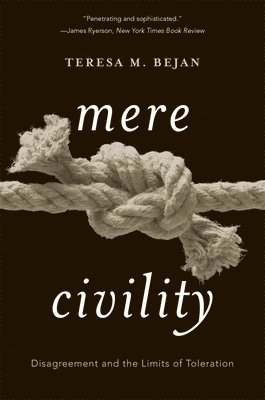
A New Statesman Best Book of the YearA Church Times Book of the YearWe are facing a crisis of civility, a war of words polluting our public sphere. In liberal democracies committed to tolerating active, often heated disagreement, the loss of this virtue appears critical. Most modern appeals to civility follow arguments by Hobbes or Locke by proposing to suppress disagreement or exclude views we deem “uncivil” for the sake of social harmony. By comparison, mere civility—a grudging conformity to norms of respectful behavior—as defended by Rhode Island’s founder, Roger Williams, might seem minimal and unappealing. Yet Teresa Bejan argues that Williams’s outlook offers a promising path forward in confronting our own crisis, one that challenges our fundamental assumptions about what a tolerant—and civil—society should look like.“Penetrating and sophisticated.”—James Ryerson, New York Times Book Review“Would that more of us might learn to look into the past with such gravity and humility. We might end up with a more (or mere) civil society, yet.”—Los Angeles Review of Books“A deeply admirable book: original, persuasive, witty, and eloquent.”—Jacob T. Levy, Review of Politics“A terrific book—learned, vigorous, and challenging.”—Alison McQueen, Stanford University
361 kr
Kommande
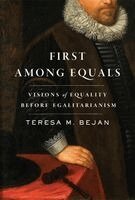
An incisive account of how equality transformed from an abstract ideal into a concrete social and political vision, thanks to seventeenth-century English dissidents like the Levellers and the political philosophers they inspired.Today, political theorists and philosophers treat as axiomatic the claim that all persons are equal. Dig deeper, however, and what we mean by equality—and what it demands from us, politically and otherwise—is far from obvious. Does it mean that we are all the same, and so the same standards should apply indifferently to everyone? Or does it mean that we are all different in ways similarly deserving of respect? These questions, and many more, reflect the profound ambiguities and contradictions that have riddled the history of the idea of equality.First Among Equals examines a radical turning point in that history. Since antiquity, influential legal and philosophical traditions have held that all humans are fundamentally equal. Yet these claims proved surprisingly at home in a world defined by social hierarchy, political exclusion, and enslavement. In seventeenth-century England, the meaning—and practical circumstances—of equality began to change. Political philosopher Teresa Bejan traces this transformation, revealing how equality finally became a concrete and actionable political ideal.Crucially, Bejan shows that influential early modern theorists of equality—chief among them Thomas Hobbes, John Locke, and the early feminist Mary Astell—were responding to the increasingly radical visions proffered by contemporary social movements like the Levellers, Diggers, and Quakers. Inspired by the Leveller leader John Lilburne, these movements insisted that equality must be a basis on which ordinary men and women could demand to stand shoulder-to-shoulder with elites. These early modern activists and philosophers can still enchant us today, Bejan argues, while also helping us to restore the power of equality as a political ideal.
145 kr
Skickas inom 5-8 vardagar
YTTRANDEFRIHET Fronesis nr 78–79 är ett fullspäckat nummer utan döda punkter. Yttrandefrihetsexperten Nils Funcke tecknar historien om yttrandefrihetens reglering i Sverige under de senaste tjugo åren – och det är ingen uppmuntrande läsning. Arbetsrättsspecialisten Friedrich Heger skriver om konflikten mellan lojalitetsplikt och kritikrätt i det privata arbetslivet. Vi publicerar den ursprungliga versionen av den skotske upplysningsfilosofen David Humes essä om tryckfriheten. Den amerikanske kulturhistorikern Robert Darnton jämför censurens sätt att fungera i Frankrike fram till 1789 och i Östtyskland fram till 1989. Tidningen Arbetets siste chefredaktör Bo Bernhardsson skriver om den avsomnade A-pressen och frågar sig hur den nuvarande ägarkoncentrationen påverkar möjligheterna till opinionsbildning. Professorn i medie- och kommunikationsvetenskap Anne Kaun diskuterar den nya digitala halvoffentligheten utifrån den tyske filosofen Jürgen Habermas nya skrift. Vidare: den ungerska historikern Andrea Petö skriver exklusivt för tidskriften om den avskaffade akademiska friheten i Ungern. Den finländska filosofen Nora Hämäläinen belyser hoten mot forskningens frihet i form av bland annat politiskt styrd finansiering och toppstyrning. Queerteoretikern Jack Halberstam uppfattar triggervarningar som ett sätt att osynliggöra marginaliserade grupper. Översättaren Johanna Hedenberg diskuterar strykning av känsliga ord i äldre texter som ett svek mot verk, författare och läsare. Den politiska filosofen Teresa M. Bejan utreder innebörden av parrhesia och isegoria i antikens Athen och knyter dem till dagens yttrandefrihetsdiskussioner. Och vi publicerar en klassisk text av den tysk-amerikanske sociologen Lewis A. Coser om den politiska eller religiösa sekten, där man inte kan säga någonting alls.