Tina Chanter - Böcker
Visar alla böcker från författaren Tina Chanter. Handla med fri frakt och snabb leverans.
16 produkter
16 produkter
322 kr
Skickas inom 7-10 vardagar
Tina Chanter resolves a fundamental problem in film theory by negotiating a middle path between "gaze theory" approaches to film and spectator studies or cultural theory approaches that emphasize the position of the viewer and thereby take account of race, class, gender, and sexuality. Chanter argues that abjection is the unthought ground of fetishistic theories. If the feminine has been the privileged excluded other of psychoanalytic theory, fueled by the myth of castration and the logic of disavowal, when fetishism is taken up by race theory, or cultural theory, the multiple and fluid registers of abjection are obscured. By mobilizing a theory of abjection, the book shows how the appeal to phallic, fetishistic theories continues to reify the hegemonic categories of race, class, sexuality, and gender, as if they stood as self-evident categories.
1 362 kr
Skickas inom 11-20 vardagar
This volume of essays, all but one previously unpublished, investigates the question of Levinas’s relationship to feminist thought. Levinas, known as the philosopher of the Other, was famously portrayed by Simone de Beauvoir as a patriarchal thinker who denigrated women by viewing them as the paradigmatic Other. Reconsideration of the validity of this interpretation of Levinas and exploration of what more positively can be derived from his thought for feminism are two of this volume’s primary aims.Levinas breaks with Heidegger’s phenomenology by understanding the ethical relation to the Other, the face-to-face, as exceeding the language of ontology. The ethical orientation of Levinas’s philosophy assumes a subject who lives in a world of enjoyment, a world that is made accessible through the dwelling. The feminine presence presides over this dwelling, and the feminine face represents the first welcome. How is this feminine face to be understood? Does it provide a model for the infinite obligation to the Other, or is it a proto-ethical relation? The essays in this volume investigate this dilemma.Contributors are Alison Ainley, Diane Brody, Catherine Chalier, Luce Irigaray, Claire Katz, Kelly Oliver, Diane Perpich, Stella Sandford, Sonya Sikka, and Ewa Ziarek.
657 kr
Skickas inom 10-15 vardagar
Ethics of Eros sheds light on contemporary feminist discourse by questioning the basic distinctions and categories in feminist theory. Tina Chanter uses the work of Luce Irigaray as the focus for a critique of French and Anglo-American feminism as it is articulated in the debate over essentialism. While these two branches of feminism represent opposing views, Chanter advocates a productive exchange between the two.
1 057 kr
Tillfälligt slut
Explores how the concept of revolution permeates and unifies Kristeva's body of work.These original essays explore how the concept of revolution permeates and unifies Julia Kristeva's body of work by tracing its trajectory from her early engagement with the Tel Quel group, through her preoccupation in the 1980s with abjection, melancholia, and love, to her latest work. Some of the leading voices in Kristeva scholarship examine her reevaluation of the concept of revolt in the context of the changing cultural and political conditions in the West; the questions of the stranger, race, and nation; her reflections on narrative, public spaces, and collectivity in the context of her engagement with Hannah Arendt's work; her development and refinement of the notions of abjection, melancholia, and narcissism in her ongoing interrogation of aesthetics; as well as her contribution to film theory. Focused primarily on Kristeva's newest work-much of it only recently translated into English-this book breaks new ground in Kristeva scholarship.
353 kr
Skickas inom 11-20 vardagar
Explores how the concept of revolution permeates and unifies Kristeva's body of work.These original essays explore how the concept of revolution permeates and unifies Julia Kristeva's body of work by tracing its trajectory from her early engagement with the Tel Quel group, through her preoccupation in the 1980s with abjection, melancholia, and love, to her latest work. Some of the leading voices in Kristeva scholarship examine her reevaluation of the concept of revolt in the context of the changing cultural and political conditions in the West; the questions of the stranger, race, and nation; her reflections on narrative, public spaces, and collectivity in the context of her engagement with Hannah Arendt's work; her development and refinement of the notions of abjection, melancholia, and narcissism in her ongoing interrogation of aesthetics; as well as her contribution to film theory. Focused primarily on Kristeva's newest work-much of it only recently translated into English-this book breaks new ground in Kristeva scholarship.
1 057 kr
Tillfälligt slut
Draws connections between the life and writings of philosopher Sarah Kofman.This groundbreaking collection sketches a portrait of Sarah Kofman (1934–1994), the brilliant French feminist philosopher and author of more than two dozen books on an impressive range of topics and figures in philosophy, literature, psychoanalysis, aesthetics, and feminism. Leading feminist philosophers examine the lessons that Kofman's rich body of work teaches us, among them that the work and life of a thinker are inextricably bound together. Each essay navigates the complex connections between work and life, thought and desire, the book and the body to explore the central themes that link together Kofman's interdisciplinary oeuvre-art, affirmation, laughter, the intolerable, Jewishness, and femininity.
347 kr
Skickas inom 7-10 vardagar
Draws connections between the life and writings of philosopher Sarah Kofman.This groundbreaking collection sketches a portrait of Sarah Kofman (1934–1994), the brilliant French feminist philosopher and author of more than two dozen books on an impressive range of topics and figures in philosophy, literature, psychoanalysis, aesthetics, and feminism. Leading feminist philosophers examine the lessons that Kofman's rich body of work teaches us, among them that the work and life of a thinker are inextricably bound together. Each essay navigates the complex connections between work and life, thought and desire, the book and the body to explore the central themes that link together Kofman's interdisciplinary oeuvre-art, affirmation, laughter, the intolerable, Jewishness, and femininity.
1 394 kr
Skickas inom 10-15 vardagar
Examining Levinas's critique of the Heideggerian conception of temporality, this book shows how the notion of the feminine both enables and prohibits the most fertile territory of Levinas's thought.According to Heidegger, the traditional notion of time, which stretches from Aristotle to Bergson, is incoherent because it rests on an inability to think together two assumptions: that the present is the most real aspect of time, and that the scientific model of time is infinite, continuous, and constituted by a series of more or less identical now-points. For Heidegger, this contradiction, which privileges the present and thinks of time as ongoing, derives from a confusion about Being. He suggests that it is not the present but the future that is the primordial ecstasis of temporality. For Heidegger, death provides an orientation for our authentic temporal understanding.Levinas agrees with Heidegger that mortality is much more significant than previous philosophers of time have acknowledged, but for Levinas, it is not my death, but the death of the other that determines our understanding of time. He is critical of Heidegger's tendency to collapse the ecstases (past, present, and future) of temporality into one another, and seeks to move away from what he sees as a totalizing view of time. Levinas wants to rehabilitate the unique character of the instant, or present, without sacrificing its internal dynamic to the onward progression of the future, and without neglecting the burdens of the past that history visits upon us.The author suggests that though Levinas's conception of subjectivity corrects some of the problems Heidegger's philosophy introduces, such as his failure to deal adequately with ethics, Levinas creates new stumbling blocks, notably the confining role he accords to the feminine. For Levinas, the feminine functions as that which facilitates but is excluded from the ethical relation that he sees as the pinnacle of philosophy. Showing that the feminine is a strategic part of Levinas's philosophy, but one that was not thought through by him, the author suggests that his failure to solidly place the feminine in his thinking is structurally consonant with his conceptual separation of politics from ethics.
322 kr
Skickas inom 7-10 vardagar
Examining Levinas's critique of the Heideggerian conception of temporality, this book shows how the notion of the feminine both enables and prohibits the most fertile territory of Levinas's thought.According to Heidegger, the traditional notion of time, which stretches from Aristotle to Bergson, is incoherent because it rests on an inability to think together two assumptions: that the present is the most real aspect of time, and that the scientific model of time is infinite, continuous, and constituted by a series of more or less identical now-points. For Heidegger, this contradiction, which privileges the present and thinks of time as ongoing, derives from a confusion about Being. He suggests that it is not the present but the future that is the primordial ecstasis of temporality. For Heidegger, death provides an orientation for our authentic temporal understanding.Levinas agrees with Heidegger that mortality is much more significant than previous philosophers of time have acknowledged, but for Levinas, it is not my death, but the death of the other that determines our understanding of time. He is critical of Heidegger's tendency to collapse the ecstases (past, present, and future) of temporality into one another, and seeks to move away from what he sees as a totalizing view of time. Levinas wants to rehabilitate the unique character of the instant, or present, without sacrificing its internal dynamic to the onward progression of the future, and without neglecting the burdens of the past that history visits upon us.The author suggests that though Levinas's conception of subjectivity corrects some of the problems Heidegger's philosophy introduces, such as his failure to deal adequately with ethics, Levinas creates new stumbling blocks, notably the confining role he accords to the feminine. For Levinas, the feminine functions as that which facilitates but is excluded from the ethical relation that he sees as the pinnacle of philosophy. Showing that the feminine is a strategic part of Levinas's philosophy, but one that was not thought through by him, the author suggests that his failure to solidly place the feminine in his thinking is structurally consonant with his conceptual separation of politics from ethics.
448 kr
Skickas inom 10-15 vardagar
Key Concepts in Philosophy is a series of concise, accessible and engaging introductions to the core ideas and subjects encountered in the study of philosophy. Specially written to meet the needs of students and those with an interest in, but little prior knowledge of, philosophy, these books open up fascinating, yet sometimes difficult ideas. The series builds to give a solid grounding in philosophy and each book is also ideal as a companion to further study. Gender: Key Concepts in Philosophy provides clear and comprehensive exposition and analysis of the main philosophical theories, ideas and arguments that inform, and are raised by, questions of gender and sexuality. It explores both early feminist arguments, which stress 'sameness' between sexes in the interests of equality, and later theories, which emphasise difference. It raises the question of how succesfully feminist theory has negotiated the relationship between gender, race and class. The text looks at how Marxist and psychoanalytic theory help to articulate feminist theory and also at how they might inhibit it.It also explores the ways in which the approaches of Foucault and Derrida have been taken up by feminist philosophy to reformulate questions of power and ideology. Finally it addresses contemporary questions of sexuality, transgender and technology, and how these require a reworking of traditional feminist theory. Philosophy undergraduates will find this an invaluable aid to study, one that goes beyond simple definitions and summaries to really open up fascinating and important ideas and arguments.
474 kr
Skickas inom 10-15 vardagar
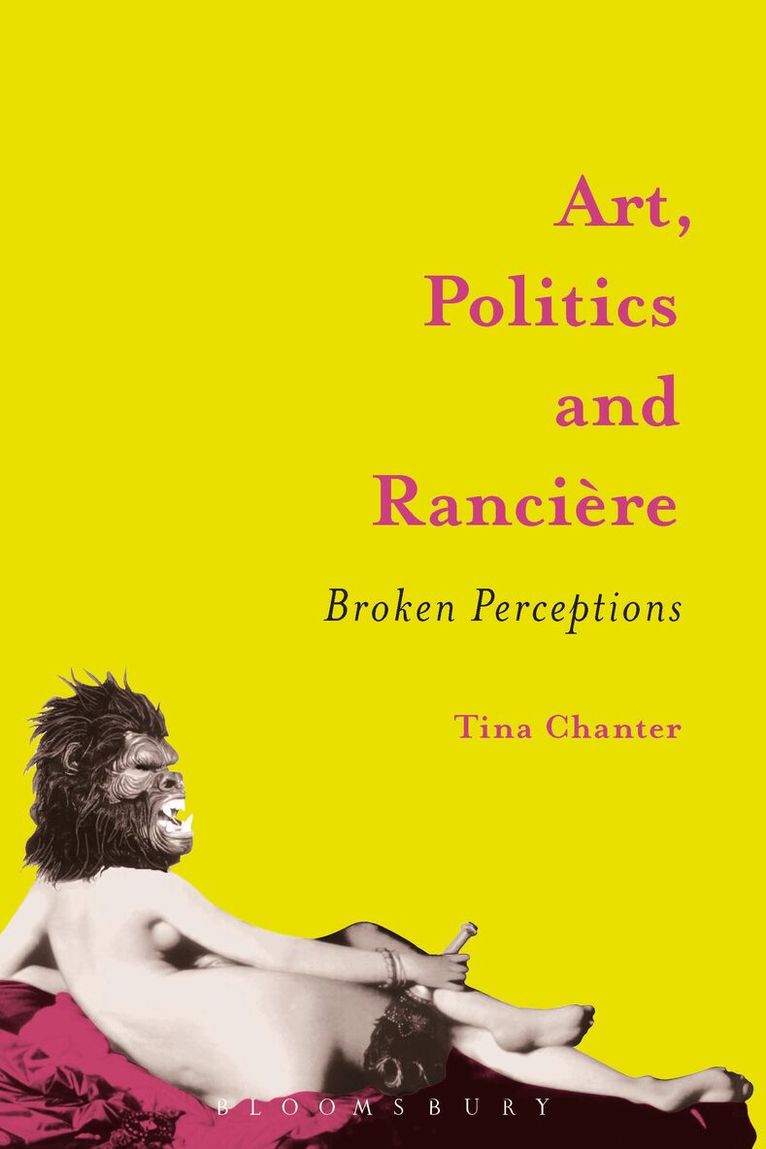
Even those who take themselves to be breaking from tradition—from the metaphysical tradition of philosophy, from grand narratives, neoliberalism or Eurocentrism—can remain blindly attached to them. Art, Politics and Rancière: Broken Perspectives provides an account of how works of art can, but do not necessarily, interrupt dominant narratives. Inspired by Jacques Rancière, Tina Chanter assumes his work as a starting point. She presents a rigorous and appreciative critique of Rancière's story of aesthetics, paying close attention to gender and race. Along with the relationship between the unconscious and the political, perception is a key theme throughout, used to address questions such as ‘How do some things become visible, while other things remain invisible?' ‘What does it take for something to be seen, and why do other things elude visibility?'Alongside illuminating discussions of Rancière, Heidegger and Levinas are informed accounts of artists Ingrid Mwangi, Phillip Noyce, Ingrid Pollard, and Gillian Wearing. Outlining the basis of a new political aesthetic, Art, Politics and Rancière develops an original philosophical consideration that is sensitive to race and gender, yet not reducible to these concerns.
440 kr
Tillfälligt slut
Argues for the importance of the neglected theme of slavery in Antigone.In this groundbreaking book, Tina Chanter challenges the philosophical and psychoanalytic reception of Sophocles' Antigone, which has largely ignored the issue of slavery. Drawing on textual and contextual evidence, including historical sources, she argues that slavery is a structuring theme of the Oedipal cycle, but one that has been written out of the record.Chanter focuses in particular on two appropriations of Antigone: The Island, set in apartheid South Africa, and Tègònni, set in nineteenth-century Nigeria. Both plays are inspired by the figure of Antigone, and yet they rework her significance in important ways that require us to return to Sophocles' "original" play and attend to some of the motifs that have been marginalized. Chanter explores the complex set of relations that define citizens as opposed to noncitizens, free men versus slaves, men versus women, and Greeks versus barbarians. Whose Antigone? moves beyond the narrow confines critics have inherited from German idealism to reinvigorate debates over the meaning and significance of Antigone, situating it within a wider argument that establishes the salience of slavery as a structuring theme.
1 215 kr
Tillfälligt slut
Argues for the importance of the neglected theme of slavery in Antigone.In this groundbreaking book, Tina Chanter challenges the philosophical and psychoanalytic reception of Sophocles' Antigone, which has largely ignored the issue of slavery. Drawing on textual and contextual evidence, including historical sources, she argues that slavery is a structuring theme of the Oedipal cycle, but one that has been written out of the record.Chanter focuses in particular on two appropriations of Antigone: The Island, set in apartheid South Africa, and Tègònni, set in nineteenth-century Nigeria. Both plays are inspired by the figure of Antigone, and yet they rework her significance in important ways that require us to return to Sophocles' "original" play and attend to some of the motifs that have been marginalized. Chanter explores the complex set of relations that define citizens as opposed to noncitizens, free men versus slaves, men versus women, and Greeks versus barbarians. Whose Antigone? moves beyond the narrow confines critics have inherited from German idealism to reinvigorate debates over the meaning and significance of Antigone, situating it within a wider argument that establishes the salience of slavery as a structuring theme.
1 135 kr
Skickas inom 11-20 vardagar
Examines Antigone's influence on contemporary European, Latin American, and African political activism, arts, and literature.Despite a venerable tradition of thinkers having declared the death of tragedy, Antigone lives on. Disguised in myriad national costumes, invited to a multiplicity of international venues, inspiring any number of political protests, Antigone transmits her energy through the ages and across the continents in an astoundingly diverse set of contexts. She continues to haunt dramatists, artists, performers, and political activists all over the world. This cutting-edge, interdisciplinary collection explores how and why, with essays ranging from philosophical, literary, and political investigations to queer theory, race theory, and artistic appropriations of the play. It also establishes an international scope for its considerations by including assessments of Latin American and African appropriations of the play alongside European receptions of the play.
463 kr
Tillfälligt slut
Examines Antigone's influence on contemporary European, Latin American, and African political activism, arts, and literature.Despite a venerable tradition of thinkers having declared the death of tragedy, Antigone lives on. Disguised in myriad national costumes, invited to a multiplicity of international venues, inspiring any number of political protests, Antigone transmits her energy through the ages and across the continents in an astoundingly diverse set of contexts. She continues to haunt dramatists, artists, performers, and political activists all over the world. This cutting-edge, interdisciplinary collection explores how and why, with essays ranging from philosophical, literary, and political investigations to queer theory, race theory, and artistic appropriations of the play. It also establishes an international scope for its considerations by including assessments of Latin American and African appropriations of the play alongside European receptions of the play.
1 703 kr
Skickas inom 10-15 vardagar
Even those who take themselves to be breaking from tradition—from the metaphysical tradition of philosophy, from grand narratives, neoliberalism or Eurocentrism—can remain blindly attached to them. Art, Politics and Rancière: Broken Perspectives provides an account of how works of art can, but do not necessarily, interrupt dominant narratives. Inspired by Jacques Rancière, Tina Chanter assumes his work as a starting point. She presents a rigorous and appreciative critique of Rancière's story of aesthetics, paying close attention to gender and race. Along with the relationship between the unconscious and the political, perception is a key theme throughout, used to address questions such as ‘How do some things become visible, while other things remain invisible?' ‘What does it take for something to be seen, and why do other things elude visibility?'Alongside illuminating discussions of Rancière, Heidegger and Levinas are informed accounts of artists Ingrid Mwangi, Phillip Noyce, Ingrid Pollard, and Gillian Wearing. Outlining the basis of a new political aesthetic, Art, Politics and Rancière develops an original philosophical consideration that is sensitive to race and gender, yet not reducible to these concerns.