Wulf Gaertner - Böcker
Visar alla böcker från författaren Wulf Gaertner. Handla med fri frakt och snabb leverans.
5 produkter
5 produkter
416 kr
Skickas inom 7-10 vardagar
Wulf Gaertner provides a comprehensive account of an important and complex issue within social choice theory: how to establish a social welfare function while restricting the spectrum of individual preferences in a sensible way. Gaertner's starting point is K. J. Arrow's famous 'Impossibility Theorem', which showed that no welfare function could exist if an unrestricted domain of preferences is to be satisfied together with some other appealing conditions. A number of leading economists have tried to provide avenues out of this 'impossibility' by restricting the variety of preferences: here, Gaertner provides a clear and detailed account, using standardized mathematical notation, of well over forty theorems associated with domain conditions. Domain Conditions in Social Choice Theory will be an essential addition to the library of social choice theory for scholars and their advanced graduate students.
1 338 kr
Skickas inom 7-10 vardagar
Wulf Gaertner provides a comprehensive account of an important and complex issue within social choice theory: how to establish a social welfare function while restricting the spectrum of individual preferences in a sensible way. Gaertner's starting point is K. J. Arrow's famous 'Impossibility Theorem', which showed that no welfare function could exist if an unrestricted domain of preferences is to be satisfied together with some other appealing conditions. A number of leading economists have tried to provide avenues out of this 'impossibility' by restricting the variety of preferences: here, Gaertner provides a clear and detailed account, using standardized mathematical notation, of well over forty theorems associated with domain conditions. Domain Conditions in Social Choice Theory will be an essential addition to the library of social choice theory for scholars and their advanced graduate students.
Empirical Social Choice
Questionnaire-Experimental Studies on Distributive Justice
Inbunden, Engelska, 2011
810 kr
Skickas inom 7-10 vardagar
Since Aristotle, many different theories of distributive justice have been proposed, by philosophers as well as social scientists. The typical approach within social choice theory is to assess these theories in an axiomatic way - most of the time the reader is confronted with abstract reasoning and logical deductions. This book shows that empirical insights are necessary if one wants to apply any theory of justice in the real world. It does so by confronting the main theories of distributive justice with data from (mostly) questionnaire experiments. The book starts with an extensive discussion on why empirical social choice makes sense and how it should be done. It then presents various experimental results relating to theories of distributive justice, including the Rawlsian equity axiom, Harsanyi's version of utilitarianism, utilitarianism with a floor, responsibility-sensitive egalitarianism, the claims problem and fairness in health.
Del 387 - Lecture Notes in Economics and Mathematical Systems
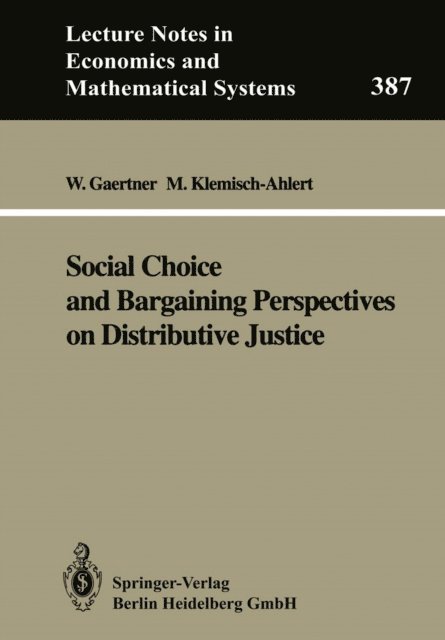
Social Choice and Bargaining Perspectives on Distributive Justice
Häftad, Engelska, 1992
519 kr
Skickas inom 10-15 vardagar
This book studies two distinct approaches to distributive justice. The first originates from axiomatic social choice theory and studies positionalist aggregation functions. Profiles of individual extended orderings over alternative social states are mapped into a social ordering of these states. The informational framework of this procedure is ordinal and requires interpersonal comparisons of utility levels. The aggregation mechanism which is proposed can be characterized as a generalized ranking rule with a nonlinear weighting scheme, allowing an equity axiom to be satisfied. The second approach is rooted in axiomatic bargaining theory and uses cardinal individual utilities which are not required to be interpersonally comparable. The second path leads to a new characterization of the Gauthier solution for n persons that can suitably be defined as a lexicographical maximin solution in relative utility gains. Again, an equity axiom proves to be useful. Both approaches are subjected to empirical investigations. In the first one, results from questionnaires are presented. In the second one, findings from laboratory experiments are discussed.
Distributive Justice and Inequality
A Selection of Papers Given at a Conference, Berlin, May 1986
Häftad, Engelska, 2011
1 061 kr
Skickas inom 10-15 vardagar
From May 20 to May 24, 1986 a conference on distributive justice and in equality was held at the Institute for Advanced Study Berlin (Wis senschaftskolleg zu Berlin). More than thirty scholars participated in this conference. The topics of the presentations ranged from ethics, welfare economics and social choice theory to characterizations of inequality meas ures and redistributive taxation schemes. This book contains a selection of the papers given at the conference. This collection of articles also appeared as issues 2 and 3 of volume 5 of Social Choice and Welfare. In the first paper P. Suppes argues for a pluralistic concept of equity. For too long the emphasis has been on income distribution but there are other characteristics which are important when one talks about equity. Suppes suggests that it would be desirable to have Lorenz curves for a variety of fea tures of societies, such as education, health and housing. P. Dasgupta studies the quality of lives in terms of an index of living stand ards. One has to distinguish between "same number choices" (the number of lives is given) and "different numbers choices" (problem of optimum popUlation). The author argues that in the latter case the anonymity (or sym metry) axiom cannot be readily defended. Once it is dropped, however, an incoherence in the moral ordering of possible worlds arises. The moral basis for different numbers choices becomes generation-dependent, an overall moral ordering of possible worlds no longer exists.