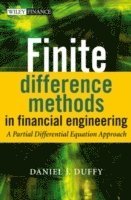
Finite Difference Methods in Financial Engineering
A Partial Differential Equation Approach
Del 312 i serien Wiley Finance Series
1 172 kr
Beställningsvara. Skickas inom 7-10 vardagar. Fri frakt över 249 kr.
Beskrivning
Produktinformation
- Utgivningsdatum:2006-03-31
- Höjd:176 x 250 x 32 mm
- Vikt:1 021 g
- Språk:Engelska
- Serie:Wiley Finance Series
- Antal sidor:448
- Förlag:John Wiley & Sons Inc
- EAN:9780470858820
Utforska kategorier
Mer om författaren
Daniel Duffy is a numerical analyst who has been working in the IT business since 1979. He has been involved in the analysis, design and implementation of systems using object-oriented, component and (more recently) intelligent agent technologies to large industrial and financial applications. As early as 1993 he was involved in C++ projects for risk management and options applications with a large Dutch bank. His main interest is in finding robust and scalable numerical schemes that approximate the partial differential equations that model financial derivatives products. He has an M.Sc. in the Finite Element Method first-order hyperbolic systems and a Ph.D. in robust finite difference methods for convection-diffusion partial differential equations. Both degrees are from Trinity College, Dublin, Ireland.Daniel Duffy is founder of Datasim Education and Datasim Component Technology, two companies involved in training, consultancy and software development.
Innehållsförteckning
- 0 Goals of this Book and Global Overview 10.1 What is this book? 10.2 Why has this book been written? 20.3 For whom is this book intended? 20.4 Why should I read this book? 20.5 The structure of this book 30.6 What this book does not cover 40.7 Contact, feedback and more information 4Part I The Continuous Theory of Partial Differential Equations 51 An Introduction to Ordinary Differential Equations 71.1 Introduction and objectives 71.2 Two-point boundary value problem 81.3 Linear boundary value problems 91.4 Initial value problems 101.5 Some special cases 101.6 Summary and conclusions 112 An Introduction to Partial Differential Equations 132.1 Introduction and objectives 132.2 Partial differential equations 132.3 Specialisations 152.4 Parabolic partial differential equations 182.5 Hyperbolic equations 202.6 Systems of equations 222.7 Equations containing integrals 232.8 Summary and conclusions 243 Second-Order Parabolic Differential Equations 253.1 Introduction and objectives 253.2 Linear parabolic equations 253.3 The continuous problem 263.4 The maximum principle for parabolic equations 283.5 A special case: one-factor generalised Black–Scholes models 293.6 Fundamental solution and the Green’s function 303.7 Integral representation of the solution of parabolic PDEs 313.8 Parabolic equations in one space dimension 333.9 Summary and conclusions 354 An Introduction to the Heat Equation in One Dimension 374.1 Introduction and objectives 374.2 Motivation and background 384.3 The heat equation and financial engineering 394.4 The separation of variables technique 404.5 Transformation techniques for the heat equation 444.6 Summary and conclusions 465 An Introduction to the Method of Characteristics 475.1 Introduction and objectives 475.2 First-order hyperbolic equations 475.3 Second-order hyperbolic equations 505.4 Applications to financial engineering 535.5 Systems of equations 555.6 Propagation of discontinuities 575.7 Summary and conclusions 59Part II Finite Difference Methods: the Fundamentals 616 An Introduction to the Finite Difference Method 636.1 Introduction and objectives 636.2 Fundamentals of numerical differentiation 636.3 Caveat: accuracy and round-off errors 656.4 Where are divided differences used in instrument pricing? 676.5 Initial value problems 676.6 Nonlinear initial value problems 726.7 Scalar initial value problems 756.8 Summary and conclusions 767 An Introduction to the Method of Lines 797.1 Introduction and objectives 797.2 Classifying semi-discretisation methods 797.3 Semi-discretisation in space using FDM 807.4 Numerical approximation of first-order systems 857.5 Summary and conclusions 898 General Theory of the Finite Difference Method 918.1 Introduction and objectives 918.2 Some fundamental concepts 918.3 Stability and the Fourier transform 948.4 The discrete Fourier transform 968.5 Stability for initial boundary value problems 998.6 Summary and conclusions 1019 Finite Difference Schemes for First-Order Partial Differential Equations 1039.1 Introduction and objectives 1039.2 Scoping the problem 1039.3 Why first-order equations are different: Essential difficulties 1059.4 A simple explicit scheme 1069.5 Some common schemes for initial value problems 1089.6 Some common schemes for initial boundary value problems 1109.7 Monotone and positive-type schemes 1109.8 Extensions, generalisations and other applications 1119.9 Summary and conclusions 11510 FDM for the One-Dimensional Convection–Diffusion Equation 11710.1 Introduction and objectives 11710.2 Approximation of derivatives on the boundaries 11810.3 Time-dependent convection–diffusion equations 12010.4 Fully discrete schemes 12010.5 Specifying initial and boundary conditions 12110.6 Semi-discretisation in space 12110.7 Semi-discretisation in time 12210.8 Summary and conclusions 12211 Exponentially Fitted Finite Difference Schemes 12311.1 Introduction and objectives 12311.2 Motivating exponential fitting 12311.3 Exponential fitting and time-dependent convection-diffusion 12811.4 Stability and convergence analysis 12911.5 Approximating the derivative of the solution 13111.6 Special limiting cases 13211.7 Summary and conclusions 132Part III Applying FDM to One-factor Instrument Pricing 13512 Exact Solutions and Explicit Finite Difference Method for One-Factor Models 13712.1 Introduction and objectives 13712.2 Exact solutions and benchmark cases 13712.3 Perturbation analysis and risk engines 13912.4 The trinomial method: Preview 13912.5 Using exponential fitting with explicit time marching 14212.6 Approximating the Greeks 14212.7 Summary and conclusions 14412.8 Appendix: the formula for Vega 14413 An Introduction to the Trinomial Method 14713.1 Introduction and objectives 14713.2 Motivating the trinomial method 14713.3 Trinomial method: Comparisons with other methods 14913.4 The trinomial method for barrier options 15113.5 Summary and conclusions 15214 Exponentially Fitted Difference Schemes for Barrier Options 15314.1 Introduction and objectives 15314.2 What are barrier options? 15314.3 Initial boundary value problems for barrier options 15414.4 Using exponential fitting for barrier options 15414.5 Time-dependent volatility 15614.6 Some other kinds of exotic options 15714.7 Comparisons with exact solutions 15914.8 Other schemes and approximations 16214.9 Extensions to the model 16214.10 Summary and conclusions 16315 Advanced Issues in Barrier and Lookback Option Modelling 16515.1 Introduction and objectives 16515.2 Kinds of boundaries and boundary conditions 16515.3 Discrete and continuous monitoring 16815.4 Continuity corrections for discrete barrier options 17115.5 Complex barrier options 17115.6 Summary and conclusions 17316 The Meshless (Meshfree) Method in Financial Engineering 17516.1 Introduction and objectives 17516.2 Motivating the meshless method 17516.3 An introduction to radial basis functions 17716.4 Semi-discretisations and convection–diffusion equations 17716.5 Applications of the one-factor Black–Scholes equation 17916.6 Advantages and disadvantages of meshless 18016.7 Summary and conclusions 18117 Extending the Black–Scholes Model: Jump Processes 18317.1 Introduction and objectives 18317.2 Jump–diffusion processes 18317.3 Partial integro-differential equations and financial applications 18617.4 Numerical solution of PIDE: Preliminaries 18717.5 Techniques for the numerical solution of PIDEs 18817.6 Implicit and explicit methods 18817.7 Implicit–explicit Runge–Kutta methods 18917.8 Using operator splitting 18917.9 Splitting and predictor–corrector methods 19017.10 Summary and conclusions 191Part IV FDM for Multidimensional Problems 19318 Finite Difference Schemes for Multidimensional Problems 19518.1 Introduction and objectives 19518.2 Elliptic equations 19518.3 Diffusion and heat equations 20218.4 Advection equation in two dimensions 20518.5 Convection–diffusion equation 20718.6 Summary and conclusions 20819 An Introduction to Alternating Direction Implicit and Splitting Methods 20919.1 Introduction and objectives 20919.2 What is ADI, really? 21019.3 Improvements on the basic ADI scheme 21219.4 ADI for first-order hyperbolic equations 21519.5 ADI classico and three-dimensional problems 21719.6 The Hopscotch method 21819.7 Boundary conditions 21919.8 Summary and conclusions 22120 Advanced Operator Splitting Methods: Fractional Steps 22320.1 Introduction and objectives 22320.2 Initial examples 22320.3 Problems with mixed derivatives 22420.4 Predictor–corrector methods (approximation correctors) 22620.5 Partial integro-differential equations 22720.6 More general results 22820.7 Summary and conclusions 22821 Modern Splitting Methods 22921.1 Introduction and objectives 22921.2 Systems of equations 22921.3 A different kind of splitting: The IMEX schemes 23221.4 Applicability of IMEX schemes to Asian option pricing 23421.5 Summary and conclusions 235Part V Applying FDM to Multi-factor Instrument Pricing 23722 Options with Stochastic Volatility: The Heston Model 23922.1 Introduction and objectives 23922.2 An introduction to Ornstein–Uhlenbeck processes 23922.3 Stochastic differential equations and the Heston model 24022.4 Boundary conditions 24122.5 Using finite difference schemes: Prologue 24322.6 A detailed example 24322.7 Summary and conclusions 24623 Finite Difference Methods for Asian Options and Other ‘Mixed’ Problems 24923.1 Introduction and objectives 24923.2 An introduction to Asian options 24923.3 My first PDE formulation 25023.4 Using operator splitting methods 25123.5 Cheyette interest models 25323.6 New developments 25423.7 Summary and conclusions 25524 Multi-Asset Options 25724.1 Introduction and objectives 25724.2 A taxonomy of multi-asset options 25724.3 Common framework for multi-asset options 26524.4 An overview of finite difference schemes for multi-asset problems 26624.5 Numerical solution of elliptic equations 26724.6 Solving multi-asset Black–Scholes equations 26924.7 Special guidelines and caveats 27024.8 Summary and conclusions 27125 Finite Difference Methods for Fixed-Income Problems 27325.1 Introduction and objectives 27325.2 An introduction to interest rate modelling 27325.3 Single-factor models 27425.4 Some specific stochastic models 27625.5 An introduction to multidimensional models 27825.6 The thorny issue of boundary conditions 28025.7 Introduction to approximate methods for interest rate models 28225.8 Summary and conclusions 283Part VI Free and Moving Boundary Value Problems 28526 Background to Free and Moving Boundary Value Problems 28726.1 Introduction and objectives 28726.2 Notation and definitions 28726.3 Some preliminary examples 28826.4 Solutions in financial engineering: A preview 29326.5 Summary and conclusions 29427 Numerical Methods for Free Boundary Value Problems: Front-Fixing Methods 29527.1 Introduction and objectives 29527.2 An introduction to front-fixing methods 29527.3 A crash course on partial derivatives 29527.4 Functions and implicit forms 29727.5 Front fixing for the heat equation 29927.6 Front fixing for general problems 30027.7 Multidimensional problems 30027.8 Front fixing and American options 30327.9 Other finite difference schemes 30527.10 Summary and conclusions 30628 Viscosity Solutions and Penalty Methods for American Option Problems 30728.1 Introduction and objectives 30728.2 Definitions and main results for parabolic problems 30728.3 An introduction to semi-linear equations and penalty method 31028.4 Implicit, explicit and semi-implicit schemes 31128.5 Multi-asset American options 31228.6 Summary and conclusions 31429 Variational Formulation of American Option Problems 31529.1 Introduction and objectives 31529.2 A short history of variational inequalities 31629.3 A first parabolic variational inequality 31629.4 Functional analysis background 31829.5 Kinds of variational inequalities 31929.6 Variational inequalities using Rothe’s methods 32329.7 American options and variational inequalities 32429.8 Summary and conclusions 324Part VII Design and Implementation in C++ 32530 Finding the Appropriate Finite Difference Schemes for your Financial Engineering Problem 32730.1 Introduction and objectives 32730.2 The financial model 32830.3 The viewpoints in the continuous model 32830.4 The viewpoints in the discrete model 33230.5 Auxiliary numerical methods 33530.6 New Developments 33630.7 Summary and conclusions 33631 Design and Implementation of First-Order Problems 33731.1 Introduction and objectives 33731.2 Software requirements 33731.3 Modular decomposition 33831.4 Useful C++ data structures 33931.5 One-factor models 33931.6 Multi-factor models 34331.7 Generalisations and applications to quantitative finance 34631.8 Summary and conclusions 34731.9 Appendix: Useful data structures in C++ 34832 Moving to Black–Scholes 35332.1 Introduction and objectives 35332.2 The PDE model 35432.3 The FDM model 35532.4 Algorithms and data structures 35532.5 The C++ model 35632.6 Test case: The two-dimensional heat equation 35732.7 Finite difference solution 35732.8 Moving to software and method implementation 35832.9 Generalisations 36132.10 Summary and conclusions 36233 C++ Class Hierarchies for One-Factor and Two-Factor Payoffs 36333.1 Introduction and objectives 36333.2 Abstract and concrete payoff classes 36433.3 Using payoff classes 36733.4 Lightweight payoff classes 36833.5 Super-lightweight payoff functions 36933.6 Payoff functions for multi-asset option problems 37133.7 Caveat: non-smooth payoff and convergence degradation 37333.8 Summary and conclusions 374Appendices 375A1 An introduction to integral and partial integro-differential equations 375A2 An introduction to the finite element method 393Bibliography 409Index 417
Mer från samma författare
Introduction to the Boost C++ Libraries; Volume I - Foundations
Robert Demming, Daniel J Duffy
686 kr
Introduction to the Boost C++ Libraries; Volume II - Advanced Libraries
Robert Demming, Daniel J Duffy
686 kr
Du kanske också är intresserad av
- Nyhet
- -30%
- Signerad!
- Nyhet