• Fri frakt över 249 kr
  • •
  • Snabba leveranser
  • •
  • Billiga böcker
Kundservice

Du är på sajten för privatpersoner.

Företag, bibliotek eller offentlig verksamhet?

Du handlar på classic.bokus.com, där alla dina funktioner finns intakta.
Till classic.bokus.com
Bokus logotyp. Gå till startsidan.
  • Erbjudanden
  • Nyheter
  • Student
  • Topplistor
  • Barn & ungdom
  • Bokus Play
  • E-böcker
  • Pocketböcker
  • Spel & pussel

10% rabatt på allt med kod NYSTART10 →

Sidfot

Mina sidor

    Hjälp

    • Kundservice
    • Vanliga frågor och svar
    • Frakt och leverans
    • Retur vid ångerrätt
    • Reklamera vara
    • Betalning
    • Köpvillkor
    • Allmänna villkor
    • Information om webbplatsens tillgänglighet

    Om Bokus

    • Om oss
    • Pressrum
    • För studenter
    • För företag
    • För bibliotek och offentlig verksamhet
    • För leverantörer
    • Hållbarhet

    Populärt

    • Aktuella erbjudanden
    • Presentkort
    • Studentlitteratur
    • Nya böcker
    • Topplistor
    • Signerade böcker
    • Engelska böcker

    Inspiration

    • Boktips
    • BookTok
    • Populära bokserier
    • Barnbokskaraktärer
    • Populära författare
    Logotyp för Bokus
    Följ oss på Facebook (extern länk)Följ oss på Instagram (extern länk)Följ oss på YouTube (extern länk)Följ oss på TikTok (extern länk)
    bokus @ CookiesAnpassa cookiesIntegritetspolicyKöpvillkor
    Till Citymail hemsida (extern länk)Till Budbee hemsida (extern länk)Till Postnord hemsida (extern länk)Till Schenker hemsida (extern länk)Till Early Bird hemsida (extern länk)Till Walleys hemsida (extern länk)
    1. Data och IT
    2. Programmeringsböcker
    3. Programvaruutveckling

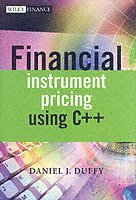
    Financial Instrument Pricing Using C++

    AvDaniel J. Duffy

    John Wiley & Sons Inc

    2004

    Del 321 i serien Wiley Finance Series

    1 671 kr

    Beställningsvara. Skickas inom 5-8 vardagar. Fri frakt över 249 kr.

    Fler format och utgåvor

    E-bok

    1 219 kr

    Inbunden

    1 059 kr

    E-bok

    1 219 kr

    E-bok

    905 kr

    E-bok

    902 kr

    Beskrivning

    One of the best languages for the development of financial engineering and instrument pricing applications is C++. This book has several features that allow developers to write robust, flexible and extensible software systems. The book is an ANSI/ISO standard, fully object-oriented and interfaces with many third-party applications. It has support for templates and generic programming, massive reusability using templates (?write once?) and support for legacy C applications. In this book, author Daniel J. Duffy brings C++ to the next level by applying it to the design and implementation of classes, libraries and applications for option and derivative pricing models. He employs modern software engineering techniques to produce industrial-strength applications: Using the Standard Template Library (STL) in financeCreating your own template classes and functionsReusable data structures for vectors, matrices and tensorsClasses for numerical analysis (numerical linear algebra ?)Solving the Black Scholes equations, exact and approximate solutionsImplementing the Finite Difference Method in C++Integration with the ?Gang of Four? Design PatternsInterfacing with Excel (output and Add-Ins)Financial engineering and XMLCash flow and yield curvesIncluded with the book is a CD containing the source code in the Datasim Financial Toolkit. You can use this to get up to speed with your C++ applications by reusing existing classes and libraries.'Unique... Let's all give a warm welcome to modern pricing tools.'-- Paul Wilmott, mathematician, author and fund manager

    Produktinformation

    • Märke:John Wiley & Sons Inc
    • Utgivningsdatum:2004-06-29
    • Höjd:175 x 252 x 33 mm
    • Vikt:998 g
    • Språk:Engelska
    • Serie:Wiley Finance Series
    • Antal sidor:432
    • Förlag:John Wiley & Sons Inc
    • EAN:9780470855096

    Utforska kategorier

    • Programvaruutveckling inom Data och IT
    • Finansiering inom Ekonomi och Ledarskap
    • Affärsapplikationer inom Data och IT

    Mer om författaren

    Daniel Duffy works for Datasim, an Amsterdam-based trainer and software developer (www.datasim-component.com, www.datasim.nl). He has been working in IT since 1979 and with object-oriented technology since 1987. He received his MSc and PhD theses (in numerical analysis) from Trinity College, Dublin. His current interests are in the modelling of financial instruments using numerical methods (for example, finite difference method) and C++. He can be contacted at dduffy@datasim.nl

    Innehållsförteckning

    • 1 Executive Overview of this Book 11.1 What is this book? 11.2 What’s special about this book? 11.3 Who is this book for? 21.4 Software requirements 31.5 The structure of this book 41.6 Pedagogical approach 51.7 What this book is not 61.8 Source code on the CD 6PART I TEMPLATE PROGRAMMING IN C++2 A Gentle Introduction to Templates in C++ 92.1 Introduction and objectives 92.2 Motivation and background 102.3 Defining a template 112.3.1 An example 132.4 Template instantiation 152.5 Function templates 162.5.1 An example 172.6 Default values and typedefs 182.7 Guidelines when implementing templates 182.8 Conclusions and summary 193 An Introduction to the Standard Template Library 203.1 Introduction and objectives 203.2 A Bird’s-eye view of STL 203.3 Sequence containers 233.4 Associative containers 273.5 Iterators in STL 303.6 Algorithms 333.7 Using STL for financial instruments 353.8 Conclusions and summary 354 STL for Financial Engineering Applications 364.1 Introduction and objectives 364.2 Clever data structures 364.3 Set theory and STL 404.4 Useful algorithms 434.5 STL adaptor containers 454.6 Conclusions and summary 465 The Property Pattern in Financial Engineering 475.1 Introduction and objectives 475.2 The Property pattern 475.3 An example 515.4 Extending the Property pattern: property sets and property lists 525.5 Properties and exotic options 575.6 Conclusions and summary 59PART II BUILDING BLOCK CLASSES6 Arrays, Vectors and Matrices 636.1 Introduction and objectives 636.2 Motivation and background 646.3 A layered approach 666.4 The Array and Matrix classes in detail 666.5 The Vector and NumericMatrix classes in detail 726.6 Associative arrays and matrices 746.7 Conclusions and summary 777 Arrays and Matrix Properties 787.1 Introduction and objectives 787.2 An overview of the functionality 787.3 Software requirements 797.4 The core processes 807.5 Other function categories 857.6 Using the functions 877.7 An introduction to exception handling 887.8 Conclusions and summary 908 Numerical Linear Algebra 918.1 Introduction and objectives 918.2 An introduction to numerical linear algebra 918.3 Tridiagonal systems 948.4 Block tridiagonal systems 998.5 What requirements should our matrix satisfy? 1018.6 Conclusions and summary 1029 Modelling Functions in C++ 1039.1 Introduction and objectives 1039.2 Function pointers in C++ 1039.3 Function objects in STL 1069.4 Some function types 1099.5 Creating your own function classes 1119.6 Arrays of functions 1149.7 Vector functions 1159.8 Real-valued functions 1159.9 Vector-valued functions 1169.10 Conclusions and summary 11610 C++ Classes for Statistical Distributions 11710.1 Introduction and objectives 11710.2 Discrete and continuous probability distribution functions 11710.3 Continuous distributions 11910.4 Discrete distributions 12410.5 Tests 12710.6 Conclusions and summary 128PART III ORDINARY AND STOCHASTIC DIFFERENTIAL EQUATIONS11 Numerical Solution of Initial Value Problems: Fundamentals 13111.1 Introduction and objectives 13111.2 A model problem 13211.3 Discretisation 13311.4 Common schemes 13411.5 Some theoretical issues 13611.6 Fitting: Special schemes for difficult problems 13711.7 Non-linear scalar problems and predictor–corrector methods 13811.8 Extrapolation techniques 13911.9 C++ design and implementation 14011.10 Generalisations 14311.11 Conclusions and summary 14412 Stochastic Processes and Stochastic Differential Equations 14512.1 Introduction and objectives 14512.2 Random variables and random processes 14512.3 An introduction to stochastic differential equations 15112.4 Some finite difference schemes 15212.5 Which scheme to use? 15312.6 Systems of SDEs 15412.7 Conclusions and summary 15413 Two-Point Boundary Value Problems 15513.1 Introduction and objectives 15513.2 Description of problem 15513.3 (Traditional) centred-difference schemes 15713.4 Approximation of the boundary conditions 15813.5 Exponentially fitted schemes and convection–diffusion 16013.6 Approximating the derivatives 16013.7 Design issues 16113.8 Conclusions and summary 16314 Matrix Iterative Methods 16414.1 Introduction and objectives 16414.2 Iterative methods 16514.3 The Jacobi method 16514.4 Gauss–Seidel method 16614.5 Successive overrelaxation (SOR) 16614.6 Other methods 16614.7 The linear complementarity problem 16814.8 Implementation 16914.9 Conclusions and summary 171PART IV PROGRAMMING THE BLACK–SCHOLES ENVIRONMENT15 An Overview of Computational Finance 17515.1 Introduction and objectives 17515.2 The development life cycle 17515.3 Partial differential equations 17615.4 Numerical approximation of PDEs 17715.5 The class of finite difference schemes 17915.6 Special schemes for special problems 17915.7 Implementation issues and the choice of programming language 18015.8 Origins and application areas 18015.9 Conclusions and summary 18116 Finite Difference Schemes for Black–Scholes 18216.1 Introduction and objectives 18216.2 Model problem: The one-dimensional heat equation 18216.3 The Black–Scholes equation 18616.4 Initial conditions and exotic options payoffs 18716.5 Implementation 19016.6 Method of lines: A whirlwind introduction 19016.7 Conclusions and summary 19117 Implicit Finite Difference Schemes for Black–Scholes 19217.1 Introduction and objectives 19217.2 Fully implicit method 19317.3 An introduction to the Crank–Nicolson method 19417.4 A critique of Crank–Nicolson 19517.5 Is there hope? the Keller scheme 19917.6 Conclusions and summary 20218 Special Schemes for Plain and Exotic Options 20318.1 Introduction and objectives 20318.2 Motivating exponentially fitted schemes 20318.3 Exponentially fitted schemes for parabolic problems 20518.4 What happens when the volatility goes to zero? 20818.5 Exponential fitting with explicit time 20918.6 Exponential fitting and exotic options 21018.7 Some final remarks 21119 My First Finite Difference Solver 21219.1 Introduction and objectives 21219.2 Modelling partial differential equations in C++ 21419.3 Finite difference schemes as C++ classes, Part I 21819.4 Finite difference schemes as C++ classes, Part II 21919.5 Initialisation issues 22019.6 Interfacing with Excel 22419.7 Conclusions and summary 22420 An Introduction to ADI and Splitting Schemes 22520.1 Introduction and objectives 22520.2 A model problem 22620.3 Motivation and history 22720.4 Basic ADI scheme for the heat equation 22820.4.1 Three-dimensional heat equation 22920.5 Basic splitting scheme for the heat equation 23020.6 Approximating cross-derivatives 23120.7 Handling boundary conditions 23220.8 Algorithms and design issues 23420.9 Conclusions and summary 23621 Numerical Approximation of Two-Factor Derivative Models 23721.1 Introduction and objectives 23721.2 Two-factor models in financial engineering 23721.3 Finite difference approximations 24121.4 ADI schemes for Asian options 24221.5 Splitting schemes 24321.6 Conclusions and summary 243PART V DESIGN PATTERNS22 A C++ Application for Displaying Numeric Data 24722.1 Introduction and objectives 24722.2 Input mechanisms 24822.3 Conversion and processing mechanisms 24922.4 Output and display mechanisms 25022.5 Putting it all together 25222.6 Output 25222.7 Other functionality 25222.8 Using Excel and property sets 25822.9 Extensions and the road to design patterns 25922.10 Conclusions and summary 26023 Object Creational Patterns 26123.1 Introduction and objectives 26123.2 The Singleton pattern 26323.3 The Prototype pattern 27023.4 Factory Method pattern (virtual constructor) 27223.5 Abstract Factory pattern 27523.6 Applications to financial engineering 27923.7 Conclusions and summary 27924 Object Structural Patterns 28124.1 Introduction and objectives 28124.2 Kinds of structural relationships between classes 28124.3 Whole–Part pattern 28624.4 The Composite pattern 28824.5 The Fa¸cade pattern 28924.6 The Bridge pattern 29024.7 Conclusions and summary 29525 Object Behavioural Patterns 29625.1 Introduction and objectives 29625.2 Kinds of behavioural patterns 29725.3 Iterator pattern 29825.4 The Visitor pattern 30125.5 Notification patterns 30525.6 Conclusions and summary 307PART VI DESIGN AND DEPLOYMENT ISSUES26 An Introduction to the Extensible Markup Language 31126.1 Introduction and objectives 31126.2 A short history of XML 31226.3 The XML structure 31226.4 Document Type Definition 31526.5 Extensible Stylesheet Language Transformation (XSLT) 32026.6 An application of XML: Financial products Markup Language 32426.7 Conclusions and summary 32727 Advanced XML and Programming Interface 32827.1 Introduction and objectives 32827.2 XML Schema 32827.3 Accessing XML data: The Document Object Model 33427.4 DOM and C++: The essentials 33527.5 DOM, entities and property sets 33827.6 XML structures for plain and barrier options 34227.7 Conclusions and summary 34528 Interfacing C++ and Excel 34628.1 Introduction and objectives 34628.2 Object model in Excel: An overview 34628.3 Under the bonnet: Technical details of C++ interfacing to Excel 34828.4 Implementing the core process 35128.5 Extensions 35428.6 Application areas 35528.7 Conclusions and summary 35529 Advanced Excel Interfacing 35629.1 Introduction and objectives 35629.2 Status report and new requirements 35629.3 A gentle introduction to Excel add-ins 35729.4 Automation add-in in detail 35929.5 Creating a COM add-in 36729.6 Future trends 37329.7 Conclusions and summary 37330 An Extended Application: Option Strategies and Portfolios 37430.1 Introduction and objectives 37430.2 Spreads 37430.3 Combinations: Straddles and strangles 37530.4 Designing and implementing spreads 37630.5 Delta hedging 37830.6 An example 37930.7 Tips and guidelines 381AppendicesA1 My C++ refresher 383A2 Dates and other temporal types 394References 397Index 401