ActaAth-4° - Böcker
Visar alla böcker i serien ActaAth-4°. Handla med fri frakt och snabb leverans.
7 produkter
7 produkter
624 kr
Skickas inom 5-8 vardagar
The importance of the zooarchaeological evidence as a source for ritual practices in ancient Greece is gradually becoming widely recognized. Animal bones form the only category of evidence for Greek cult which is constantly significantly increasing, and they can complement and elucidate the information provided by texts, inscriptions and images. This volume brings together sixteen contributions exploring ritual practices and animal bones from different chronological and geographical perspectives, foremost ancient Greece in the historical period, but also in the Bronze Age and as early as the Neolithic period, as well as Anatolia, France and Scandinavia, providing new empirical evidence from a number of major sanctuaries and cult-places. On a methodological level, the complexity of identifying ritual activity from the zooarchaeological evidence is a recurrent theme, as is the prominence of local variation visible in the bone material, suggesting that the written sources and iconography may offer simplified or idealized versions of the rituals actually performed. Although zooarchaeology needs to and should be integrated with other kinds of sources, the independent study of the bones in an unbiased manner is of utmost importance, as the bones can provide a different reality than that encountered in our other sources.
673 kr
Skickas inom 5-8 vardagar
This volume contains the proceedings of the conference Mycenaeans up to date: The archaeology of the north-eastern Peloponnese - current concepts and new directions, which was held 10-16 November 2010, under the auspices of the Swedish Institute at Athens. The published papers reveal the latest news in the field of Mycenaean archaeology in the Argolid and the surrounding areas. Ongoing fieldwork, as well as new interpretations of the extant archaeological material is presented and discussed in detail. The first part of the volume consists of papers dealing with new, unpublished evidence regarding many of the well-known Argive sites, including Mycenae, Tiryns, Argos, Midea, and the Nemea Valley, among others. The second part is devoted to in-depth studies on a number of major themes, such as Mycenaean architecture, administration, mortuary practices and religion.
624 kr
Skickas inom 5-8 vardagar
Johan Hedenborg (1786-1865) was a medical doctor whose curiosity gave him a wide range of interests in natural and social sciences. In 1825, he was attached to the embassy of Sweden and Norway to the Sublime Porte. After exploring the Aegean and both sides of the Red Sea for fifteen years, he settled in Rhodes with the aim of writing a history of the island. The manuscript, completed in 1857, was never published. It contains copies of 303 inscriptions on stone, 54 of them otherwise unknown, and drawings of more than 150 stamped amphora handles and tiles. All these documents are studied here.
Agios Elias of Asea, Arcadia
Inbunden, Engelska, 2021
515 kr
Skickas inom 5-8 vardagar
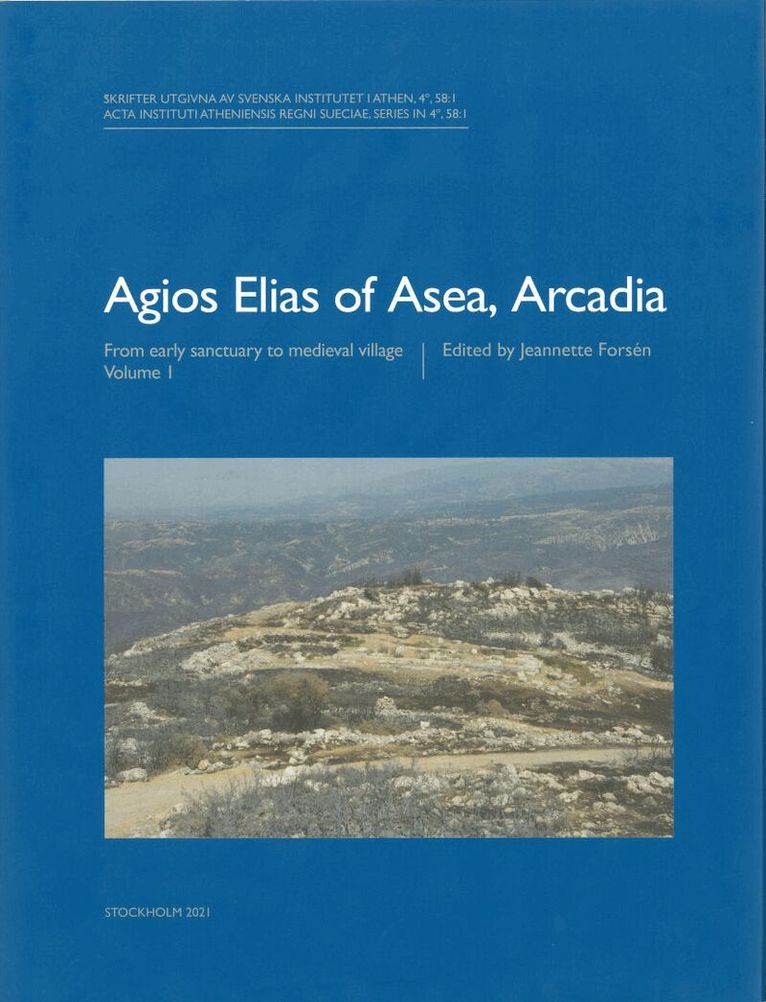
A brief four-week excavation campaign in 1997 at the temple on top of the mountain of Agios Elias at Asea produced abundant archaeological material which partly is presented in this study, along with a stratigraphic report of part of the excavated area. The pottery, miniature vessels, miscellaneous terracotta finds, roof tiles, faunal and human bones, glass, coins, sculpture and miscellaneous stone objects are included in the present work. The first focus of activities at the site took place around c. 720-690 BC (Early Protocorinthian). No architecture was found in connection with this period. However, roof tiles of a temple and some auxiliary buildings from c. 590-560 BC (Middle Corinthian-Late Corinthian I) are accompanied by a large amount of pottery which point at a second floruit of the site during this period. Some of the pottery is local/regional, with other examples originating from many parts of southern Greece in addition to Attica and possibly East Greece as well. During the 14th century AD a village, named Kandreva, and church existed where the ancient temple once stood, as indicated by numerous burials, pottery finds, and coins. Then, as during ancient times, the presence of exotic pottery indicates that, although seemingly "hidden" in the Arcadian mountains, this site was far from isolated.
752 kr
Skickas inom 5-8 vardagar
The “material turn” in the humanities and social sciences has brought about an expanded understanding of the material dimension of all cultural and social phenomena. In the Classics it has resulted in the breaking down of boundaries within the discipline and a growing interest in materiality within literature. In the study of religion cross-culturally new perspectives are emphasising religion as a material phenomenon and belief as a practice founded in the material world. This volume brings together experts in all aspects of Greek religion to consider its material dimensions. Chapters cover both themes traditionally approached by archaeologists, such as dedications and sacred space, and themes traditionally approached by philologists, such as the role of objects in divine power. They include a wide variety of themes ranging from the imminent material experience of religion for ancient Greek worshippers to the role of material culture in change and continuity over the long term. Contents Matthew Haysom, Maria Mili & Jenny Wallensten, ‘Introduction’, 7–14 Robin Osborne, ‘Stuff and godsense’, 15–24 Maria Mili, ‘Why did the Greek gods need objects?’, 25–34 Cécile Durvye, ‘Of things and men in the sanctuary of Aphrodite (Delos). Does the content of a sanctuary define the personality of the god?’, 35–45 Hedvig von Ehrenheim, ‘Incubation rituals. Creating a locality for the divine?’, 47–55 Petra Pakkanen, ‘Movable sacrality. Considerations on oscillating sacredness of material objects relating Greek sanctuaries’, 57–68 Gunnel Ekroth, ‘A room of one’s own? Exploring the temenos concept as divine property’, 69–82 Tyler Jo Smith, ‘Resistant, willing, and controlled. Sacrificial animals as “things” on Greek vases’, 83–95 Jenny Wallensten, ‘Decisive dedications. Dedications outside of sanctuary contexts’, 97–109 Caitlín E. Barrett, ‘The affordances of terracotta figurines in domestic contexts. Reconsidering the gap between material and ritual’, 111–132 Matthew Haysom, ‘Investigating the instability of religious material culture in Greek prehistory. The case of “bench shrines”’, 133–148 Catherine Morgan, ‘Adding buildings to Early Iron Age sanctuaries. The materiality of built space’, 149–166 Charlotte R. Potts, ‘An external view. Architecture and ritual in central Italy’, 167–180 Gina Salapata, ‘Ambiguity versus specificity in modest votive offerings’, 181–191 James Whitley, ‘Writing to the gods? Archaic votives, inscribed and uninscribed’, 193–213 Nassos Papalexandrou, ‘The asethetics of rare experiences in early Greek sanctuaries’, 215–223 Troels Myrup Kristensen, ‘Dephi and the omphalos. Materiality, replication and the mythistory of the Sanctuary of Apollo’, 225–234 Caroline Vout, ‘The stuff of crowded sanctuaries’, 235–246 ‘Index’, 247–248
730 kr
Skickas inom 5-8 vardagar
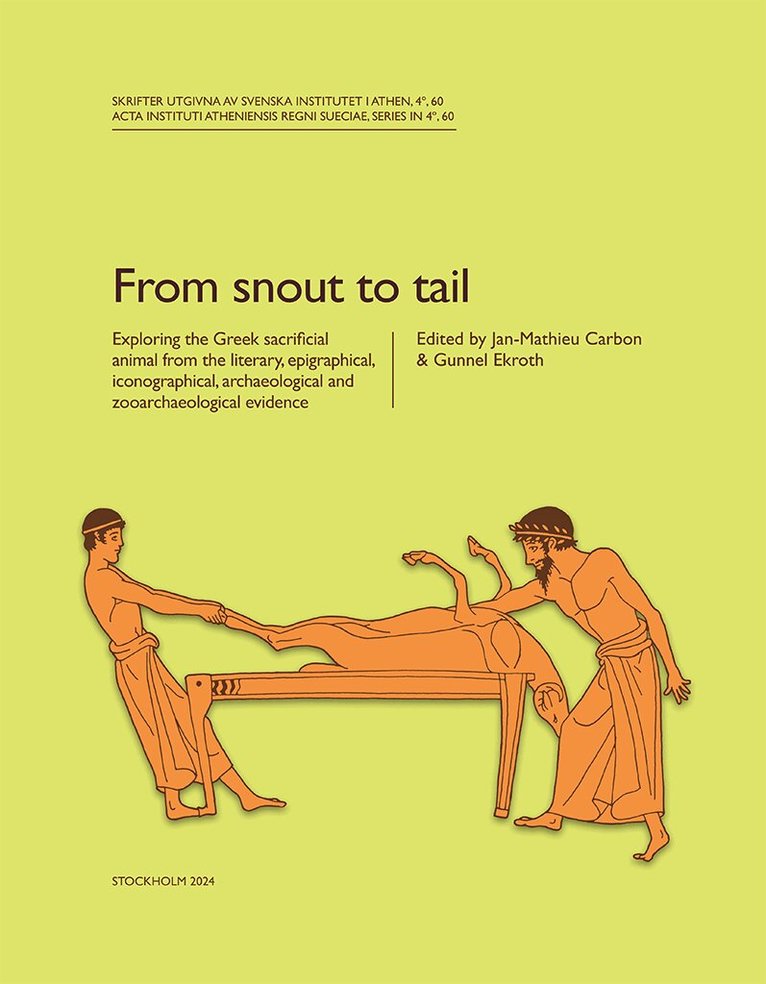
Animal sacrifice fundamentally informed how the ancient Greeks defined themselves, their relation to the divine, and the structure of their society. Adopting an explicitly cross-disciplinary perspective, the present volume explores the practical execution and complex meaning of animal sacrifice within ancient Greek religion (c. 1000 BC–AD 200). The objective is twofold. First, to clarify in detail the use and meaning of body parts of the animal within sacrificial ritual. This involves a comprehensive study of ancient Greek terminology in texts and inscriptions, representations on pottery and reliefs, and animal bones found in sanctuaries. Second, to encourage the use and integration of the full spectrum of ancient evidence in the exploration of Greek sacrificial rituals, which is a prerequisite for understanding the complex use and meaning of Greek animal sacrifice. Twelve contributions by experts on the literary, epigraphical, iconographical, archaeological and zooarchaeological evidence for Greek animal sacrifice explore the treatment of legs, including feet and hoofs, tails, horns; heads, including tongues, brains, ears and snouts; internal organs; blood; as well as the handling of the entire body by burning it whole. Three further contributions address Hittite, Israelite and Etruscan animal sacrifice respectively, providing important contextualization for Greek ritual practices. Contents ‘Preface’, 7 Jan-Mathieu Carbon & Gunnel Ekroth, ‘From snout to tail. Dividing animals and reconstructing ancient Greek sacrifice’, 9–20 Jake Morton, ‘From the butcher’s knife to god’s ears. The leg and tail in Greek sacrifice’, 21–32 Flint Dibble, ‘Beyond burned thighbones. The anatomy of ancient Greek sacrifice’, 33–54 François Lissarrague, ‘Vous trouvez sabot ? Sur la table et sous la table, un morceau peu choisi’, 55–65 Michael MacKinnon, ‘Animal heads and feet in ancient Greek ritual contexts. Their relationship between sacred and profane’, 67–91 Tyler Jo Smith, ‘Taking the bull by the horns. Animal heads in scenes of sacrifice on Greek vasess’, 93–109 Vasiliki Zachari, ‘Bucrane stylisé. Au-delà de l’ornementalité’, 111–132 Stella Georgoudi, ‘Heads, tongues and the rest. The kephale and its parts in the sacrificial practices’, 133–150 Bartek Bednarek, ‘Μέχρι σπλάγχνων. When is that?’, 151–164 Vinciane Pirenne-Delforge, ‘The viscera (splanchna) and the “Greek way” of sacrificing’, 165–178 Jennifer Larson, ‘Blood and ritual killing: Exploring intuitive models’, 179–192 Gunnel Ekroth, ‘To burn it all? The practice of holocausts and moirocausts in ancient Greek religion’, 193–206 Alice Mouton, ‘Burnt animals for the Hittite gods. Cremation as a type of animal sacrifice in Hittite Anatolia’, 207–217 Jonathan S. Greer, ‘From flock to temple to table. The sacrificial animal of the fellowship offering in Ancient Israel in text and archaeology’, 219–231 Katie A. Rask, ‘Animal sacrifice in parts. Theorizing bodily division in Greek and Etruscan ritual killing’, 233–254 ‘Indices’, 255–270
469 kr
Skickas inom 5-8 vardagar
The date of the destruction of the palace at Knossos on Crete has been one of the key problems of Aegean prehistory since the palace was excavated at the beginning of the 20th century. The excavator Arthur Evans argued for an LM II date as he presumed that the inscribed tablets found in the palace destruction layers must have been written by the people who had produced the large and richly adorned Palace Style jars which he dated to the LM II period. After his death Evans’ date has been questioned, keenly debated and finally lowered to early LM IIIA:2. Nobody, however, has studied the amount and distribution of the latest pottery of LM IIIB date found in the palace, its connection to the inscribed tablets and its presence in the surrounding houses, town and cemeteries. The LM IIIB pottery in Knossos is here scrutinized through the Day and Note Books of the excavation, the original excavation reports in the Annual of the British School at Athens and the published sherds and complete vases. Finally the close connections between the two largest LM IIIB towns, Knossos and Kydonia—currently the only ones in Crete with Linear B tablets—are highlighted. Contents Preface, pp. 7–8. The Knossian controversy, pp. 9–10. Introduction, pp. 11–13. The LM IIIB evidence from the palace, pp. 15–71. The LM IIIB pottery from the palace, pp. 73–91. The LM IIIB evidence from the houses surrounding the palace, pp. 93–126. The LM IIIB evidence from the tombs, pp. 127–157. The Knossos–Kydonia relations, pp. 159–168. Conclusions, pp. 169–173. References, pp. 175–184.