Law, Society, and Culture in China – serie
Visar alla böcker i serien Law, Society, and Culture in China. Handla med fri frakt och snabb leverans.
10 produkter
10 produkter
1 528 kr
Skickas inom 7-10 vardagar
To what extent do newly available case records bear out our conventional assumptions about the Qing legal system? Is it true, for example, that Qing courts rarely handled civil lawsuits—those concerned with disputes over land, debt, marriage, and inheritance—as official Qing representations led us to believe? Is it true that decent people did not use the courts? And is it true that magistrates generally relied more on moral predilections than on codified law in dealing with cases? Based in large part on records of 628 civil dispute cases from three counties from the 1760's to the 1900's, this book reexamines those widely accepted Qing representations in the light of actual practice.The Qing state would have had us believe that civil disputes were so "minor" or "trivial" that they were left largely to local residents themselves to resolve. However, case records show that such disputes actually made up a major part of the caseloads of local courts. The Qing state held that lawsuits were the result of actions of immoral men, but ethnographic information and case records reveal that when community/kin mediation failed, many common peasants resorted to the courts to assert and protect their legitimate claims. The Qing state would have had us believe that local magistrates, when they did deal with civil disputes, did so as mediators rather than judges. Actual records reveal that magistrates almost never engaged in mediation but generally adjudicated according to stipulations in the Qing code.
880 kr
Skickas inom 7-10 vardagar
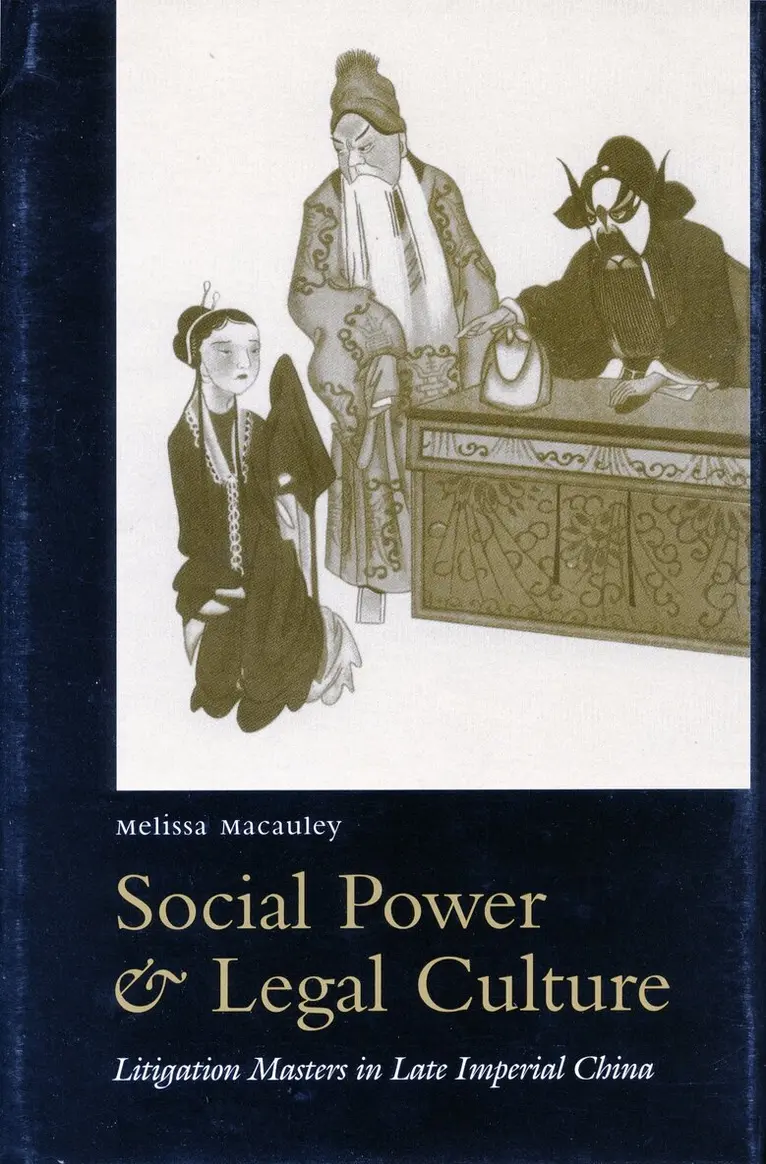
Asserting that litigation in late imperial China was a form of documentary warfare, this book offers a social analysis of the men who composed legal documents for commoners and elites alike. Litigation masters—a broad category of legal facilitators ranging from professional plaintmasters to simple but literate men to whom people turned for assistance—emerge in this study as central players in many of the most scandalous cases in eighteenth- and nineteenth-century China. These cases reveal the power of scandal to shape entire categories of law in the popular and official imaginations.The author characterizes litigation masters as entrepreneurs of power, intermediaries who typically emerge in the process of limited state expansion to provide links between local interests and the infrastructure of the state. These powermongers routinely acted in the interests of the local elite and the male lineage. But cases preserved in criminal archives also reveal a clientele surprisingly composed of the subordinate actors in legal disputes—widows fighting in-laws and other men, debtors contesting creditors, younger brothers disputing older ones, and common people charging the rich. Challenging earlier scholarship claiming that the Chinese legal system simply maintained the hegemony of elites and the patriarchal order, this study shows how the legal tools of domination were often transformed into weapons of social resistance and revenge.The book also examines the manifold ways in which legal practice, Confucian ideology, and popular entertainments like opera and storytelling coalesced into Chinese legal culture. Popular traditions in particular did not simply reflect legal culture but actively influenced it, shaping common presumptions about law that transcended differences of class and region. Exploring Chinese legal culture in the structural contexts of commercialization, changes in property transactions, and ineradicable litigation backlogs, the author explains why litigation was condemned by all classes of Chinese men and women even as all classes litigated.
374 kr
Skickas inom 7-10 vardagar
To what extent do newly available case records bear out our conventional assumptions about the Qing legal system? Is it true, for example, that Qing courts rarely handled civil lawsuits—those concerned with disputes over land, debt, marriage, and inheritance—as official Qing representations led us to believe? Is it true that decent people did not use the courts? And is it true that magistrates generally relied more on moral predilections than on codified law in dealing with cases? Based in large part on records of 628 civil dispute cases from three counties from the 1760's to the 1900's, this book reexamines those widely accepted Qing representations in the light of actual practice.The Qing state would have had us believe that civil disputes were so "minor" or "trivial" that they were left largely to local residents themselves to resolve. However, case records show that such disputes actually made up a major part of the caseloads of local courts. The Qing state held that lawsuits were the result of actions of immoral men, but ethnographic information and case records reveal that when community/kin mediation failed, many common peasants resorted to the courts to assert and protect their legitimate claims. The Qing state would have had us believe that local magistrates, when they did deal with civil disputes, did so as mediators rather than judges. Actual records reveal that magistrates almost never engaged in mediation but generally adjudicated according to stipulations in the Qing code.
1 310 kr
Skickas inom 7-10 vardagar
Previous scholarship has presented a static picture of property inheritance in China, mainly because it has focused primarily on men, whose rights changed little throughout the Imperial and Republican periods. However, when our focus shifts to women, a very different and dynamic picture emerges.Drawing on newly available archival case records, this book demonstrates that women's rights to property changed substantially from the Song through the Qing dynasties, and even more dramatically under the Republican Civil Code of 1929-30. The consolidation in law of patrilineal succession in the Ming and Qing dynasties curtailed women's claims, but the adoption of the Civil Code and the gradual dismantling of patrilineal succession in the twentieth century greatly strengthened women's rights to inherit property.Through an examination of the changes in women's claims, the author argues that we can discern larger changes in property rights in general. Previous scholarship assumed that patrilineal succession and household division were but different sides of the same coin—sons divided their father's property equally as his patrilineal heirs. The focus on women, however, reveals that patrilineal succession and household division were, in fact, two separate processual and conceptual complexes with their own distinct histories. While household division changed little, patrilineal succession changed greatly. Imperial and Republican laws of inheritance, finally, were based on two radically different property logics, the full implications of which cannot be truly appreciated unless the two are examined in tandem.
324 kr
Skickas inom 10-15 vardagar
Previous scholarship has presented a static picture of property inheritance in China, mainly because it has focused primarily on men, whose rights changed little throughout the Imperial and Republican periods. However, when our focus shifts to women, a very different and dynamic picture emerges.Drawing on newly available archival case records, this book demonstrates that women's rights to property changed substantially from the Song through the Qing dynasties, and even more dramatically under the Republican Civil Code of 1929-30. The consolidation in law of patrilineal succession in the Ming and Qing dynasties curtailed women's claims, but the adoption of the Civil Code and the gradual dismantling of patrilineal succession in the twentieth century greatly strengthened women's rights to inherit property.Through an examination of the changes in women's claims, the author argues that we can discern larger changes in property rights in general. Previous scholarship assumed that patrilineal succession and household division were but different sides of the same coin—sons divided their father's property equally as his patrilineal heirs. The focus on women, however, reveals that patrilineal succession and household division were, in fact, two separate processual and conceptual complexes with their own distinct histories. While household division changed little, patrilineal succession changed greatly. Imperial and Republican laws of inheritance, finally, were based on two radically different property logics, the full implications of which cannot be truly appreciated unless the two are examined in tandem.
822 kr
Skickas inom 7-10 vardagar
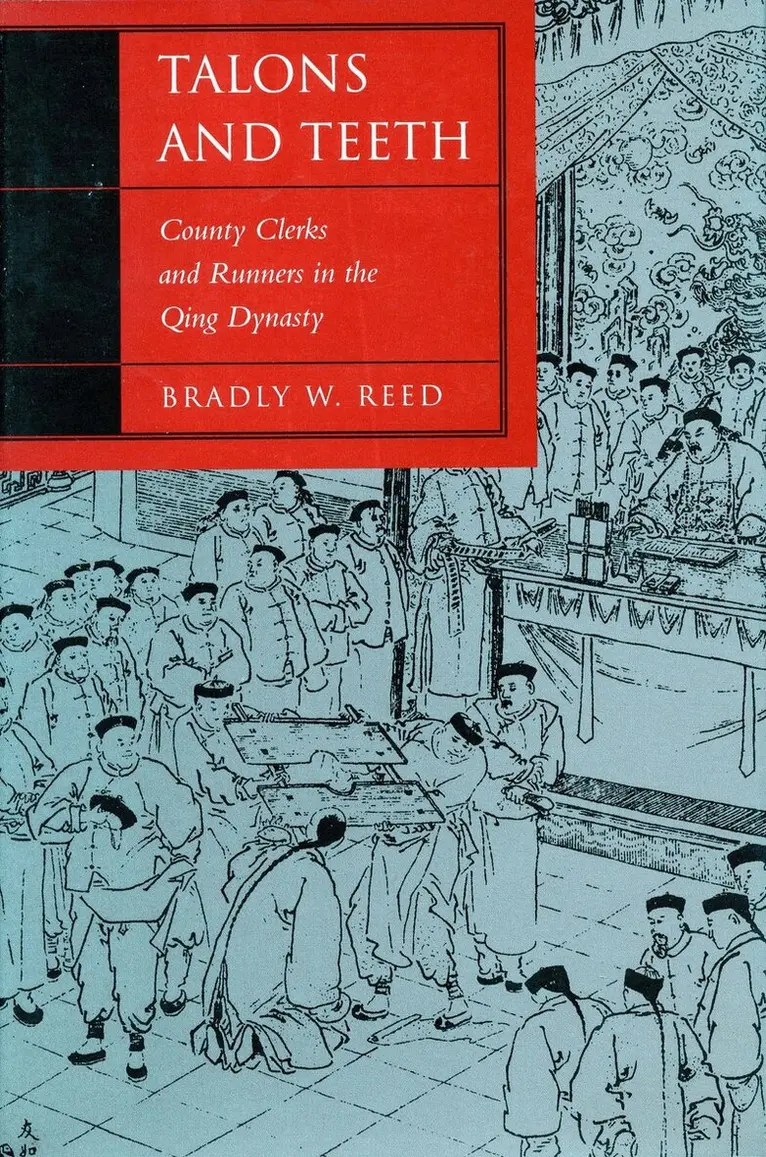
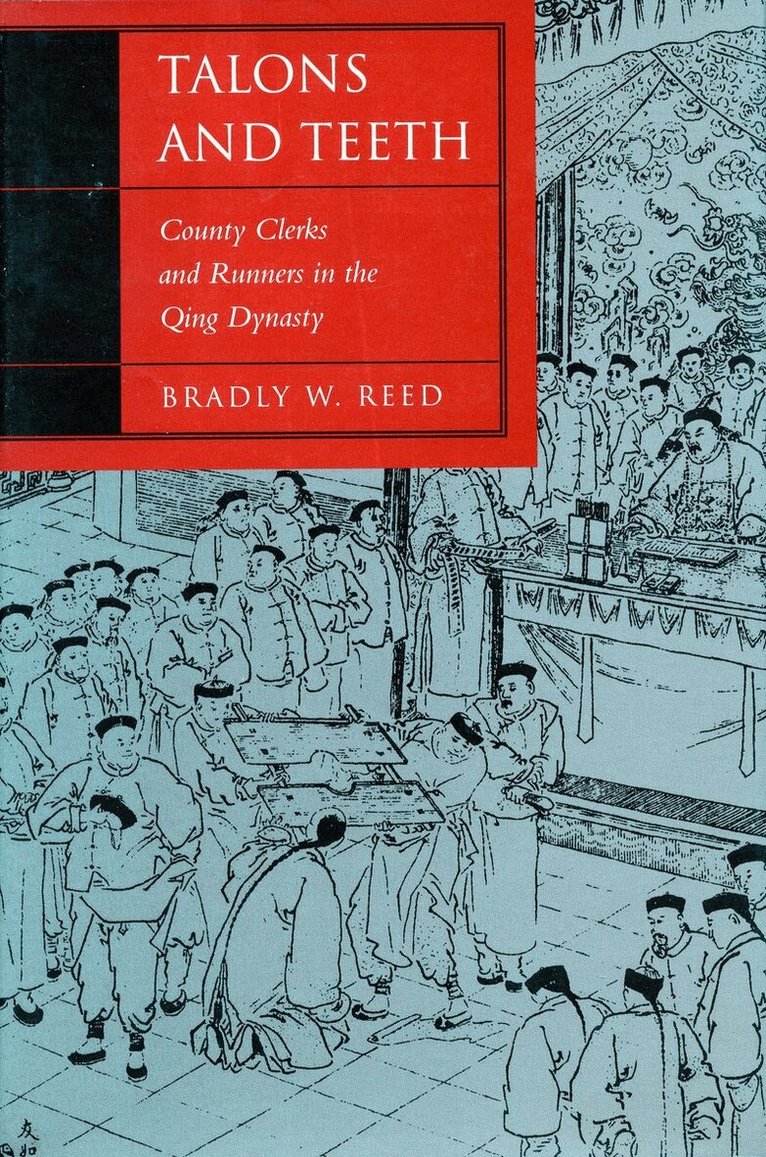
For commoners in the Qing dynasty, the most salient agents of the imperial state were not the emperor's appointed officials but rather the clerks and runners of the county yamen, the lowest level of functionaries in the Qing state's administrative hierarchy. Yet until now we have known very little about these critically important persons beyond the caricatured portrayals of corruption and venality left by Qing high officials and elites.Drawing from the rich archival records of Ba county, Sichuan, the author challenges the simplicity of these portrayals by taking us inside the county yamen to provide the first detailed look at local administrative practice from the perspective of those who actually carried it out. Who were the county clerks and runners? How were they recruited, organized, disciplined, and rewarded? What was the economic basis for a career in the yamen? How did clerks and runners view themselves as well as legitimize their role in Qing government? And what impact did their interests and practices have on symbolically laden elements of imperial government such as the magistrate's court?In addressing these questions, the author traverses the disjuncture between statutory regulations and the realities of daily administrative practice, uncovering a realm of informal, semiautonomous, yet highly structured and even rationalized procedures. Although frequently in violation of formal law, this extra-statutory system nevertheless remained an irreducible component of local government under the Qing. Recognizing the centrality of such informal practice to yamen administration forces us to rethink not only traditional assumptions concerning local corruption in the Qing, but also the ways in which we conceptualize the boundaries between state and society in late imperial China.
428 kr
Skickas inom 7-10 vardagar
This pioneering volume shows that contrary to previous scholarly understanding, the courts in Qing (1644-1911) and Republican (1911-1949) China dealt extensively with civil matters such as land rights, debt, marriage, and inheritance; and, moreover, did so in a consistent and predictable way. Drawing on records of hundreds of cases from local archives in several parts of China, it considers such questions as the relation between codified law and legal practice, the role of legal and paralegal personnel, and the continuity in civil law between Qing and Republican China.
1 549 kr
Skickas inom 10-15 vardagar
Drawing on archival records of actual cases, this study provides a new understanding of late imperial and Republican Chinese law. It also casts a new light on Chinese law by emphasizing rural areas and by comparing the old and the new.The book asks the question: What changes occurred and what remained the same in Chinese civil justice from the Qing to the Republic? Civil justice is here interpreted to mean not only codified law but also actual legal practice. Since the consequences of court actions frequently differed from the code's intent, this book also addresses the question of how legal practice mediated between code and custom. It aims to track the developing history of the legal system and to discover what it meant in the lives of the Chinese people.Part One covers the revising of the Qing code and the drafting of new codes, especially the Civil Code of 1929-30, the major institutional changes that preceded the promulgation of new laws, and the organizing principles of those laws. Part Two, the main body of the text, uses case records from both the Qing and the Republic to examine certain topics that engendered frequent litigation: conditional sales of land, topsoil ownership, debt, old-age support, and women's choices in marriage, divorce, and illicit sex.The book demonstrates the contrasting logics of Qing and Republican law: of privileges granted by the absolutist ruler versus rights independent of the will of the ruler, of a survival ethic versus a capitalist one, of patrifamilial property versus individual property, of reciprocal parent-child support versus unidirectional support, and of partial and limited choice for women versus independent agency. The book shows, however, that in actual practice the new legal systems made many accommodations to traditional customs, thus making major concessions to social realities while still holding to radically different principles.The author demonstrates the inadequacies of a simple contrast between the Chinese legal tradition and modernity, or between China and the West. He argues instead for paying attention to the local knowledge of modernization and to the logics not only of the codes but also of customs and court actions. He shows, finally, the importance of both systemic structure and individual choice for this social and cultural study of Chinese law.
374 kr
Skickas inom 7-10 vardagar
Drawing on archival records of actual cases, this study provides a new understanding of late imperial and Republican Chinese law. It also casts a new light on Chinese law by emphasizing rural areas and by comparing the old and the new.The book asks the question: What changes occurred and what remained the same in Chinese civil justice from the Qing to the Republic? Civil justice is here interpreted to mean not only codified law but also actual legal practice. Since the consequences of court actions frequently differed from the code's intent, this book also addresses the question of how legal practice mediated between code and custom. It aims to track the developing history of the legal system and to discover what it meant in the lives of the Chinese people.Part One covers the revising of the Qing code and the drafting of new codes, especially the Civil Code of 1929-30, the major institutional changes that preceded the promulgation of new laws, and the organizing principles of those laws. Part Two, the main body of the text, uses case records from both the Qing and the Republic to examine certain topics that engendered frequent litigation: conditional sales of land, topsoil ownership, debt, old-age support, and women's choices in marriage, divorce, and illicit sex.The book demonstrates the contrasting logics of Qing and Republican law: of privileges granted by the absolutist ruler versus rights independent of the will of the ruler, of a survival ethic versus a capitalist one, of patrifamilial property versus individual property, of reciprocal parent-child support versus unidirectional support, and of partial and limited choice for women versus independent agency. The book shows, however, that in actual practice the new legal systems made many accommodations to traditional customs, thus making major concessions to social realities while still holding to radically different principles.The author demonstrates the inadequacies of a simple contrast between the Chinese legal tradition and modernity, or between China and the West. He argues instead for paying attention to the local knowledge of modernization and to the logics not only of the codes but also of customs and court actions. He shows, finally, the importance of both systemic structure and individual choice for this social and cultural study of Chinese law.
338 kr
Skickas inom 10-15 vardagar
This study of the regulation of sexuality in the Qing dynasty explores the social context for sexual behavior criminalized by the state, arguing that the eighteenth century in China was a time of profound change in sexual matters. During this time, the basic organizing principle for state regulation of sexuality shifted away from status, under which members of different groups had long been held to distinct standards of familial and sexual morality. In its place, a new regime of gender mandated a uniform standard of sexual morality and criminal liability across status boundaries—all people were expected to conform to gender roles defined in terms of marriage.This shift in the regulation of sexuality, manifested in official treatment of charges of adultery, rape, sodomy, widow chastity, and prostitution, represented the imperial state's efforts to cope with disturbing social and demographic changes. Anachronistic status categories were discarded to accommodate a more fluid social structure, and the state initiated new efforts to enforce rigid gender roles and thus to shore up the peasant family against a swelling underclass of single, rogue males outside the family system. These men were demonized as sexual predators who threatened the chaste wives and daughters (and the young sons) of respectable households, and a flood of new legislation targeted them for suppression.In addition to presenting official and judicial actions regarding sexuality, the book tells the story of people excluded from accepted patterns of marriage and household who bonded with each other in unorthodox ways (combining sexual union with resource pooling and fictive kinship) to satisfy a range of human needs. This previously invisible dimension of Qing social practice is brought into sharp focus by the testimony, gleaned from local and central court archives, of such marginalized people as peasants, laborers, and beggars.