Kathryn Bernhardt – författare
Visar alla böcker från författaren Kathryn Bernhardt. Handla med fri frakt och snabb leverans.
6 produkter
6 produkter
1 000 kr
Skickas inom 10-15 vardagar
A Stanford University Press classic.
1 313 kr
Skickas inom 5-8 vardagar
Previous scholarship has presented a static picture of property inheritance in China, mainly because it has focused primarily on men, whose rights changed little throughout the Imperial and Republican periods. However, when our focus shifts to women, a very different and dynamic picture emerges.Drawing on newly available archival case records, this book demonstrates that women's rights to property changed substantially from the Song through the Qing dynasties, and even more dramatically under the Republican Civil Code of 1929-30. The consolidation in law of patrilineal succession in the Ming and Qing dynasties curtailed women's claims, but the adoption of the Civil Code and the gradual dismantling of patrilineal succession in the twentieth century greatly strengthened women's rights to inherit property.Through an examination of the changes in women's claims, the author argues that we can discern larger changes in property rights in general. Previous scholarship assumed that patrilineal succession and household division were but different sides of the same coin—sons divided their father's property equally as his patrilineal heirs. The focus on women, however, reveals that patrilineal succession and household division were, in fact, two separate processual and conceptual complexes with their own distinct histories. While household division changed little, patrilineal succession changed greatly. Imperial and Republican laws of inheritance, finally, were based on two radically different property logics, the full implications of which cannot be truly appreciated unless the two are examined in tandem.
324 kr
Skickas inom 10-15 vardagar
Previous scholarship has presented a static picture of property inheritance in China, mainly because it has focused primarily on men, whose rights changed little throughout the Imperial and Republican periods. However, when our focus shifts to women, a very different and dynamic picture emerges.Drawing on newly available archival case records, this book demonstrates that women's rights to property changed substantially from the Song through the Qing dynasties, and even more dramatically under the Republican Civil Code of 1929-30. The consolidation in law of patrilineal succession in the Ming and Qing dynasties curtailed women's claims, but the adoption of the Civil Code and the gradual dismantling of patrilineal succession in the twentieth century greatly strengthened women's rights to inherit property.Through an examination of the changes in women's claims, the author argues that we can discern larger changes in property rights in general. Previous scholarship assumed that patrilineal succession and household division were but different sides of the same coin—sons divided their father's property equally as his patrilineal heirs. The focus on women, however, reveals that patrilineal succession and household division were, in fact, two separate processual and conceptual complexes with their own distinct histories. While household division changed little, patrilineal succession changed greatly. Imperial and Republican laws of inheritance, finally, were based on two radically different property logics, the full implications of which cannot be truly appreciated unless the two are examined in tandem.
429 kr
Skickas inom 5-8 vardagar
This pioneering volume shows that contrary to previous scholarly understanding, the courts in Qing (1644-1911) and Republican (1911-1949) China dealt extensively with civil matters such as land rights, debt, marriage, and inheritance; and, moreover, did so in a consistent and predictable way. Drawing on records of hundreds of cases from local archives in several parts of China, it considers such questions as the relation between codified law and legal practice, the role of legal and paralegal personnel, and the continuity in civil law between Qing and Republican China.
Del 1 - Social Sciences of Practice
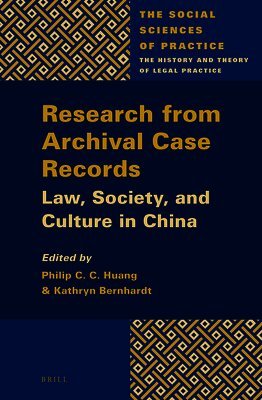
Research from Archival Case Records
Law, Society and Culture in China
Inbunden, Engelska, 2014
3 962 kr
Skickas inom 5-8 vardagar
Legal history studies have often focused mainly on codified law, without attention to actual practice, and on the past, without relating it to the present. As the title—Research from Archival Case Records: Law, Society, and Culture in China—of this book suggests, the authors deliberately follow the research method of starting from court actions and only on that basis engage in discussions of laws and legal concepts and theory. The articles cover a range of topics and source materials, both past and present. They provide some surprising findings—about disjunctures between code and practice, adjustments between them, and how those reveal operative principles and logics different from what the legal texts alone might suggest.Contributors are: Kathryn Bernhardt, Danny Hsu, Philip C. C. Huang, Christopher Isett, Yasuhiko Karasawa, Margaret Kuo, Huaiyin Li, Jennifer M. Neighbors, Bradly W. Reed, Matthew H. Sommer, Huey Bin Teng, Lisa Tran, Elizabeth VanderVen, and Chenjun You.
Del 3 - Social Sciences of Practice
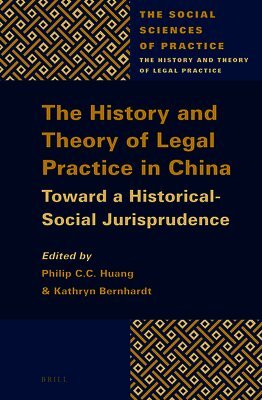
History and Theory of Legal Practice in China
Toward a Historical-Social Jurisprudence
Inbunden, Engelska, 2014
3 454 kr
Skickas inom 5-8 vardagar
The History and Theory of Legal Practice in China: Toward a Historical-Social Jurisprudence goes beyond the either/or dichotomy of Chinese vs. Western law, tradition vs. modernity, and the substantive-practical vs. the formal. It does so by proceeding not from abstract legal texts but from the realities of legal practice. Whatever the declared intent of a law, it must in actual application adapt to social realities. It is the two dimensions of representation and practice, and law and society, that together make up the entirety of a legal system. The assembled articles by the editors and a new generation of Chinese scholars illustrate a new “historical-social jurisprudence,” and explore the possible conceptual underpinnings of a modern Chinese legal system that would both accommodate and integrate the unavoidable paradoxes of contemporary China.