Avant-Garde & Modernism Collection – serie
Visar alla böcker i serien Avant-Garde & Modernism Collection. Handla med fri frakt och snabb leverans.
2 produkter
2 produkter
368 kr
Tillfälligt slut
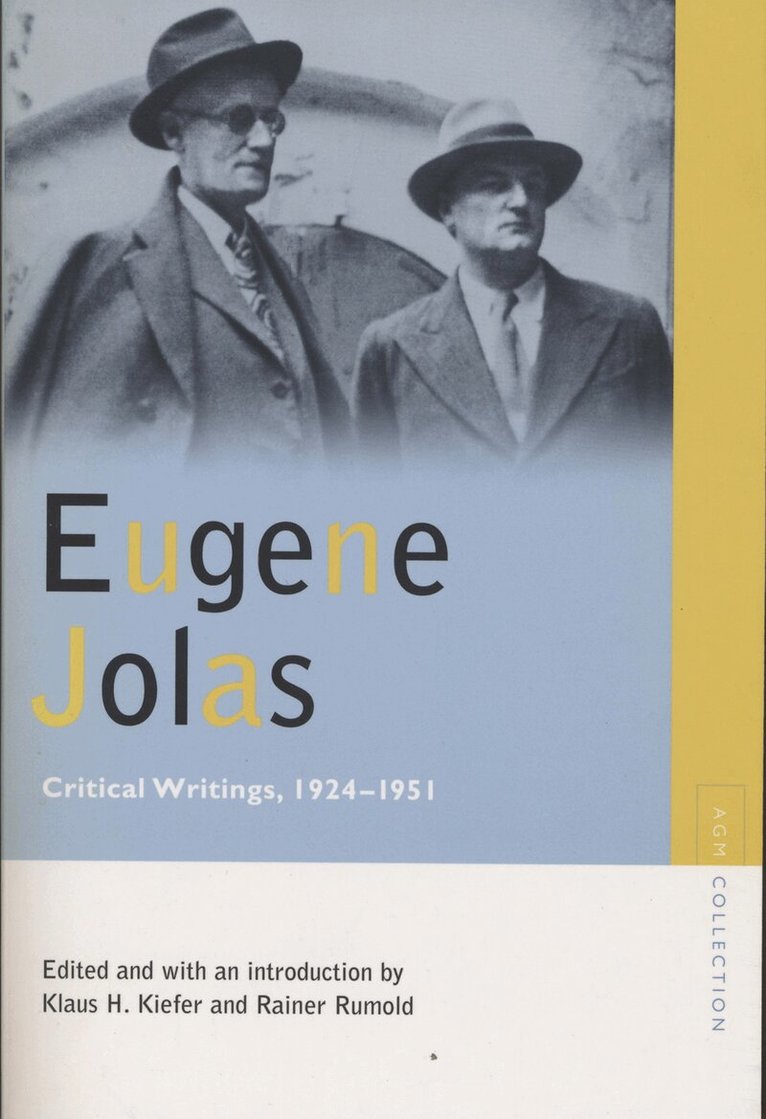
Dividing his youth between the United States and the bilingual Alsace-Lorraine, Eugene Jolas (1894-1952) flourished in three languages. As an editor and poet, he came to know the major writers and artists of his time and enjoyed a pivotal position between the Anglo-American and Continental avant-garde. His editorship of transition, the leading avant-garde journal of Paris in the twenties and early thirties, provided a major impetus to writers from James Joyce (whose ""Finnegans Wake"" was serialized in transition) to Gertrude Stein, and Samuel Beckett, with first translations of Andre Breton, and Franz Kafka, among others. Jolas' critical work, collected in this volume, includes introductions to anthologies, manifestoes like the famous Vertical, essays, some published here for the first time, on writers as various as Novalis, Trakl, the major Surrealists, Heidegger, and other philosophers. An acute observer of the literary scene as well as of the roiling politics of the time, Jolas emerges here in his role at the very center of avant-garde activity between the wars. Accordingly, this book is of signal importance to anyone with an interest in modernism, avant-garde, multilingualism, and the culture of Western Europe in the first half of the twentieth century.
Three Sons
Franz Kafka and the Fiction of J. M. Coetzee, Philip Roth, and W. G. Sebald
Häftad, Engelska, 2010
406 kr
Skickas inom 5-8 vardagar
Franz Kafka was a self-conscious writer whose texts were highly if mysteriously autobiographical. Three giants of contemporary fiction - J. M. Coetzee, Philip Roth, and W. G. Sebald - have all acknowledged their debt to the work of Kafka, both in interviews and in their own academic essays and articles for a general readership about him. In this striking feat of literary scholarship, Daniel Medin finds that the use of Kafka by Coetzee, Roth, and Sebald is similarly self-reflexive and autobiographical. That writers from such divergent national and ethnic traditions can have such unique critical readings of Kafka, and that Kafka could exert such a powerful influence over their oeuvres, Medin contends, attests to the central place of Kafka in the contemporary literary imagination.