Bernard Berenson Lectures on the Italian Renaissance Delivered at Villa I Tatti – serie
Visar alla böcker i serien Bernard Berenson Lectures on the Italian Renaissance Delivered at Villa I Tatti. Handla med fri frakt och snabb leverans.
6 produkter
6 produkter
Del 1 - Bernard Berenson Lectures on the Italian Renaissance Delivered at Villa I Tatti
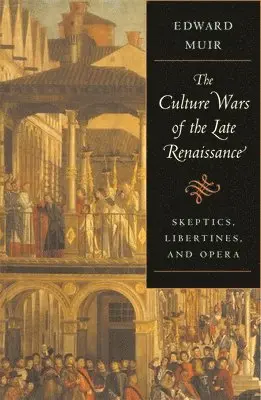
Culture Wars of the Late Renaissance
Skeptics, Libertines, and Opera
Inbunden, Engelska, 2007
407 kr
Skickas inom 10-15 vardagar
In the summer of 1591 students from the University of Padua attacked the local Jesuit college and successfully appealed to the Venetian Senate to intervene on behalf of the university. When the Jesuits were expelled from the Venetian dominion a few years later, religious censorship was virtually eliminated. The result was a remarkable era of cultural innovation that promoted free inquiry in the face of philosophical and theological orthodoxy, advocated libertine morals, critiqued the tyranny of aristocratic fathers over their daughters, and expanded the theatrical potential of grand opera.In Padua a faction of university faculty, including Galileo Galilei and the philosopher Cesare Cremonini, pursued an open and free inquiry into astronomy and philosophy. In Venice some of Cremonini's students founded the Accademia degli Incogniti (Academy of the Unknowns), one of whose most notorious members was the brilliant polemicist Ferrante Pallavicino. The execution of Pallavicino for his writings attacking Pope Urban VIII silenced the more outrageous members of the Incogniti, who soon turned to writing libretti for operas. The final phase of the Venetian culture wars pitted commercial opera, with its female performers and racy plot lines, against the decorous model of Jesuit theater. The libertine inclinations of the Incogniti suffuse many of the operas written in the 1640s, especially Monteverdi's masterpiece, L'Incoronazione di Poppea.Edward Muir's exploration of an earlier age of anxiety reveals the distinguished past of today's culture wars, including debates about the place of women in society, the clash between science and faith, and the power of the arts to stir emotions.
Del 2 - Bernard Berenson Lectures on the Italian Renaissance Delivered at Villa I Tatti
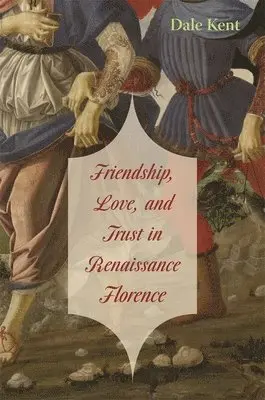
Friendship, Love, and Trust in Renaissance Florence
Inbunden, Engelska, 2009
440 kr
Skickas inom 10-15 vardagar
The question of whether true friendship could exist in an era of patronage occupied Renaissance Florentines as it had the ancient Greeks and Romans whose culture they admired and emulated. Rather than attempting to measure Renaissance friendship against a universal ideal defined by essentially modern notions of disinterestedness, intimacy, and sincerity, in this book Dale Kent explores the meaning of love and friendship as they were represented in the fifteenth century, particularly the relationship between heavenly and human friendship.She documents the elements of shared experience in friendships between Florentines of various occupations and ranks, observing how these were shaped and played out in the physical spaces of the city: the streets, street corners, outdoor benches and loggias, family palaces, churches, confraternal meeting places, workshops of artisans and artists, taverns, dinner tables, and the baptismal font.Finally, Kent examines the betrayal of trust, focusing on friends at moments of crisis or trial in which friendships were tested, and failed or endured. The exile of Cosimo de’ Medici in 1433 and his recall in 1434, the attempt in 1466 of the Medici family’s closest friends to take over their patronage network, and the Pazzi conspiracy to assassinate Lorenzo and Giuliano de’ Medici in 1478 expose the complexity and ambivalence of Florentine friendship, a combination of patronage with mutual intellectual passion and love—erotic, platonic, and Christian—sublimely expressed in the poetry and art of Michelangelo.
Del 4 - Bernard Berenson Lectures on the Italian Renaissance Delivered at Villa I Tatti
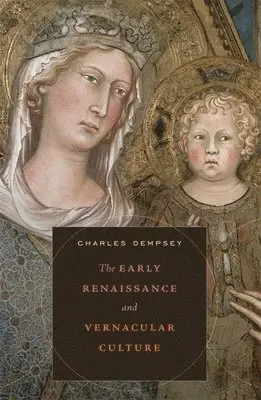
Early Renaissance and Vernacular Culture
Inbunden, Engelska, 2012
496 kr
Skickas inom 10-15 vardagar
Why do the paintings and poetry of the Italian Renaissance—a celebration of classical antiquity—also depict the Florentine countryside populated with figures dressed in contemporary silk robes and fleur-de-lys crowns? Upending conventional interpretations of this well-studied period, Charles Dempsey argues that a fusion of classical form with contemporary content, once seen as the paradox of the Renaissance, can be better understood as its defining characteristic.Dempsey describes how Renaissance artists deftly incorporated secular and popular culture into their creations, just as they interwove classical and religious influences. Inspired by the love lyrics of Parisian troubadours, Simone Martini altered his fresco Maestà in 1321 to reflect a court culture that prized terrestrial beauty. As a result the Maestà scandalously revealed, for the first time in Italian painting, a glimpse of the Madonna’s golden locks. Modeled on an ancient statue, Botticelli’s Birth of Venus went much further, featuring fashionable beauty ideals of long flowing blonde hair, ivory skin, rosy cheeks, and perfectly arched eyebrows. In the only complete reconstruction of Feo Belcari’s twelve Sybilline Octaves, Dempsey shows how this poet, patronized by the Medici family, was also indebted to contemporary dramatic modes. Popularizing biblical scenes by mixing the familiar with the exotic, players took the stage outfitted in taffeta tunics and fanciful hats, and one staging even featured a papier-maché replica of Jonah’s Whale. As Dempsey’s thorough study illuminates, Renaissance poets and artists did not simply reproduce classical aesthetics but reimagined them in vernacular idioms.
Del 3 - Bernard Berenson Lectures on the Italian Renaissance Delivered at Villa I Tatti
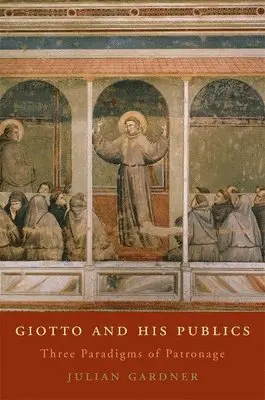
Giotto and His Publics
Three Paradigms of Patronage
Inbunden, Engelska, 2011
390 kr
Skickas inom 7-10 vardagar
This probing analysis of three works by Giotto and the patrons who commissioned them goes far beyond the clichés of Giotto as the founding figure of Western painting. It traces the interactions between Franciscan friars and powerful bankers, illuminating the complex interplay between mercantile wealth and the iconography of poverty.Political strife and religious faction lacerated fourteenth-century Italy. Giotto’s commissions are best understood against the background of this social turmoil. They reflected the demands of his patrons, the requirements of the Franciscan Order, and the restlessly inventive genius of the painter. Julian Gardner examines this important period of Giotto’s path-breaking career through works originally created for Franciscan churches: Stigmatization of Saint Francis from San Francesco at Pisa, now in the Louvre, the Bardi Chapel cycle of the Life of St. Francis in Santa Croce at Florence, and the frescoes of the crossing vault above the tomb of Saint Francis in the Lower Church of San Francesco at Assisi.These murals were executed during a twenty-year period when internal tensions divided the friars themselves and when the Order was confronted by a radical change of papal policy toward its defining vow of poverty. The Order had amassed great wealth and built ostentatious churches, alienating many Franciscans in the process and incurring the hostility of other Orders. Many elements in Giotto’s frescoes, including references to St. Peter, Florentine politics, and church architecture, were included to satisfy patrons, redefine the figure of Francis, and celebrate the dominant group within the Franciscan brotherhood.
Del 6 - Bernard Berenson Lectures on the Italian Renaissance Delivered at Villa I Tatti
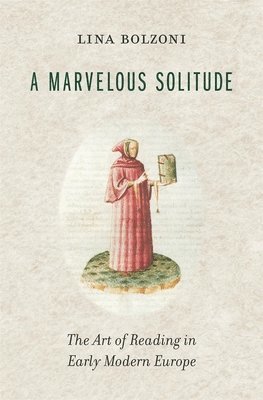
Marvelous Solitude
The Art of Reading in Early Modern Europe
Inbunden, Engelska, 2023
371 kr
Skickas inom 7-10 vardagar
A Times Literary Supplement Best Book of the YearA preeminent Renaissance scholar illuminates early modern encounters with books, in which literature became a portal to self-awareness and miraculous communion between author and reader.The experience of reading is often presented as personal and transformative—a journey of self-discovery and, perhaps, renewal. In A Marvelous Solitude, Lina Bolzoni examines the early modern roots of this attitude toward the readerly act. Between the fourteenth and sixteenth centuries, European men of letters increasingly came to see books as something more than compendia of knowledge: they could also help readers understand the human condition. As Bolzoni shows, Petrarch, Boccaccio, Machiavelli, Montaigne, and Tasso all presented reading as a private encounter and a dialogue with the author.For many Renaissance intellectuals, reading was instrumental to the construction of the self, which was enriched by contact with other learned men. These readers imagined the book as a mirror image of its author, with whom they held a secret affinity. In their letters to one another, humanists described the book as a body, reflecting the notion that reading literature placed its author in the room with oneself. Reading the work of a deceased author became akin to a necromantic rite, as the writers of bygone times were resurrected and placed in contemporary conversation. The vogue for hanging portraits of authors in libraries and studios ensured that the image of the creator was never far from his words, cementing bonds of friendship across barriers of time.These myths—charming, fragile, and powerful—invested the readerly encounter with miraculous properties that lingered in the hearts of the Romantics. And something of those wonders persists today, in the intimate feeling that reading yet provokes.
Del 5 - Bernard Berenson Lectures on the Italian Renaissance Delivered at Villa I Tatti
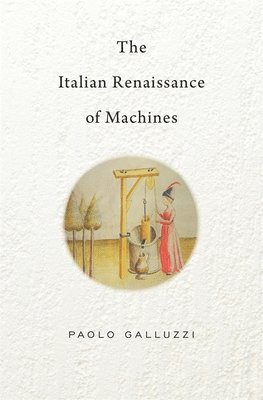
Italian Renaissance of Machines
Inbunden, Engelska, 2020
357 kr
Skickas inom 7-10 vardagar
The Renaissance was not just a rebirth of the mind. It was also a new dawn for the machine.When we celebrate the achievements of the Renaissance, we instinctively refer, above all, to its artistic and literary masterpieces. During the fifteenth and sixteenth centuries, however, the Italian peninsula was the stage of a no-less-impressive revival of technical knowledge and practice. In this rich and lavishly illustrated volume, Paolo Galluzzi guides readers through a singularly inventive period, capturing the fusion of artistry and engineering that spurred some of the Renaissance’s greatest technological breakthroughs.Galluzzi traces the emergence of a new and important historical figure: the artist-engineer. In the medieval world, innovators remained anonymous. By the height of the fifteenth century, artist-engineers like Leonardo da Vinci were sought after by powerful patrons, generously remunerated, and exhibited in royal and noble courts. In an age that witnessed continuous wars, the robust expansion of trade and industry, and intense urbanization, these practitioners—with their multiple skills refined in the laboratory that was the Renaissance workshop—became catalysts for change. Renaissance masters were not only astoundingly creative but also championed a new concept of learning, characterized by observation, technical know-how, growing mathematical competence, and prowess at the draftsman’s table.The Italian Renaissance of Machines enriches our appreciation for Taccola, Giovanni Fontana, and other masters of the quattrocento and reveals how da Vinci’s ambitious achievements paved the way for Galileo’s revolutionary mathematical science of mechanics.