Cookbooks Ser. - Böcker
Visar alla böcker i serien Cookbooks Ser.. Handla med fri frakt och snabb leverans.
12 produkter
12 produkter
254 kr
Skickas inom 7-10 vardagar
Jython is an implementation of the Python programming language written in 100% pure Java, so it runs under any compliant Java Virtual Machine. The secret to Jython's popularity lies in the combination of Java's libraries and tools with Python's rapid development capabilities. With Jython, you can write Python programs that integrate seamlessly with any Java code. And like Python, Jython can be used interactively, so you can get immediate results as you are programming. Jython Essentials provides a solid introduction to the Python language, offering a brief but thorough tour of the Python concepts you'll need to understand to use Jython effectively. The book makes frequent comparisons between Python and Java, with special emphasis on the different object-oriented semantics of the two languages, so Java programmers can quickly get up to speed with Jython. Jython Essentials also covers the various ways in which Jython and Java can interact. For example, Jython code can create instances of pre-existing Java classes and call methods in those instances.You can write Jython classes that are direct subclasses of existing Java classes and use introspection to discern the capabilities of JavaBeans components. This book provides examples of using Jython with existing Java libraries, including the Swing GUI toolkit, the JDBC database API, the Servlet API, and various XML tools. And finally, the book shows how Jython can be used as a scripting language within a Java program. With Jython Essentials, you have everything you need to start creating applications that mix the best of Python's interactivity and Java's robust libraries.
254 kr
Skickas inom 7-10 vardagar
Extreme Programming does not mean programming naked while rollerblading down the side of the Grand Canyon. It does mean a new approach to software development that is both radical and common-sense. Unlike many software development methodologies, XP has been accepted quickly because its core practices - particularly code sharing, test-first development, and continuous integration - resonated immediately with software developers everywhere. Instead of impressing developers with a body of theory, XP got programmers to say, "Yeah, that's how I'd like to work." Oddly enough, although most developers turn to Extreme Programming methods in order to code real, hands-on, and extensible projects quickly ("Code comes first"), most books on Extreme Programming insist on focusing on the theory and not the practice. Not the Java Extreme Programming Cookbook.Brimming with over 100 "recipes" for getting down to business and actually doing XP, the Java Extreme Programming Cookbook doesn't try to "sell" you on XP; it succinctly documents the most important features of popular open source tools for XP in Java - including Ant, Junit, HttpUnit, Cactus, Tomcat, XDoclet - and then digs right in, providing recipes for implementing the tools in real-world environments. Each recipe offers solutions that help you put an extreme programming environment together: then provides code for automating the build process and testing. Although the time saved using any one of these solutions will more than pay for the book, Java Extreme Programming Cookbook offers more than just a collection of cut-and-paste code. Each recipe also includes explanations of how and why the approach works, so you can adapt the techniques to similar situation. One of the biggest challenges facing developers today is sorting through the wide variety of tools available form various source and figuring out how to them effectively. The recipes in Java Extreme Programming Cookbook showcase how to use the most important features of these XP tools.Many of these tools are geared towards unit testing, while others are invaluable for continuous integration; with these practical examples, you'll be able to choose the most effective tools to accomplish your goals, then implement them in a cohesive development environment quickly.
290 kr
Skickas inom 7-10 vardagar
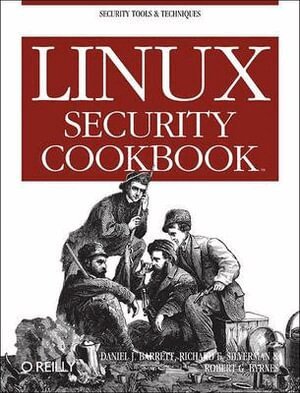
Computer security is an ongoing process, a relentless contest between system administrators and intruders. A good administrator needs to stay one step ahead of any adversaries, which often involves a continuing process of education. If you're grounded in the basics of security, however, you won't necessarily want a complete treatise on the subject each time you pick up a book. Sometimes you want to get straight to the point. That's exactly what the new "Linux Security Cookbook" does. Rather than provide a total security solution for Linux computers, the authors present a series of easy-to-follow recipes-short, focused pieces of code that administrators can use to improve security and perform common tasks securely. The book includes real solutions to a wide range of targeted problems, such as sending encrypted email within Emacs, restricting access to network services at particular times of day, firewalling a webserver, preventing IP spoofing, setting up key-based SSH authentication, and much more. With over 150 ready-to-use scripts and configuration files, this unique book helps administrators secure their systems without having to look up specific syntax.The book begins with recipes devised to establish a secure system, then moves on to secure day-to-day practices, and concludes with techniques to help your system stay secure. Some of the "recipes" you'll find in this book are: controlling access to your system from firewalls down to individual services, using iptables, ipchains, xinetd, inetd, and more; monitoring your network with tcpdump, dsniff, netstat, and other tools; protecting network connections with Secure Shell (SSH) and stunnel; safeguarding email sessions with Secure Sockets Layer (SSL); encrypting files and email messages with GnuPG; and probing your own security with password crackers, nmap, and handy scripts.
537 kr
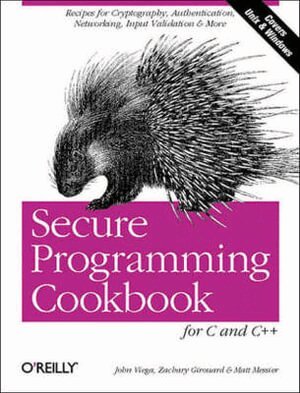
Password sniffing, spoofing, buffer overflows, and denial of service: these are only a few of the attacks on today's computer systems and networks. At the root of this epidemic is poorly written, poorly tested, and insecure code that puts everyone at risk. Clearly, today's developers need help figuring out how to write code that attackers won't be able to exploit. But writing such code is surprisingly difficult. Secure Programming Cookbook for C and C++ is an important new resource for developers serious about writing secure code. It contains a wealth of solutions to problems faced by those who care about the security of their applications. It covers a wide range of topics, including safe initialization, access control, input validation, symmetric and public key cryptography, cryptographic hashes and MACs, authentication and key exchange, PKI, random numbers, and anti-tampering. The rich set of code samples provided in the book's more than 200 recipes will help programmers secure the C and C++ programs they write for both Unix(r) (including Linux(r)) and Windows(r) environments.Readers will learn: * How to avoid common programming errors, such as buffer overflows, race conditions, and format string problems * How to properly SSL-enable applications * How to create secure channels for client-server communication without SSL * How to integrate Public Key Infrastructure (PKI) into applications * Best practices for using cryptography properly * Techniques and strategies for properly validating input to programs * How to launch programs securely * How to use file access mechanisms properly * Techniques for protecting applications from reverse engineering The book's web site supplements the book by providing a place to post new recipes, including those written in additional languages like Perl, Java, and Python. Monthly prizes will reward the best recipes submitted by readers. Secure Programming Cookbook for C and C++ is destined to become an essential part of any developer's library, a code companion developers will turn to again and again as they seek to protect their systems from attackers and reduce the risks they face in today's dangerous world.
360 kr
Skickas inom 7-10 vardagar
More often than not, the words "sendmail configuration" strike dread in the hearts of sendmail and system administrators--and not without reason. sendmail configuration languages are as complex as any other programming languages, but used much more infrequently--only when sendmail is installed or configured. The average system administrator doesn't get enough practice to truly master this inscrutable technology. Fortunately, there's help. The sendmail Cookbook provides step-by-step solutions for the administrator who needs to solve configuration problems fast. Say you need to configure sendmail to relay mail for your clients without creating an open relay that will be abused by spammers. A recipe in the Cookbook shows you how to do just that. No more wading through pages of dense documentation and tutorials and creating your own custom solution--just go directly to the recipe that addresses your specific problem. Each recipe in the sendmail Cookbook outlines a configuration problem, presents the configuration code that solves that problem, and then explains the code in detail.The discussion of the code is critical because it provides the insight you need to tweak the code for your own circumstances. The sendmail Cookbook begins with an overview of the configuration languages, offering a quick how-to for downloading and compiling the sendmail distribution. Next, you'll find a baseline configuration recipe upon which many of the subsequent configurations, or recipes, in the book are based. Recipes in the following chapters stand on their own and offer solutions for properly configuring important sendmail functions such as: Delivering and forwarding mail Relaying Masquerading Routing mail Controlling spam Strong authentication Securing the mail transport Managing the queue Securing sendmail sendmail Cookbook is more than just a new approach to discussing sendmail configuration. The book also provides lots of new material that doesn't get much coverage elsewhere--STARTTLS and AUTH are given entire chapters, and LDAP is covered in recipes throughout the book. But most of all, this book is about saving time--something that most system administrators have in short supply. Pick up the sendmail Cookbook and say good-bye to sendmail dread.
360 kr
Skickas inom 7-10 vardagar
With literally hundreds of examples and thousands of lines of code, the Java Servlet and JSP Cookbook yields tips and techniques that any Java web developer who uses JavaServer Pages or servlets will use every day, along with full-fledged solutions to significant web application development problems that developers can insert directly into their own applications. Java Servlet and JSP Cookbook presents real-world problems, and provides concise, practical solutions to each. Finding even one tested code "recipe" that solves a gnarly problem in this comprehensive collection of solutions and best practices will save hours of frustration--easily justifying the cost of this invaluable book. But "Java Servlet and JSP Cookbook" is more than just a wealth of cut-and-paste code. It also offers clear explanations of how and why the code works, warns of potential pitfalls, and directs you to sources of additional information, so you can learn to adapt the problem-solving techniques to similar situations. These recipes include vital topics like the use of Ant to setup a build environment, extensive coverage of the WAR file format and web.xml deployment descriptor, file-uploading, error-handling, cookies, logging, dealing with non-HTML content, multimedia, request filtering, web services, I18N, web services, and a host of other topics that frustrate even the most seasoned developers.For Java web developers of all levels who are eager to put into practice the theory presented in other API-focused books, the solutions presented in this practical book will prove invaluable over and over again. This is painless way for less experienced developers who prefer to learn by doing to expand their skills and productivity, while accomplishing practical solutions to the pressing problems they face every day. More experienced developers can use these recipes to solve time-consuming problems quickly, freeing up their time for the more creative aspects of their work.
325 kr
Skickas inom 7-10 vardagar
Each year, Windows XP is pre-installed on 30 million PCs sold in the U.S.--and 90 million worldwide--making it the world's most popular operating system, and proving to frustrated users everywhere that preponderance does not equate to ease of use. There are literally thousands of programs, tools, commands, screens, scripts, buttons, tabs, applets, menus, and settings contained within Windows XP. And it has only been in the last couple of years that Microsoft's documentation has actually been more of a help than a hindrance. But it still isn't enough. Windows XP users and administrators need a quick and easy way to find answers. Plenty of books go into detail about the theory behind a particular technology or application, but few go straight to the essentials for getting the job done. Windows XP Cookbook does just that, tackling the most common tasks needed to install, manage, and support Windows XP. Featuring a new twist to O'Reilly's proven Cookbook formula, this problem-solving guide offers multiple solutions for each of its 300-plus recipes. Solve dilemmas with the graphical user interface, the command line, through the Registry, or by using scripts.Each step-by-step recipe includes a discussion that explains how and why it works. The book is also among the first to cover Microsoft's XP Service Pack 2. With these practical, on-the-job solutions, Windows XP Cookbook will save you hours of time searching for answers. Windows XP Cookbook will be useful to anyone that has to use, deploy, administer, or automate Windows XP. But this isn't a typical end-user book; it covers the spectrum of topics involved with running Windows XP in both small and large environments. As a result, IT professionals and system administrators will find it a great day-to-day reference. And power users will find Windows XP Cookbook a great source for information on tweaking XP and getting the most out of their systems. The bottom line is that Windows XP Cookbook will make just about anyone who uses XP more productive.
290 kr
Skickas inom 7-10 vardagar
If you are a network administrator, you're under a lot of pressure to ensure that mission-critical systems are completely safe from malicious code, buffer overflows, stealth port scans, SMB probes, OS fingerprinting attempts, CGI attacks, and other network intruders. Designing a reliable way to detect intruders before they get in is an essential - but often overwhelming - challenge. SNORT, the defacto open source standard of intrusion detection tools, is capable of performing real-time traffic analysis and packet logging on IP network. It can perform protocol analysis, content searching, and matching. SNORT can save countless headaches; the new SNORT Cookbook will save countless hours of sifting through dubious online advice or wordy tutorials in order to leverage the full power of SNORT. Each recipe in the popular and practical problem-solution-discussion O'Reilly cookbook format contains a clear and thorough description of the problem, a concise but complete discussion of a solution, and real-world examples that illustrate that solution.The SNORT Cookbook covers important issues that sys admins and security pros will us everyday, such as: - installation - optimization - logging - alerting - rules and signatures - detecting viruses - countermeasures - detecting common attacks - administration - honeypots - log analysis But the SNORT Cookbook offers far more than quick cut-and-paste solutions to frustrating security issues. Those who learn best in the trenches - and don't have the hours to spare to pore over tutorials or troll online for best-practice snippets of advice - will find that the solutions offered in this ultimate SNORT sourcebook not only solve immediate problems quickly, but also showcase the best tips and tricks they need to master be security gurus - and still have a life.
360 kr
Skickas inom 7-10 vardagar
If you have large quantities of data in a Microsoft Access database, and need to study that data in depth, this book is a data cruncher's dream. "Access Data Analysis Cookbook" offers practical recipes to solve a variety of common problems that users have with extracting Access data and performing calculations on it. Each recipe includes a discussion on how and why the solution works. Whether you use Access 2007 or an earlier version, this book will teach you new methods to query data, different ways to move data in and out of Access, how to calculate answers to financial and investment issues, and more. Learn how to apply statistics to summarize business information, how to jump beyond SQL by manipulating data with VBA, how to process dates and times, and even how to reach into the Excel data analysis toolkit.The recipes demonstrate ways to: develop basic and sophisticated queries; apply aggregate functions, custom functions, regular expressions, and crosstabs; apply queries to perform non-passive activities such as inserting, updating, and deleting data; create and manipulate tables and queries programmatically; manage text-based data, including methods to isolate parts of a string and ways to work with numbers that are stored as text; use arrays, read and write to the Windows registry, encrypt data, and use transaction processing; and, use the FileSystemObject, use XML with XSLT, communicate with SQL Server, and exchange data with other Office products. They also demonstrate ways to: find answers from time-based data, such as how to add time, count elapsed time, work with leap years, and how to manage time zones in your calculations; deal with business and finance problems, including methods for calculating depreciation, loan paybacks, and Return on Investment (ROI); and, explore statistical techniques, such as frequency, variance, kurtosis, linear regression, combinations and permutations."Access Data Analysis Cookbook" is a one-stop-shop for extracting nuggets of valuable information from your database, and anyone with Access experience will benefit from these tips and techniques, including seasoned developers. If you want to use your data, and not just store it, you'll find this guide indispensable.
325 kr
Skickas inom 7-10 vardagar
In today's Web 2.0 world, JavaScript and Dynamic HTML are at the center of the hot new approach to designing highly interactive pages on the client side. With this environment in mind, the new edition of this book offers bite-sized solutions to very specific scripting problems that web developers commonly face. Each recipe includes a focused piece of code that you can insert right into your application. Why is "JavaScript & DHTML Cookbook" so popular? After reading thousands of forum threads over the years, author and scripting pioneer Danny Goodman has compiled a list of problems that frequently vex scripters of various experience levels. For every problem he addresses, Goodman not only offers code, but a discussion of how and why the solution works.Recipes range from simple tasks, such as manipulating strings and validating dates in JavaScript, to entire libraries that demonstrate complex tasks, such as cross-browser positioning of HTML elements, sorting tables, and implementing Ajax features on the client.Ideal for novices as well as experienced scripters, this book contains more than 150 recipes for: working with interactive forms and style sheets; presenting user-friendly page navigation; creating dynamic content via Document Object Model scripting; producing visual effects for stationary content; positioning HTML elements; and working with XML data in the browser.Recipes in this Cookbook are compatible with the latest W3C standards and browsers, including Internet Explorer 7, Firefox 2, Safari, and Opera 9. Several new recipes provide client-side Ajax solutions, and many recipes from the previous edition have been revised to help you build extensible user interfaces for Web 2.0 applications. If you want to write your own scripts and understand how they work, rather than rely on a commercial web development framework, the "JavaScript & DHTML Cookbook" is a must.
ActionScript 3.0 Cookbook
Solutions for Flash Platform and Flex Application Developers
Häftad, Engelska, 2006
290 kr
Skickas inom 7-10 vardagar
Well before Ajax and Microsoft's Windows Presentation Foundation hit the scene, Macromedia offered the first method for building web pages with the responsiveness and functionality of desktop programs with its Flash-based "Rich Internet Applications". Now, new owner Adobe is taking Flash and its powerful capabilities beyond the Web and making it a full-fledged development environment. Rather than focus on theory, the ActionScript 3.0 Cookbook concentrates on the practical application of ActionScript, with more than 300 solutions you can use to solve a wide range of common coding dilemmas. You'll find recipes that show you how to: Detect the user's Flash Player version or their operating system Build custom classes Format dates and currency types Work with strings Build user interface components Work with audio and video Make remote procedure calls using Flash Remoting and web services Load, send, and search XML data And much, much more ...Each code recipe presents the Problem, Solution, and Discussion of how you can use it in other ways or personalize it for your own needs, and why it works.You can quickly locate the recipe that most closely matches your situation and get the solution without reading the whole book to understand the underlying code. Solutions progress from short recipes for small problems to more complex scripts for thornier riddles, and the discussions offer a deeper analysis for resolving similar issues in the future, along with possible design choices and ramifications. You'll even learn how to link modular ActionScript pieces together to create rock-solid solutions for Flex 2 and Flash applications. When you're not sure how ActionScript 3.0 works or how to approach a specific programming dilemma, you can simply pick up the book, flip to the relevant recipe(s), and quickly find the solution you're looking for. Adobe Developer Library is a co-publishing partnership between O'Reilly Media and Adobe Systems, Inc. and is designed to produce the number one information resources for developers who use Adobe technologies. Created in 2006, the Adobe Developer Library is the official source for comprehensive learning solutions to help developers create expressive and interactive web applications that can reach virtually anyone on any platform.With top-notch books and innovative online resources covering the latest in rich Internet application development, the Adobe Developer Library offers expert training and in-depth resources, straight from the source.
290 kr
Skickas inom 7-10 vardagar
This unique cookbook contains a wealth of solutions to problems that SQL programmers face all the time. The recipes inside range from how to perform simple tasks, like importing external data, to ways of handling issues that are more complicated, like set algebra. Authors Ales Spetic and Jonathan Gennick, two authorities with extensive database and SQL programming experience, include a discussion with each recipe to explain the logic and concepts underlying the solution. SQL (Structured Query Language) is the closest thing to a standard query language that currently exists, and Transact-SQL -- a full-featured programming language that dramatically extends the power of SQL -- is the procedural language of choice for both Microsoft SQL Server and Sybase SQL Server systems. The Transact-SQL Cookbook is designed so you can use the recipes directly, as a source of ideas, or as a way to learn a little more about SQL and what you can do with it. Topics covered include: *Audit logging.In addition to recipes for implementing an audit log, this chapter also includes recipes for: improving performance where large log tables are involved; supporting multiple-languages; and simulating server push. *Hierarchies. Recipes show you how to manipulate hierarchical data using Transact-SQL. *Importing data. This chapter introduces concepts like normalization and recipes useful for working with imported data tables. *Sets. Recipes demonstrate different operations, such as how to find common elements, summarize the data in a set, and find the element in a set that represents an extreme. *Statistics. This chapter?s recipes show you how to effectively use SQL for common statistical operations from means and standard deviations to weighted moving averages. *Temporal data. Recipes demonstrate how to construct queries against time-based data. *Data Structures. This chapter shows how to manipulate data structures like stacks, queues, matrices, and arrays. With an abundance of recipes to help you get your job done more efficiently, the Transact-SQL Cookbook is sure to become an essential part of your library.