Frontiers Of Accounting And Financial History – serie
Visar alla böcker i serien Frontiers Of Accounting And Financial History. Handla med fri frakt och snabb leverans.
5 produkter
5 produkter
Del 1 - Frontiers Of Accounting And Financial History
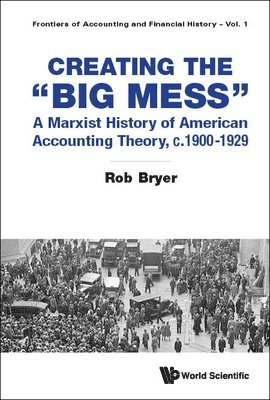
Creating The "Big Mess": A Marxist History Of American Accounting Theory, C.1900-1929
Inbunden, Engelska, 2021
2 089 kr
Skickas inom 3-6 vardagar
Creating the "Big Mess" and its sequel Accounting for Crises use Marx's theory of capitalism to explain why there is no generally accepted theory of financial accounting, and explore the consequences, by studying the history of American accounting theory from c.1900 to 2007. The answer, Creating the "Big Mess", is first that while late-19th century British accounting principles, founded on the going-concern concept, provided an objective basis for holding management accountable to shareholders for its stewardship of capital, and were accepted by the nascent American profession, they are inchoate. Second, Irving Fisher's economic theory of accounting, based on the assertion that present value is the accountants' measurement ideal, which is subjective, framed early-20th century American accounting theory, which undermined British principles, making them incoherent. In an unregulated, pro-business environment, leading theorists, particularly Henry Rand Hatfield and William A. Paton, Jr., became authorities for management discretion, creating the "big mess" Hatfield saw in late-1920s American accounting. Accounting for Crises examines the roles of Fisher's theory in promoting the speculation leading to the 1929 Great Crash, aggravating the Great Depression, hindering accounting regulation from the 1930s, producing the Financial Accounting Standard Board's conceptual framework, and facilitating the 2007-2008 Global Financial Crisis.
Del 2 - Frontiers Of Accounting And Financial History
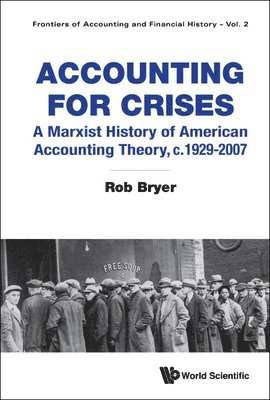
Accounting For Crises: A Marxist History Of American Accounting Theory, C.1929-2007
Inbunden, Engelska, 2023
2 160 kr
Skickas inom 3-6 vardagar
Historians have not convincingly explained modern capitalism's two major economic crises, the Great Depression of the 1930s, and the Global Financial Crisis (GFC) of 2008-2009. Accounting for Crises offers a new explanation, why both began and were more severe in the USA ("America"), based on an accounting interpretation of Marx's theory of crises. It explains their origins in capitalists' control of accumulation, which reveals important overlooked roles for Irving Fisher's accounting theory. This theory, by allowing discretion in accounts, in the context of falling rates of profit, encouraged "swindling", overstating reported profits, and understating their risk, which facilitated and aggravated both crises. Framed by Fisher's theory, during the 1920s American accounting theorists justified discretion, which Creating the "Big Mess" (the companion volume) concluded it management used to conservatively smooth earnings. Accounting for Crises shows that Fisher's theory , also underlays the popular new theory of investment that justified valuing shares using reported earnings, which encouraged their manipulation and legitimized "speculation". This, it argues, underlays America's exceptional late-1920s stock market boom, the 1929 Great Crash, and the depth and length of its Great Depression. Prominently associated with the boom, Fisher became unpopular after the crash, his name disappearing from public debate. Nevertheless, the book concludes, his theory hindered economic recovery, weakened 1930s reforms, undermined accounting regulation from the late-1930s, and following his rehabilitation from the late-1950s, underlies the Financial Accounting Standards Board's conceptual framework, which by allowing off-balance-sheet accounting for securitization-SPEs, fostered the 2007 "credit crunch" that triggered the 2008-2009 Global Financial Crisis (GFC).
Del 3 - Frontiers Of Accounting And Financial History
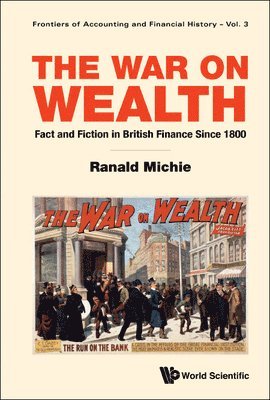
War On Wealth, The: Fact And Fiction In British Finance Since 1800
Inbunden, Engelska, 2023
1 817 kr
Skickas inom 3-6 vardagar
This book addresses the divide that exists between the reality of finance and the image it projects. A functioning financial system is an essential feature of a modern economy, providing it with money, credit, capital, and investments. Conversely, those who provide this essential service are neither respected nor trusted. The causes and consequences of this divide is explored using the British experience from 1800 to the present, drawing upon a mixture of factual evidence and contemporary fiction. Nothing of this scale has been attempted before and this is the product of 50 years of research.
Del 4 - Frontiers Of Accounting And Financial History
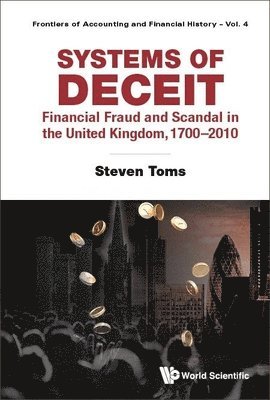
Systems Of Deceit: Financial Fraud And Scandal In The United Kingdom, 1700-2010
Inbunden, Engelska, 2024
1 624 kr
Skickas inom 3-6 vardagar
Financial fraud is a serious and seemingly intractable problem. Financial scandals regularly punctuate newspaper headlines and regulators and auditors appear bereft of effective responses. But has this always been the case?This book quantifies financial crime in the UK using three centuries of data. It demonstrates how financial fraud and scandal vary according to systematic economic and institutional arrangements. In doing so, it retells the history of British capitalism, from the mercantilism of the eighteenth century to the financial capitalism of the twenty-first century, illustrating the often negative consequences of economic ideology, policy and structure. It identifies periods when fraud has been less problematic and contrasts these with times when it has surged. The variation of outcomes reflects the balance of power between the state, industrial and financial sectors, the provision of credit through risky lending, and the effectiveness of audits. "Rogue traders" and other flawed individuals are frequently the focus of blame narratives constructed with the intention of deflecting comprehensive systematic reforms.
Del 5 - Frontiers Of Accounting And Financial History
Critical History Of Double Entry Accounting 1150-1800
Inbunden, Engelska, 2025
2 224 kr
Skickas inom 3-6 vardagar
The English language accounting history of double entry accounting before 1800 has reached an impasse. The doors to its reawakening are fiercely guarded by combination locks powered by confirmation bias and adherence to a priori wisdom requiring vast amounts of supportive scholarship to make public the smallest contribution to what is known and understood of the first 600 years of its use. To open those doors, a foundation is needed upon which scholarship can begin anew — a framework of reference that can be used to justify the validity and relevance of scholarship and discovery in this field. That is the purpose and role of this book.It does not focus on the technical. It focuses on the environment and context of use of the method, and its function. It considers 'why' and consequences. It asks who, when, where, and what, along with 'how'. It adopts the perspective that the reason for the bookkeeping drove how it was adopted, not the availability of parchment or paper, nor the emergence of the concept of the technology — the book — in which it was recorded. Rather its use was driven by a need of the person who wrote the record, or by the needs of those who wished a record to be kept.A critical traditional historical method is adopted. Explanations are sought and identified utilising knowledge of the environment and context of practice that, to this point, rarely if ever feature in the antiquarian historiography this book ideally seeks to replace. The approach adopted is multi-disciplinary and the sources used are multi-disciplinary and multi-lingual. This book is essential reading for anyone with an interest in accounting's past.