Great Debates in Philosophy - Böcker
Visar alla böcker i serien Great Debates in Philosophy. Handla med fri frakt och snabb leverans.
14 produkter
14 produkter
425 kr
Skickas inom 7-10 vardagar
The unique approach taken within The Ethics of Patriotism brings together the differing perspectives of three leading figures in the philosophical debate who deliver an up-to-date, accessible, and vigorous presentation of the major views and arguments. Brings together the differing perspectives of three leading philosophers, who, together, explore the major positions on the ethics of patriotismConnects with several burgeoning fields of interest in philosophy and politics, including nationalism, civic virtue, liberalism and republicanism, loyalty, and cosmopolitanismDemonstrates that it is possible to make progress on the question of the ethics of patriotism while taking an ecumenical approach to larger theoretical questionsA timely and relevant response to the upsurge of interest in nationalism, patriotism, and secessions
Del 10 - Great Debates in Philosophy
Epistemic Justification
Internalism vs. Externalism, Foundations vs. Virtues
Inbunden, Engelska, 2003
1 452 kr
Skickas inom 7-10 vardagar
Ever since Plato it has been thought that one knows only if one's belief hits the mark of truth and does so with adequate justification. The issues debated by Laurence BonJour and Ernest Sosa concern mostly the nature and conditions of such epistemic justification, and its place in our understanding of human knowledge. Presents central issues pertaining to internalism vs. externalism and foundationalism vs. virtue epistemology in the form of a philosophical debate.Introduces students to fundamental questions within epistemology while engaging in contemporary debates.Written by two of today’s foremost epistemologists.Includes an extensive bibliography.
Del 4 - Great Debates in Philosophy
Epistemic Justification
Internalism vs. Externalism, Foundations vs. Virtues
Häftad, Engelska, 2003
445 kr
Skickas inom 7-10 vardagar
Ever since Plato it has been thought that one knows only if one's belief hits the mark of truth and does so with adequate justification. The issues debated by Laurence BonJour and Ernest Sosa concern mostly the nature and conditions of such epistemic justification, and its place in our understanding of human knowledge. Presents central issues pertaining to internalism vs. externalism and foundationalism vs. virtue epistemology in the form of a philosophical debate.Introduces students to fundamental questions within epistemology while engaging in contemporary debates.Written by two of today’s foremost epistemologists.Includes an extensive bibliography.
467 kr
Skickas inom 7-10 vardagar
Do moral questions have objective answers? In this great debate, Gilbert Harman explains and argues for relativism, emotivism, and moral scepticism. In his view, moral disagreements are like disagreements about what to pay for a house; there are no correct answers ahead of time, except in relation to one or another moral framework.Independently, Judith Jarvis Thomson examines what she takes to be the case against moral objectivity, and rejects it; she argues that it is possible to find out the correct answers to some moral questions. In her view, some moral disagreements are like disagreements about whether the house has a ghost. Harman and Thomson then reply to each other. This important, lively accessible exchange will be invaluable to all students of moral theory and meta-ethics.
1 068 kr
Skickas inom 7-10 vardagar
Is belief in God epistemically justified? That's the question at the heart of this volume in the Great Debates in Philosophy series, with Alvin Plantinga and Michael Tooley each addressing this fundamental question with distinctive arguments from opposing perspectives. The first half of the book contains each philosopher's explanation of his particular view; the second half allows them to directly respond to each other's arguments, in a lively and engaging conversationOffers the reader a one of a kind, interactive discussionForms part of the acclaimed Great Debates in Philosophy series
440 kr
Skickas inom 7-10 vardagar
Is belief in God epistemically justified? That's the question at the heart of this volume in the Great Debates in Philosophy series, with Alvin Plantinga and Michael Tooley each addressing this fundamental question with distinctive arguments from opposing perspectives. The first half of the book contains each philosopher's explanation of his particular view; the second half allows them to directly respond to each other's arguments, in a lively and engaging conversationOffers the reader a one of a kind, interactive discussionForms part of the acclaimed Great Debates in Philosophy series
1 492 kr
Skickas inom 7-10 vardagar
During the past decade ethical theory has been in a lively state of development, and three basic approaches to ethics - Kantian ethics, consequentialism, and virtue ethics - have assumed positions of particular prominence.
506 kr
Skickas inom 7-10 vardagar
During the past decade ethical theory has been in a lively state of development, and three basic approaches to ethics - Kantian ethics, consequentialism, and virtue ethics - have assumed positions of particular prominence.
1 448 kr
Skickas inom 7-10 vardagar
In this book two philosophers, each committed to unambiguous versions of belief and disbelief, debate the central issues of atheism and theism. Considers one of the oldest and most widely disputed philosophical questions: is there a God?Presents the atheism/theism issue in the form of philosophical debate between two highly regarded scholars, widely praised for the clarity and verve of their work.This second edition contains new essays by each philosopher, responding to criticisms and building on their previous work.
467 kr
Skickas inom 7-10 vardagar
In this book two philosophers, each committed to unambiguous versions of belief and disbelief, debate the central issues of atheism and theism. Considers one of the oldest and most widely disputed philosophical questions: is there a God?Presents the atheism/theism issue in the form of philosophical debate between two highly regarded scholars, widely praised for the clarity and verve of their work.This second edition contains new essays by each philosopher, responding to criticisms and building on their previous work.
296 kr
Skickas inom 7-10 vardagar
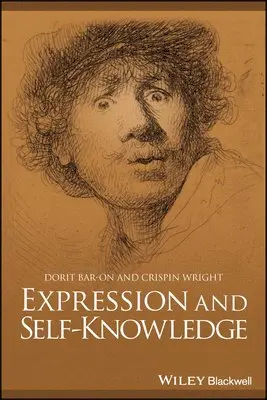
Provides a timely and original contribution to the debate surrounding privileged self-knowledge Contemporary epistemologists and philosophers of mind continue to find puzzling the nature and source of privileged self-knowledge: the ordinary and effortless ‘first-person’ knowledge we have of our own sensations, moods, emotions, beliefs, desires, and hopes. In Expression and Self-Knowledge, Dorit Bar-On and Crispin Wright articulate their joint dissatisfaction with extant accounts of self-knowledge and engage in a sustained and substantial critical debate over the merits of an expressivist approach to the topic. The authors incorporate cutting-edge research while defending their own alternatives to existing approaches to so-called ‘first-person privilege’. Bar-On defends her neo-expressivist account, addressing the objection that neo-expressivism fails to provide an adequate epistemology of ordinary self-knowledge, and addresses new objections levelled by Wright. Wright then presents an alternative pluralist approach, and Bar-On argues in response that pluralism faces difficulties neo-expressivism avoids. Providing invaluable insights on a hotly debated topic in epistemology and philosophy of mind, Expression and Self-Knowledge: Presents an in-depth debate between two leading philosophers over the expressivist approach Offers novel developments and penetrating criticisms of the authors' respective views Features two different perspectives on the influential remarks on expression and self-knowledge found in Wittgenstein’s later writings Includes four jointly written chapters that offer a critical overview of prominent existing accounts, which provide a useful advanced introduction to the subject.Expression and Self-Knowledge is essential reading for epistemologists, philosophers of mind and language, psychologists with an interest in self-knowledge, and researchers and graduate students working in expression, expressivism, and self-knowledge.
414 kr
Skickas inom 7-10 vardagar
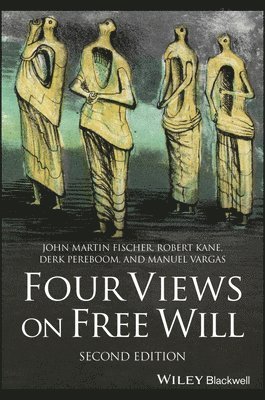
A lively and engaging debate between four representative views on free will, completely revised and updated with new perspectives Four Views on Free Will is a robust and careful debate about free will, how it interacts with determinism and indeterminism, and whether we have it or not. Providing the most up-to-date account of four major positions in the free will debate, the second edition of this classic text presents the opposing perspectives of renowned philosophers John Martin Fischer, Robert Kane, Derk Pereboom, and Manuel Vargas. Substantially revised throughout, this new volume contains eight in-depth chapters, almost entirely rewritten for the new edition, in which the authors state their different positions on the debate, offer insights into how their views have evolved over the past fifteen years, respond to recent critical literature in the field, and interact and engage with each other in dialogue. In the first four chapters the authors defend their distinctive views about free will: libertarianism, compatibilism, hard incompatibilism, and revisionism. The subsequent four chapters consist of direct replies by each of the authors to the other three. Offering a one-of-a-kind interactive conversation about the most recent work on the subject, Four Views on Free Will, Second Edition provides a balanced and enlightening discussion on all the key concepts and conflicts in the free will debate. Part of the acclaimed Great Debates in Philosophy series, it remains essential reading for undergraduate and graduate students, lecturers and scholars in philosophy, ethics, free will, philosophy of mind, political philosophy, law, and related subjects.
1 216 kr
Skickas inom 7-10 vardagar
Focusing on the concepts and interactions of free will, moral responsibility, and determinism, this text represents the most up-to-date account of the four major positions in the free will debate. Four serious and well-known philosophers explore the opposing viewpoints of libertarianism, compatibilism, hard incompatibilism, and revisionismThe first half of the book contains each philosopher's explanation of his particular view; the second half allows them to directly respond to each other's arguments, in a lively and engaging conversationOffers the reader a one of a kind, interactive discussionForms part of the acclaimed Great Debates in Philosophy series
545 kr
Skickas inom 7-10 vardagar
Philosophical controversies within contemporary critical theory arise largely from questions about the nature, scope and limits of human reason. As the linguistic turn in twentieth-century philosophy has increasingly given way to a sociocritical turn, traditional ideas of 'pure' reason have been left further and further behind. There is however considerable disagreement about what that shift entails for enlightenment ideals of self-consciousness, self-determination, and self-realization. In this book two prominent philosophers bring these disagreements into focus around a set of familiar philosophical issues concerning reason and the rational subject, truth and representation, knowledge and objectivity, identity and difference, relativism and universalism, the right and the good. But these "perennial problems" are resituated within the context of critical theory as it has developed from the work of the Frankfurt School in the 1930's and 1940's to the multiplicity of contemporary approaches: genealogical, hermeneutic, neopragmatist, deconstructive, and reconstructive.