212 kr
Philip Pettit – författare
- Häftad, Engelska, 2025A major new account of the state and its importance by a leading political philosopherThe future of our species depends on the state. Can states resist corporate capture, religious zealotry, and nationalist mania? Can they find a way to work together so that the earth heals and its peoples prosper? Or is the state just not up to the task? In this book, the prominent political philosopher Philip Pettit examines the nature of the state and its capacity to serve goals like peace and justice within and beyond its borders. In doing so, he breaks new ground by making the state the focus of political theory—with implications for economic, legal, and social theory—and presents a persuasive, historically informed image of an institution that lies at the center of our lives.Offering an account that is more realist than utopian, Pettit starts from the function the polity is meant to serve, looks at how it can best discharge that function, and explores its ability to engage beneficially in the life of its citizens. This enables him to identify an ideal of statehood that is a precondition of justice. Only if states approximate this functional ideal will they be able to deal with the perennial problems of extreme poverty and bitter discord as well as the challenges that loom over the coming centuries, including climate change, population growth, and nuclear arms.
- Inbunden, Engelska, 2018
693 kr
Skickas inom 5-8 vardagar
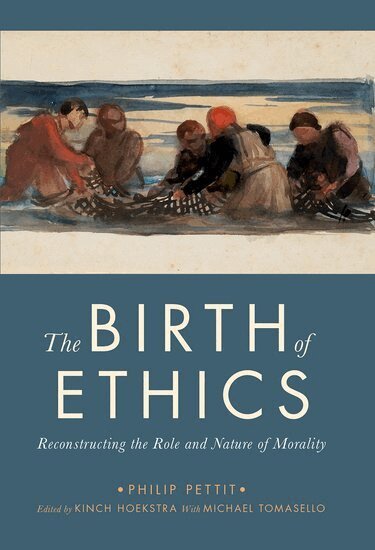
Imagine a human society, perhaps in pre-history, in which people were generally of a psychological kind with us, had the use of natural language to communicate with one another, but did not have any properly moral concepts in which to exhort one another to meet certain standards and to lodge related claims and complaints. According to The Birth of Ethics, the members of that society would have faced a set of pressures, and made a series of adjustments in response, sufficient to put them within reach of ethical concepts. Without any planning, they would have more or less inevitably evolved a way of using such concepts to articulate desirable patterns of behavior and to hold themselves and one another responsible to those standards. Sooner or later, they would have entered ethical space. While this central claim is developed as a thesis in conjectural history or genealogy, the aim of the exercise is philosophical. Assuming that it explains the emergence of concepts and practices that are more or less equivalent to ours, the story offers us an account of the nature and role of morality. It directs us to the function that ethics plays in human life and alerts us to the character in virtue of which it can serve that function. The emerging view of morality has implications for the standard range of questions in meta-ethics and moral psychology, and enables us to understand why there are divisions in normative ethics like that between consequentialist and Kantian approaches. - E-bokPDF, Engelska, 2018
284 kr
Läs direkt efter köp
Imagine a human society, perhaps in pre-history, in which people were generally of a psychological kind with us, had the use of natural language to communicate with one another, but did not have any properly moral concepts in which to exhort one another to meet certain standards and to lodge related claims and complaints. According to The Birth of Ethics, the members of that society would have faced a set of pressures, and made a series of adjustments in response, sufficient to put them within reach of ethical concepts. Without any planning, they would have more or less inevitably evolved a way of using such concepts to articulate desirable patterns of behavior and to hold themselves and one another responsible to those standards. Sooner or later, they would have entered ethical space.While this central claim is developed as a thesis in conjectural history or genealogy, the aim of the exercise is philosophical. Assuming that it explains the emergence of concepts and practices that are more or less equivalent to ours, the story offers us an account of the nature and role of morality. It directs us to the function that ethics plays in human life and alerts us to the character in virtue of which it can serve that function. The emerging view of morality has implications for the standard range of questions in meta-ethics and moral psychology, and enables us to understand why there are divisions in normative ethics like that between consequentialist and Kantian approaches. - E-bokEngelska, 2018
284 kr
Läs direkt efter köp
Imagine a human society, perhaps in pre-history, in which people were generally of a psychological kind with us, had the use of natural language to communicate with one another, but did not have any properly moral concepts in which to exhort one another to meet certain standards and to lodge related claims and complaints. According to The Birth of Ethics, the members of that society would have faced a set of pressures, and made a series of adjustments in response, sufficient to put them within reach of ethical concepts. Without any planning, they would have more or less inevitably evolved a way of using such concepts to articulate desirable patterns of behavior and to hold themselves and one another responsible to those standards. Sooner or later, they would have entered ethical space.While this central claim is developed as a thesis in conjectural history or genealogy, the aim of the exercise is philosophical. Assuming that it explains the emergence of concepts and practices that are more or less equivalent to ours, the story offers us an account of the nature and role of morality. It directs us to the function that ethics plays in human life and alerts us to the character in virtue of which it can serve that function. The emerging view of morality has implications for the standard range of questions in meta-ethics and moral psychology, and enables us to understand why there are divisions in normative ethics like that between consequentialist and Kantian approaches. - E-bokPDF, Engelska, 2015
377 kr
Läs direkt efter köp
Philip Pettit offers a new insight into moral psychology. He shows that attachments such as love, and certain virtues such as honesty, require not only their characteristic positive behaviours in the actual world (i.e. as things are), but preservation of those characteristic behaviours across a range of counterfactual scenarios in which things are different from how they actually are. The counterfactual ''robustness'', in this sense, of these behaviours is thus part ofour very conception of these attachments and these virtues. Pettit shows that attachment, virtues, and respect all conform to a similar conceptual geography. He explores the implications of this idea for key moral issues, such as the doctrine of double effect and the distinction between doing andallowing. He articulates and argues against an assumption, which he calls ''moral behaviourism,'' which permeates contemporary ethics. - E-bokEngelska, 2015
373 kr
Läs direkt efter köp
Philip Pettit offers a new insight into moral psychology. He shows that attachments such as love, and certain virtues such as honesty, require not only their characteristic positive behaviours in the actual world (i.e. as things are), but preservation of those characteristic behaviours across a range of counterfactual scenarios in which things are different from how they actually are. The counterfactual ''robustness'', in this sense, of these behaviours is thus part ofour very conception of these attachments and these virtues. Pettit shows that attachment, virtues, and respect all conform to a similar conceptual geography. He explores the implications of this idea for key moral issues, such as the doctrine of double effect and the distinction between doing andallowing. He articulates and argues against an assumption, which he calls ''moral behaviourism,'' which permeates contemporary ethics. - E-bokPDF, Engelska, 1997
600 kr
Läs direkt efter köp
This is the first full-length presentation of a republican alternative to the liberal and communitarian theories that have dominated political philosophy in recent years. Professor Pettit''s eloquent, compelling account opens with an examination of the traditional republican conception of freedom as non-domination, contrasting this with established negative and positive views of liberty. The first part traces the rise and decline of this conception, displays its manyattractions, and makes a case for why it should still be regarded as a central political ideal. The second part looks at what the implementation of the ideal would imply for substantive policy-making, constitutional and democratic design, regulatory control and the relation between state and civilsociety. Prominent in this account is a novel concept of democracy, under which government is exposed to systematic contestation, and a vision of relations between state and society founded upon civility and trust.Professor Pettit''s powerful and insightful new work offers not only a unified, theoretical overview of the many strands of republican ideas, it also provides a new and sophisticated perspective on studies in related fields including the history of ideas, jurisprudence, and criminology. - E-bokPDF, Engelska, 2004
553 kr
Läs direkt efter köp
However much people want esteem, it is an untradable commodity-- there is no way that you can buy the good opinion of another or sell to others your good opinion of them. And yet esteem is allocated in society according to systematic determinants: people's performance, publicity, and presentation relative to others will help to fix how much esteem they enjoy and how much disesteem they avoid. In turn, rational individuals are bound to compete with one another, however tacitly, in the attempt to increase their chances of winning esteem and avoiding disesteem. And this competition shapes the environments in which they each pursue esteem, setting relevant comparators and benchmarks, and determining the cost that a person must bear for obtaining a given level of esteem. Hidden in the multifarious interactions and exchanges of social life, then, there is a quiet force at work -- a force as silent and powerful as gravity -- which molds the basic form of people's relationships and associations. This force was more or less routinely invoked in the writings of classical theorists like Aristotle and Plato, Locke and Montesquieu, Mandeville and Hume and Madison. Although Adam Smith himself gave it great credence, however, the rise of economics proper coincided with a sudden decline in the attention devoted to the economy of esteem. What had been a topic of compelling interest for earlier authors fell into relative neglect throughout the nineteenth and twentieth centuries. This book is designed to reverse the trend. It begins by outlining the psychology of esteem and the way the working of that psychology can give rise to an economy. It then shows how a variety of social patterns that are otherwise anomalous come to make a lot of sense within an economics of esteem. And it looks, finally, at the ways in which the economy of esteem may be reshaped to improve overall social outcomes. While making connections with older patterns of social theorising, it offers a novel orientation for contemporary thought about how society works and how it may be made to work. It puts the economy of esteem firmly on the agenda of economics and social science and of moral and political theory. - E-bokPDF, Engelska, 2004
686 kr
Läs direkt efter köp
Reason and Value collects 15 new papers by leading contemporary philosophers on themes from the work of Joseph Raz. Raz has made major contributions in a wide range of areas, including jurisprudence, political philosophy, and the theory of practical reason; but all of his work displays a deep engagement with central themes in moral philosophy. The subtlety and power of Raz's reflections on ethical topics make his writings a fertile source for anyone working in this area. Especially significant are his explorations of the connections between practical reason and the theory of value, which constitute a sustained and penetrating treatment of a set of issues at the very center of moral philosophy as it is practiced today. The contributors to the volume acknowledge the importance of Raz's contributions by engaging critically with his positions and offering independent perspectives on the topics that he has addressed. The volume aims both to honour Raz's accomplishments in the area of ethical theorizing, and to contribute to an enhanced appreciation of the significance of his work for the subject. Contributors: Michael E. Bratman, John Broome, Ruth Chang, Jonathan Dancy, Harry Frankfurt, Ulrike Heuer, Philip Pettit, Peter Railton, Donald H. Regan, T. M. Scanlon, Samuel Scheffler, Seana Valentine Shiffrin, Michael Smith, Michael Stocker, Michael Thompson, R. Jay Wallace. - E-bokPDF, Engelska, 2004
447 kr
Läs direkt efter köp
Frank Jackson, Philip Pettit, and Michael Smith have been at the forefront of philosophy in Australia for much of the last two decades, and their collaborative work has had widespread influence throughout the world. Mind, Morality, and Explanation collects the best of that work in a single volume, showcasing their seminal contributions to philosophical psychology, the theory of psychological and social explanation, moral theory, and moral psychology. - E-bokPDF, Engelska, 2011
431 kr
Läs direkt efter köp
Are companies, churches, and states genuine agents? Or are they just collections of individual agents that give a misleading impression of unity? This question is important, since the answer dictates how we should go about explaining the behaviour of these entities and whether we should treat them as responsible and accountable in the manner of individuals. Group Agency offers a new approach to that question and is relevant, therefore, in a range of fieldsfrom philosophy to law, politics, and the social sciences. Christian List and Philip Pettit take the line that there really are group or corporate agents, over and above the individual agents who compose them, and that a proper social science and a proper approach to law, morality, and politics have to takeaccount of this fact. Unlike some earlier defences of group agency, their account is entirely unmysterious in character and, despite not being technically difficult, is grounded in cutting-edge work in social choice theory, economics, and philosophy. - Häftad, Engelska, 1996
1 088 kr
Skickas inom 5-8 vardagar
Pettit argues for an original way of marking off thinking subjects, in particular human beings, from other intentional systems, natural and artificial. - Häftad, Engelska, 2021
476 kr
Skickas inom 5-8 vardagar
Imagine a human society, perhaps in pre-history, in which people were generally of a psychological kind with us, had the use of natural language to communicate with one another, but did not have any properly moral concepts in which to exhort one another to meet certain standards and to lodge related claims and complaints. According to The Birth of Ethics, the members of that society would have faced a set of pressures, and made a series of adjustments in response, sufficient to put them within reach of ethical concepts. Without any planning, they would have more or less inevitably evolved a way of using such concepts to articulate desirable patterns of behavior and to hold themselves and one another responsible to those standards. Sooner or later, they would have entered ethical space. While this central claim is developed as a thesis in conjectural history or genealogy, the aim of the exercise is philosophical. Assuming that it explains the emergence of concepts and practices that are more or less equivalent to ours, the story offers us an account of the nature and role of morality. It directs us to the function that ethics plays in human life and alerts us to the character in virtue of which it can serve that function. The emerging view of morality has implications for the standard range of questions in meta-ethics and moral psychology, and enables us to understand why there are divisions in normative ethics like that between consequentialist and Kantian approaches. - E-bokPDF, Engelska, 1996
600 kr
Läs direkt efter köp
What makes human beings intentional and thinking subjects? How does their intentionality and thought connect with their social nature and their communal experience? How do the answers to these questions shape the assumptions which it is legitimate to make in social explanation and political evaluation? These are the broad-ranging issues which Pettit addresses in this novel study. The Common Mind argues for an original way of marking off thinking subjects, in particular human beings, from other intentional systems, natural and artificial. It holds by the holistic view that human thought requires communal resources while denying that this social connection compromises the autonomy of individuals. And, in developing the significance of this view of social subjects--this holistic individualism--it outlines a novel framework for social and political theory. Within this framework, social theory is allowed to follow any of a number of paths: space is found for intentional interpretation and decision-theoretic reconstruction, for structural explanation and rational choice derivation. But political theory is treated less ecumenically. The framework raises serious questions about contractarian and atomistic modes of thought and it points the way to a republican rethinking of liberal commitments. - Häftad, Engelska, 1992
1 140 kr
Skickas inom 5-8 vardagar
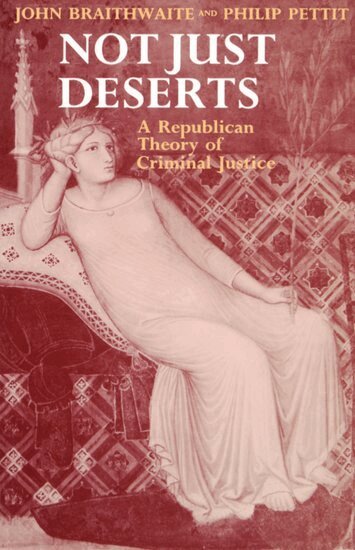
A new approach to sentencingNot Just Deserts inaugurates a radical shift in the research agenda of criminology. The authors attack currently fashionable retributivist theories of punishment, arguing that the criminal justice system is so integrated that sentencing policy has to be considered in the system-wide context. They offer a comprehensive theory of criminal justice which draws on a philosophical view of the good and the right, and which points the way to practical intervention in the real world of incremental reform. They put the case for a criminal justice system which maximizes freedom in the old republican sense of the term, and which they call `dominion'. - Häftad, Engelska, 1986
711 kr
Skickas inom 7-10 vardagar
Are mental states "in the head"? Or do they intrinsically involve aspects of the subject's physical and social context? This volume presents a number of essays dealing with the compass of the mind. The contributors broach a range of issues with a commmon view that physical and social magnets do act upon mental states. The approaches that run through these papers make the volume challenging to cognitive psychologists, theorists of artificial intelligence, social theorists, and philosophers. - Inbunden, Engelska, 1997
2 278 kr
Skickas inom 5-8 vardagar
This is the first full-length presentation of a republican alternative to the liberal and communitarian theories that have dominated political philosophy in recent years. Professor Pettit's eloquent, compelling account opens with an examination of the traditional republican conception of freedom as non-domination, contrasting this with established negative and positive views of liberty. The first part traces the rise and decline of this conception, displays its many attractions, and makes a case for why it should still be regarded as a central political ideal. The second part looks at what the implementation of the ideal would imply for substantive policy-making, constitutional and democratic design, regulatory control and the relation between state and civil society. Prominent in this account is a novel concept of democracy, under which government is exposed to systematic contestation, and a vision of relations between state and society founded upon civility and trust.Professor Pettit's powerful and insightful new work offers not only a unified, theoretical overview of the many strands of republican ideas, it also provides a new and sophisticated perspective on studies in related fields including the history of ideas, jurisprudence, and criminology. - Häftad, Engelska, 1999
867 kr
Skickas inom 5-8 vardagar
This is the first full-length presentation of a republican alternative to the liberal and communitarian theories that have dominated political philosophy in recent years. The author's eloquent, compelling account opens with an examination of the traditional republican conception of freedom as non-domination, contrasting this with established negative and positive views of liberalism. The book examines what the implementation of the ideal would imply for substantive policy-making, constitutional and democratic design, regulatory control and the relation between state and civil society. Professor Pettit's powerful and insightful new work offers not only a unified, theoretical overview of the many strands of republican ideas, it also provides a new and sophisticated perspective on studies in related fields including the history of ideas, jurisprudence, and criminology. The author had included a new postscript to this paperback edition, which offers a sketch of the crucial republican ideas, and to reinforce the argument that the republican tradition deserves more attention than it has generally received among contemporary political theorists. - Inbunden, Engelska, 2015
1 115 kr
Skickas inom 5-8 vardagar
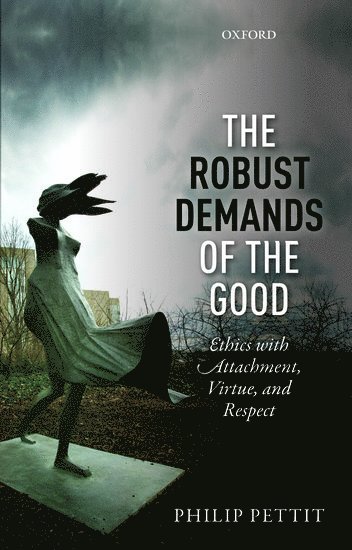
Some goods that we generate for others, as when we give them attention or help or encouragement, require us to provide that benefit under the actual circumstances where we interact. Other goods that we generate require not just that we actually provide that sort of benefit but that we are also poised to provide it, even should actual circumstances change in various ways. These goods demand robust and not merely actual beneficence. Thus to give you friendship I must be robustly, not just accidentally, attentive to your needs; to give you a virtue like honesty I must be robustly disposed to tell you the truth; and to give you respect I must be robustly committed to showing restraint in my dealings with you. In this original contribution to normative ethics, Philip Pettit charts the range of robustly demanding goods, building on his earlier work on the robust demands of freedom. He explores the rationale behind our concern for being able to rely on others to treat us well, not just for being lucky enough to enjoy good treatment. And then he traces the implications for ethics of giving a central place to robustly demanding goods. The lessons he draws teach us that there is a tighter connection between being good and doing good than is generally recognized; that it is harder to count as doing good than it is to count as doing evil; and that there is a serious issue, ignored in many ethical theories, about the basis on which we should deliberate in day-to-day decisions about what it is right to do.The book amounts to a radical rethinking of ethics in which many standard positions shift or fall. The association between being good and doing good casts doubt on the orthodox dichotomy between evaluating agents and evaluating actions. The calibration between doing good and doing evil explains the Knobe effect, so called, as well as explaining the superficial appeal of doctrines like that of double effect. And the investigation of how to be guided in deliberating about the right reduces the gap between the recommendations of approaches like Kantianism, contractualism, and virtue theory and their common, consequentialist foe. - Häftad, Engelska, 2017
421 kr
Skickas inom 7-10 vardagar
Philip Pettit offers a new insight into moral psychology. He shows that attachments such as love, and certain virtues such as honesty, require not only their characteristic positive behaviours in the actual world (i.e. as things are), but preservation of those characteristic behaviours across a range of counterfactual scenarios in which things are different from how they actually are. The counterfactual 'robustness', in this sense, of these behaviours is thus part of our very conception of these attachments and these virtues. Pettit shows that attachment, virtues, and respect all conform to a similar conceptual geography. He explores the implications of this idea for key moral issues, such as the doctrine of double effect and the distinction between doing and allowing. He articulates and argues against an assumption, which he calls 'moral behaviourism,' which permeates contemporary ethics. - Inbunden, Engelska, 2004
902 kr
Skickas inom 5-8 vardagar
However much people want esteem, it is an untradable commodity: there is no way that I can buy the good opinion of another or sell to others my good opinion of them. But though it is a non-tradable good, esteem is allocated in society according to systematic determinants; people's performance, publicity, and presentation relative to others will help to fix how much esteem they enjoy and how much disesteem they avoid. The fact that it is subject to such determinants means in turn that rational individuals are bound to compete with one another, however tacitly, in the attempt to control those influences, increasing their chances of winning esteem and avoiding disesteem. And the fact that they all compete for esteem in this way shapes the environment in which they each pursue the good, setting relevant comparators and benchmarks, and determining the cost that a person must bear -- the price that they must pay -- for obtaining a given level of esteem in any domain of activity. Hidden in the multifarious interactions and exchanges of social life, then, there is a quiet force at work -- a force as silent and powerful as gravity -- which moulds the basic form of people's relationships and associations. This force was more or less routinely invoked in the writings of classical theorists like Aristotle and Plato, Locke and Montesquieu, Mandeville and Hume and Madison. Sometimes it was invoked to explain why people behaved as they did, sometimes to identify initiatives whereby they might be persuaded to behave better. Although Adam Smith himself gave it great credence, however, the rise of economics proper coincided with a sudden decline in the attention devoted to the economy of esteem. What had been a topic of compelling interest for earlier authors fell into relative neglect throughout the nineteenth and twentieth centuries. This book is designed to reverse the trend. It begins by outlining the psychology of esteem and the way the working of that psychology can give rise to an economy. It then shows how a variety of social patterns that are otherwise anomalous come to make a lot of sense within an economics of esteem. And it looks, finally, at the ways in which the economy of esteem may be reshaped so as to make for an improvement -- by reference to received criteria - in overall social outcomes. While making connections with older patterns of social theorising, it offers a novel orientation for contemporary thought about how society works and how it may be made to work. It puts the economy of esteem firmly on the agenda of economic and social science and of moral and political theory. - Inbunden, Engelska, 2002
3 210 kr
Skickas inom 5-8 vardagar
Philip Pettit has drawn together here a series of interconnected essays on three subjects to which he has made notable contributions. The first part of the book discusses the rule-following character of thought. The second considers how choice can be responsive to different sorts of factors, while still being under the control of thought and the reasons that thought marshals. The third examines the implications of this view of choice and rationality for the normative regulation of social behaviour. - Häftad, Engelska, 2002
884 kr
Skickas inom 5-8 vardagar
Philip Pettit has drawn together here a series of interconnected essays on three subjects to which he has made notable contributions. The first part of the book deals with the rule-following character of thought. The second discusses the many factors to which choice is rationally responsive - and by reference to which choice can be explained - consistently with being under the control of thought. The third examines the implications of this multiple sensitivity for the normative regulation of social affairs. Thus the volume covers a large swathe of territory, ranging from metaphysics to philosophical psychology to the theory of rational regulation. The connections that Pettit makes between these areas are original and illuminating.Each part of the book develops a key theme. The first is that thought succeeds in following rules - and overcomes Wittgenstein's rule-following problem - so far as it is response-dependent; it is a sort of enterprise that is accessible only to creatures like us for whom certain responses are primitive and shared. The second is that while human choice may be sensitive to discursive reasons, as we would expect in a thinking subject, it can at the same time be subject to the control - the virtual control, in the model developed here - of rational self-interest. And the third is that the rational interest of agents in achieving esteem in the eyes of others, and in avoiding disesteem, exercises a virtual form of control that can explain the emergence of norms and various other aspects of social life. - Inbunden, Engelska, 2004
1 275 kr
Skickas inom 5-8 vardagar
Frank Jackson, Philip Pettit, and Michael Smith have been at the forefront of philosophy in Australia for much of the last two decades, and their collaborative work has had widespread influence throughout the world. Mind, Morality, and Explanation collects the best of that work in a single volume, showcasing their seminal contributions to philosophical psychology, the theory of psychological and social explanation, moral theory, and moral psychology. - Häftad, Engelska, 2004
725 kr
Skickas inom 5-8 vardagar
Frank Jackson, Philip Pettit, and Michael Smith have been at the forefront of philosophy in Australia for much of the last two decades, and their collaborative work has had widespread influence throughout the world. Mind, Morality, and Explanation collects the best of that work in a single volume, showcasing their seminal contributions to philosophical psychology, the theory of psychological and social explanation, moral theory, and moral psychology. - Inbunden, Engelska, 2004
2 705 kr
Skickas inom 5-8 vardagar
Reason and Value collects 15 new papers by leading contemporary philosophers on themes from the work of Joseph Raz. Raz has made major contributions in a wide range of areas, including jurisprudence, political philosophy, and the theory of practical reason; but all of his work displays a deep engagement with central themes in moral philosophy. The subtlety and power of Raz's reflections on ethical topics make his writings a fertile source for anyone working in this area. Especially significant are his explorations of the connections between practical reason and the theory of value, which constitute a sustained and penetrating treatment of a set of issues at the very center of moral philosophy as it is practiced today. The contributors to the volume acknowledge the importance of Raz's contributions by engaging critically with his positions and offering independent perspectives on the topics that he has addressed. The volume aims both to honour Raz's accomplishments in the area of ethical theorizing, and to contribute to an enhanced appreciation of the significance of his work for the subject.Contributors: Michael E. Bratman, John Broome, Ruth Chang, Jonathan Dancy, Harry Frankfurt, Ulrike Heuer, Philip Pettit, Peter Railton, Donald H. Regan, T. M. Scanlon, Samuel Scheffler, Seana Valentine Shiffrin, Michael Smith, Michael Stocker, Michael Thompson, R. Jay Wallace. - Häftad, Engelska, 2005
1 009 kr
Skickas inom 5-8 vardagar
However much people want esteem, it is an untradable commodity-- there is no way that you can buy the good opinion of another or sell to others your good opinion of them. And yet esteem is allocated in society according to systematic determinants: people's performance, publicity, and presentation relative to others will help to fix how much esteem they enjoy and how much disesteem they avoid. In turn, rational individuals are bound to compete with one another, however tacitly, in the attempt to increase their chances of winning esteem and avoiding disesteem. And this competition shapes the environments in which they each pursue esteem, setting relevant comparators and benchmarks, and determining the cost that a person must bear for obtaining a given level of esteem. Hidden in the multifarious interactions and exchanges of social life, then, there is a quiet force at work -- a force as silent and powerful as gravity -- which molds the basic form of people's relationships and associations. This force was more or less routinely invoked in the writings of classical theorists like Aristotle and Plato, Locke and Montesquieu, Mandeville and Hume and Madison. Although Adam Smith himself gave it great credence, however, the rise of economics proper coincided with a sudden decline in the attention devoted to the economy of esteem. What had been a topic of compelling interest for earlier authors fell into relative neglect throughout the nineteenth and twentieth centuries. This book is designed to reverse the trend. It begins by outlining the psychology of esteem and the way the working of that psychology can give rise to an economy. It then shows how a variety of social patterns that are otherwise anomalous come to make a lot of sense within an economics of esteem. And it looks, finally, at the ways in which the economy of esteem may be reshaped to improve overall social outcomes. While making connections with older patterns of social theorising, it offers a novel orientation for contemporary thought about how society works and how it may be made to work. It puts the economy of esteem firmly on the agenda of economics and social science and of moral and political theory. - Häftad, Engelska, 2006
1 133 kr
Skickas inom 5-8 vardagar
Reason and Value collects 15 new papers by leading contemporary philosophers on themes from the work of Joseph Raz. Raz has made major contributions in a wide range of areas, including jurisprudence, political philosophy, and the theory of practical reason; but all of his work displays a deep engagement with central themes in moral philosophy. The subtlety and power of Raz's reflections on ethical topics make his writings a fertile source for anyone working in this area. Especially significant are his explorations of the connections between practical reason and the theory of value, which constitute a sustained and penetrating treatment of a set of issues at the very center of moral philosophy as it is practiced today. The contributors to the volume acknowledge the importance of Raz's contributions by engaging critically with his positions and offering independent perspectives on the topics that he has addressed. The volume aims both to honour Raz's accomplishments in the area of ethical theorizing, and to contribute to an enhanced appreciation of the significance of his work for the subject. - Inbunden, Engelska, 2011
1 506 kr
Skickas inom 5-8 vardagar
Are companies, churches, and states genuine agents? Or are they just collections of individual agents that give a misleading impression of unity? This question is important, since the answer dictates how we should explain the behaviour of these entities and whether we should treat them as responsible and accountable on the model of individual agents. Group Agency offers a new approach to that question and is relevant, therefore, to a range of fields from philosophy to law, politics, and the social sciences. Christian List and Philip Pettit argue that there really are group or corporate agents, over and above the individual agents who compose them, and that a proper approach to the social sciences, law, morality, and politics must take account of this fact. Unlike some earlier defences of group agency, their account is entirely unmysterious in character and, despite not being technically difficult, is grounded in cutting-edge work in social choice theory, economics, and philosophy. - Häftad, Engelska, 2013
616 kr
Skickas inom 5-8 vardagar
Are companies, churches, and states genuine agents? Or are they just collections of individual agents that give a misleading impression of unity? This question is important, since the answer dictates how we should go about explaining the behaviour of these entities and whether we should treat them as responsible and accountable in the manner of individuals. Group Agency offers a new approach to that question and is relevant, therefore, in a range of fields from philosophy to law, politics, and the social sciences. Christian List and Philip Pettit take the line that there really are group or corporate agents, over and above the individual agents who compose them, and that a proper social science and a proper approach to law, morality, and politics have to take account of this fact. Unlike some earlier defences of group agency, their account is entirely unmysterious in character and, despite not being technically difficult, is grounded in cutting-edge work in social choice theory, economics, and philosophy.