Kinch Hoekstra - Böcker
Visar alla böcker från författaren Kinch Hoekstra. Handla med fri frakt och snabb leverans.
3 produkter
3 produkter
590 kr
Skickas inom 5-8 vardagar
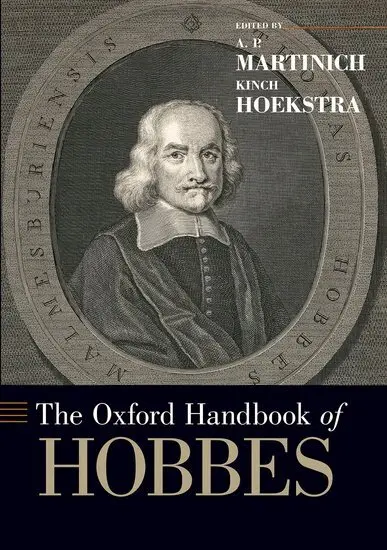
The Oxford Handbook of Hobbes collects twenty-six newly commissioned, original chapters on the philosophy of the English thinker Thomas Hobbes (1588-1679). Best known today for his important influence on political philosophy, Hobbes was in fact a wide and deep thinker on a diverse range of issues. The chapters included in this Oxford Handbook cover the full range of Hobbes's thought--his philosophy of logic and language; his view of physics and scientific method; his ethics, political philosophy, and philosophy of law; and his views of religion, history, and literature. Several of the chapters overlap in fruitful ways, so that the reader can see the richness and depth of Hobbes's thought from a variety of perspectives. The contributors are experts on Hobbes from many countries, whose home disciplines include philosophy, political science, history, and literature. A substantial introduction places Hobbes's work, and contemporary scholarship on Hobbes, in a broad context.
417 kr
Skickas inom 5-8 vardagar
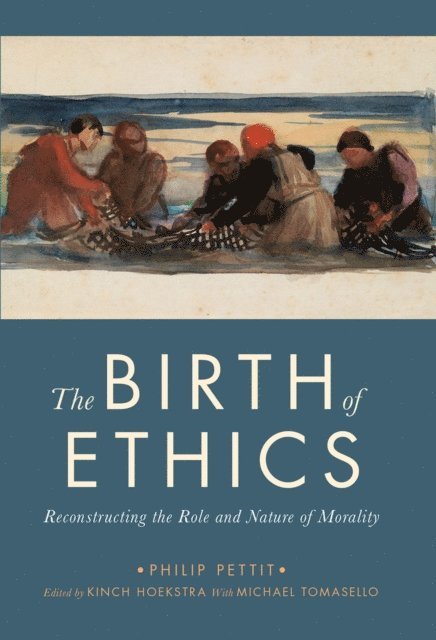
Imagine a human society, perhaps in pre-history, in which people were generally of a psychological kind with us, had the use of natural language to communicate with one another, but did not have any properly moral concepts in which to exhort one another to meet certain standards and to lodge related claims and complaints. According to The Birth of Ethics, the members of that society would have faced a set of pressures, and made a series of adjustments in response, sufficient to put them within reach of ethical concepts. Without any planning, they would have more or less inevitably evolved a way of using such concepts to articulate desirable patterns of behavior and to hold themselves and one another responsible to those standards. Sooner or later, they would have entered ethical space. While this central claim is developed as a thesis in conjectural history or genealogy, the aim of the exercise is philosophical. Assuming that it explains the emergence of concepts and practices that are more or less equivalent to ours, the story offers us an account of the nature and role of morality. It directs us to the function that ethics plays in human life and alerts us to the character in virtue of which it can serve that function. The emerging view of morality has implications for the standard range of questions in meta-ethics and moral psychology, and enables us to understand why there are divisions in normative ethics like that between consequentialist and Kantian approaches.
2 193 kr
Skickas inom 5-8 vardagar
The Oxford Handbook of Hobbes collects twenty-six newly commissioned, original chapters on the philosophy of the English thinker Thomas Hobbes (1588-1679). Best known today for his important influence on political philosophy, Hobbes was in fact a wide and deep thinker on a diverse range of issues. The chapters included in this Oxford Handbook cover the full range of Hobbes's thought--his philosophy of logic and language; his view of physics and scientific method; his ethics, political philosophy, and philosophy of law; and his views of religion, history, and literature. Several of the chapters overlap in fruitful ways, so that the reader can see the richness and depth of Hobbes's thought from a variety of perspectives. The contributors are experts on Hobbes from many countries, whose home disciplines include philosophy, political science, history, and literature. A substantial introduction places Hobbes's work, and contemporary scholarship on Hobbes, in a broad context.