Institute for the Study of the Ancient World Exhibition Catalogs – serie
Visar alla böcker i serien Institute for the Study of the Ancient World Exhibition Catalogs. Handla med fri frakt och snabb leverans.
9 produkter
9 produkter
618 kr
Skickas inom 7-10 vardagar
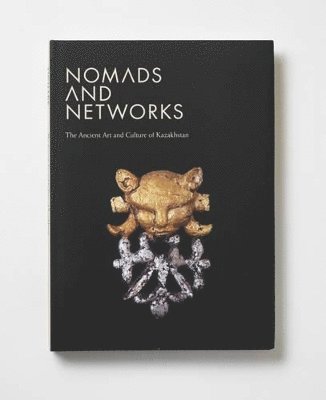
The catalogue for the groundbreaking exhibition at New York University's Institute for the Study of the Ancient World, Nomads and Networks presents an unparalleled overview of the sophisticated culture of pastoral nomadic populations who lived on the territory of present-day Kazakhstan from roughly the middle of the first millennium BCE to the early centuries CE. Focusing on material from the Altai and Tianshan regions, Nomads and Networks explores the specific conditions of mobile lifeways that resulted from particular ecological conditions in the steppes and high valleys of Inner Eurasia. Highlights of the exhibition are grave goods from the burial mounds at the site of Berel and gold mortuary ornaments from Shilikty, Zhalauli, and Kargaly. Attesting to a sophisticated decorative art flourishing among these nomadic populations, the objects skillfully combine older iconographic traditions of animal style in the steppe with more recent influences from foreign cultures--most notably Persia and China. Contributors include Nursan Alimbai, Nikolay A. Bokovenko, Claudia Chang, Bryan K. Hanks, Sagynbay Myrgabayev, Karen S. Rubinson, Zainolla S. Samashev, Soren Stark, and Abdesh T.Toleubaev. Cover photograph (c) Bruce M. White, 2016
553 kr
Skickas inom 7-10 vardagar
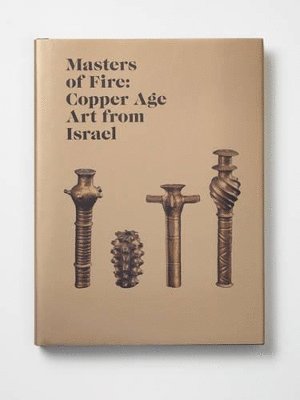
The catalogue for the exciting exhibition at New York University's Institute for the Study of the Ancient World, Masters of Fire presents a comprehensive overview of the little-known yet extraordinary Chalcolithic culture, which existed in the southern Levant from 4500-3600 bce. Masters of Fire focuses on the people of the southern Levant who harnessed the power of metallurgy during the fourth millennium bce. Artisans produced extraordinary copper objects while other craftsmen molded pottery and stone into complex anthropomorphic burial containers, statuettes, and ritual objects. Taken together, these artifacts reveal the first stratified culture known in the ancient Near East. Highlights of the exhibition include a selection of material from the Nahal Mishmar hoard, an unprecedented collection of copper prestige and ritual objects, organic materials from the Cave of the Warrior, and an exceptional group of ritual figurines. Contributors include Thomas E. Levy, Daniel M. Master, Osnat Misch-Brandl, Yorke M. Rowan, Michael Sebbane, Dina Shalem, and Orit Shamir. Cover photograph (c) Bruce M. White, 2016
414 kr
Skickas inom 7-10 vardagar
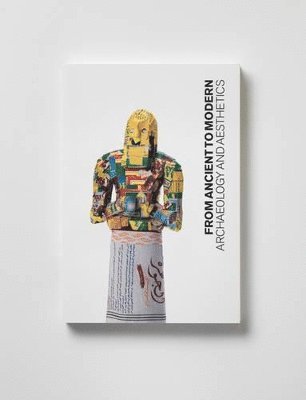
As archaeologists unearth the past, they seek meaning or purpose for the objects they uncover by looking at the objects themselves and their archaeological context. Art historians, on the other hand, primarily focus on aesthetics, asking why a particular object stimulates our senses, and what that tells us about ourselves. From Ancient to Modern offers a lens for understanding ancient objects through the perspectives and processes of both archaeology and aesthetics, and, in so doing, illuminates the multiple layers of meaning that a single object can take on--sometimes simultaneously--over the course of its existence. This beautifully illustrated volume is the accompanying catalog for the exhibition at New York University's Institute for the Study of the Ancient World and focuses on fifty objects from three iconic sites in the ancient Near East: Ur, Diyala, and Kish. The excavation, unique characteristics, and transformative journey of each object--from archaeological artifact to aesthetic item--are examined. Select contemporary artworks are also considered in the investigation of how ancient objects acquire meaning in the present day.Contributors include Kim Benzel, Jennifer Chi, Jean Evans, Lynn Grant, Jack Green, William Hafford, Marc Marin, Naomi Miller, Holly Pittman, Clemens Reichel, Karen Wilson, and Richard Zettler. Cover photograph (c) Bruce M. White, 2016
537 kr
Skickas inom 7-10 vardagar
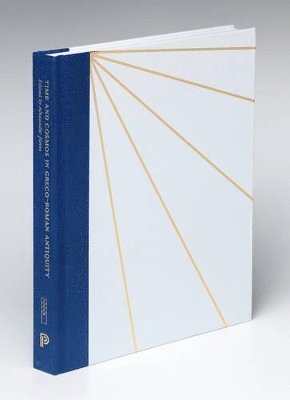
The Greeks and Romans lived according to a distinctively Hellenic conception of time as an aspect of cosmic order and regularity. Appropriating ideas from Egypt and the Near East, the Greeks integrated them into a cosmological framework governed by mathematics and linking the cycles of the heavenly bodies to the human environment. From their cosmology they derived instruments for measuring and tracking the passage of time that were sophisticated embodiments of scientific reasoning and technical craft, meant not solely for the study of specialists and connoisseurs but for the public gaze. Time and Cosmos in Greco-Roman Antiquity, the accompanying catalogue for the exhibition at the Institute for the Study of the Ancient World, New York University, explores through thematic essays and beautiful illustrations the practical as well as the artistic, ideological, and spiritual role of time technology and time imagery in the Mediterranean civilizations.Highlights among the more than one hundred objects from the exhibition include marvelously inventive sundials and portable timekeeping devices, stone and ceramic calendars, zodiac boards for displaying horoscopes, and mosaics, sculptures, and coins that reflect ancient perceptions of the controlling power of time and the heavens. Contributors include James Evans, Dorian Gieseler Greenbaum, Stephan Heilen, Alexander Jones, Daryn Lehoux, Karlheinz Schaldach, John Steele, and Bernhard Weisser. Exhibition Dates: October 19, 2016-April 23, 2017 Cover photograph (c) Bruce M. White, 2016
374 kr
Skickas inom 7-10 vardagar
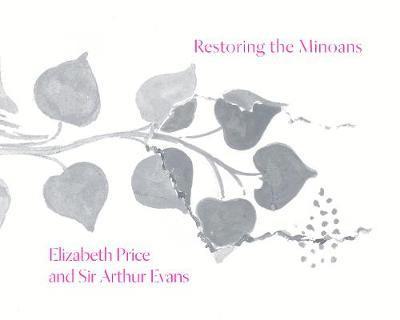
How do archaeologists and artists reimagine what life was like during the Greek Bronze Age? How do contemporary conditions influence the way we understand the ancient past? This innovative book considers two imaginative restorations of the ancient world that test the boundaries of interpretation and invention by bringing together the discovery of Minoan culture by the British archaeologist Sir Arthur Evans (1851-1941) and the work of the Turner Prize-winning video artist Elizabeth Price (b. 1966). Featured essays examine Evans's interpretation and restoration of the Knossos palace and present fresh photography of Minoan artifacts and archival photographs of the dig alongside beautiful, previously unpublished watercolors and drawings by the archaeological illustrators and restorers who worked on the site: Emile Gillieron pere(1850-1924), Emile Gillieron fils (1885-1939), Piet de Jong (1887-1967), and others. An interview with Price explores how her attraction to the Sir Arthur Evans Archive became the basis for her commissioned video installation at the University of Oxford's Ashmolean Museum and offers insight into her creative practice.Exhibition dates: October 5, 2017-January 7, 2018
439 kr
Skickas inom 7-10 vardagar
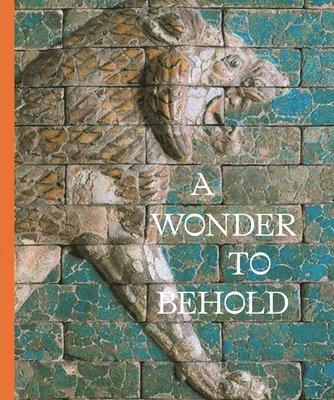
An in-depth and beautifully illustrated look at one of the most revered works of antiquity, the Ishtar Gate of ancient BabylonIn the ancient Near East, expert craftspeople were more than technicians: they numbered among those special members of society who could access the divine. While the artisans’ names are largely unknown today, their legacy remains in the form of spectacular artworks and monuments. One of the most celebrated works of antiquity—Babylon's Ishtar Gate and its affiliated Processional Way—featured a dazzling array of colorful beasts assembled from molded, baked, and glazed bricks. Such an awe-inspiring structure demanded the highest level of craft; each animal was created from dozens of bricks that interlocked like a jigsaw. Yet this display of technical and artistic skill also served a ritual purpose, since the Gate provided a divinely protected entrance to the sacred inner city of Babylon.A Wonder to Behold explores ancient Near Eastern ideas about the transformative power of materials and craftsmanship as they relate to the Ishtar Gate. This beautifully illustrated catalogue accompanies an exhibition at New York University’s Institute for the Study of the Ancient World. Essays by archaeologists, art historians, curators, conservators, and text specialists examine a wide variety of artifacts from major American and European institutions.Contributors include Anastasia Amrhein, Heather Baker, Jean-François de Lapérouse, Eduardo Escobar, Anja Fügert, Sarah Graff, Helen Gries, Elizabeth Knott, Katherine Larson, Beate Pongratz-Leisten, Shiyanthi Thavapalan, and May-Sarah Zeßin.Distributed for the Institute for the Study of the Ancient World at New York UniversityExhibition ScheduleInstitute for the Study of the Ancient World, New York UniversityExhibition Dates: November 6, 2019–May 24, 2020
455 kr
Skickas inom 7-10 vardagar
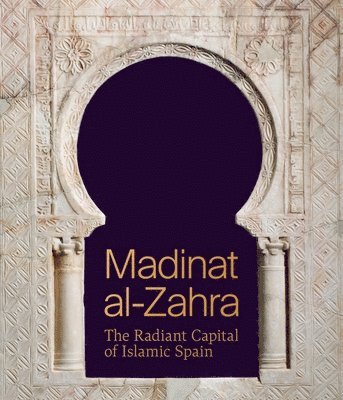
A beautifully illustrated exploration of the famed palace-city that was once the heart of Islamic SpainMadinat al-Zahra, a tenth-century palace-city on the western outskirts of Córdoba, Spain, and a UNESCO World Heritage Site, stands as a testament to the multicultural environment fostered by its founders. Built by ʿAbd al-Rahman III (r. 929–961), a member of the Umayyad dynasty and the first caliph of al-Andalus, the city symbolized the caliph’s aspiration to rule over the Fatimid Caliphs of Ifriqiya in North Africa and the Abbasid Caliphs in Baghdad and was the site of vast cultural and artistic creation.The companion volume to an exhibition at New York University’s Institute for the Study of the Ancient World, this book showcases the complex visual vocabulary of Madinat al-Zahra, which derived from diverse cultural traditions and was translated into new and unique architectural and material cultures. Thematic essays examine the history of the Islamic Caliphate in Muslim Iberia (al-Andalus), the cultural and artistic traditions of the time, and the resulting multicultural society, while shorter, object-focused chapters explore the variety of works found at the ancient site—from jewelry and ceramics to medical texts and epigraphic materials.Contributors include Maribel Fierro Bello, Gerrit Bos, Patrice Cressier, Miquel Forcada, Teresa Garulo, Tawfiq Ibrahim, Fabian Käs, Ana Labarta, Eduardo Manzano Moreno, Antonia Martínez Núñez, Jorge Elices Ocón, Mariam Rosser-Owen, Irene Montilla Torres, Antonio Vallejo Triano, and Mercè Viladrich.Distributed for the Institute for the Study of the Ancient World at New York UniversityExhibition ScheduleInstitute for the Study of the Ancient World, New York UniversityOctober 30, 2024–March 2, 2025
374 kr
Skickas inom 7-10 vardagar
A richly illustrated exploration of how ancient Egyptian art stirred Rodin’s imagination and inspired his sculptureCelebrated as one of the fathers of modern European sculpture, Auguste Rodin (1840–1917) created expressive and emotive human bodies in works that abandoned narrative and embraced the subject and materiality of his medium. While his revolutionary approach to the body broke from neoclassical tradition, he revered the works of antiquity, in which he saw the truest expressions of nature. Rodin was particularly enthralled by the art of ancient Egypt, amassing a collection of more than 1,000 Egyptian objects. Rodin’s Egypt—the companion volume to an exhibition at New York University’s Institute for the Study of the Ancient World—reveals the profound influence Egyptian art had on Rodin’s work and the advent of modernity in European sculpture.Illustrated with some 120 color images, the book traces Rodin’s antiquity collecting; places masterpieces by Rodin in dialogue with Egyptian sculpture, statuettes, and reliefs; and reveals Rodin’s conception of the human form as a logical continuation of ancient Egyptian artistic canons. The book also illuminates how Rodin’s work provides new perspectives on the body in ancient Egypt, enriching conversations on corporeality across the centuries.Contributors include Élisabeth David, Bénédicte Garnier, Dimitri Laboury, Alessio Delli Castelli, Faustine Boulay, and Carl Walsh.Distributed for the Institute for the Study of the Ancient World at New York UniversityExhibition ScheduleInstitute for the Study of the Ancient World, New York UniversityNovember 19, 2025–March 15, 2026
450 kr
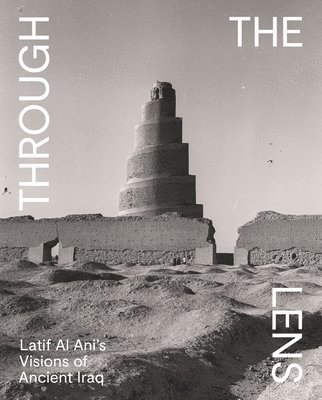
A beautifully illustrated exploration of how Latif Al Ani’s photographs and contemporary Iraqi artists continue to challenge the colonial appropriation of Iraq’s ancient pastBeginning in the early nineteenth century, Mesopotamian and early Islamic ruins became the focus of many Western colonial expeditions. These missions, which routinely dismissed the role and knowledge of local communities, came to shape the historical narrative of ancient civilizations and modern people. In Iraq, home to renowned sites such as Babylon, Dur-Kurigalzu, Ctesiphon, Hatra, and Samarra, foreign excavations appropriated ancient cultures and influenced how they were interpreted and transmitted. And these excavations still reverberate today in understandings of Iraqi identity. Centered around the images of pioneering Iraqi photographer Latif Al Ani (1932–2021), Through the Lens: Latif Al Ani’s Visions of Ancient Iraq highlights the voices of those who explored the Iraqi past and the deeply personal stories of those who confront its legacy, challenging the Western colonial narrative that has dominated for centuries.The companion volume to an exhibition at New York University’s Institute for the Study of the Ancient World, the book features archival documents, lithographs, 1960s photography, essays that explore the rich history of ancient and modern Iraq, and the work and personal accounts of five contemporary Iraqi artists who reflect on the complex issues of Iraqi cultural identity and heritage.Contributors include Adel Abidin, Narmin Amin, Pedro Azara, Roberta Casagrande-Kim, Abdulrahman K. Darwesh, Nelida Fuccaro, Nadine Hattom, Hanaa Malallah, Nat Muller, Mahmoud Obaidi, and Ala Younis.Distributed for the Institute for the Study of the Ancient World at New York UniversityExhibition ScheduleInstitute for the Study of the Ancient World, New York UniversityNovember 8, 2023–February 25, 2024