Journalism in Perspective - Böcker
Visar alla böcker i serien Journalism in Perspective. Handla med fri frakt och snabb leverans.
4 produkter
4 produkter
345 kr
Skickas inom 7-10 vardagar
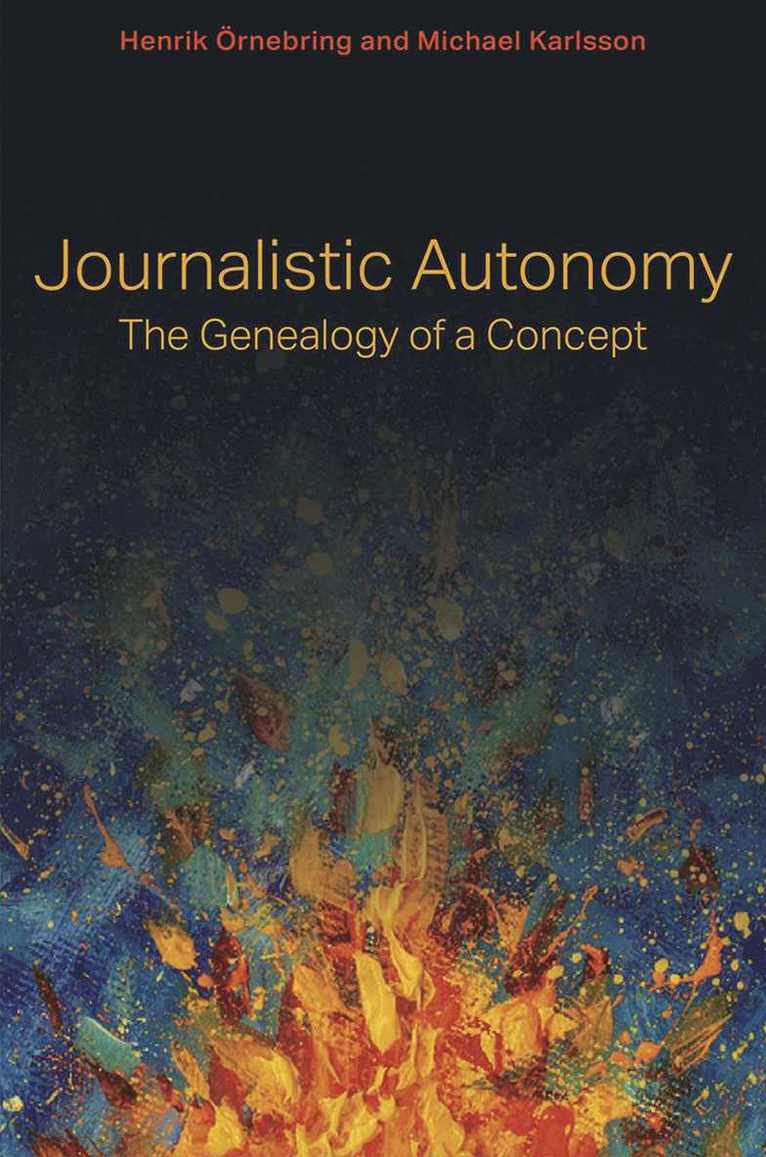
The idea that journalism should be independent is foundational to its contemporary understandings and its role in democracy. But from what, exactly, should journalism be independent? This book traces the genealogy of the idea of journalistic autonomy, from the press freedom debates of the 17th century up to the digital, networked world of the 21st. Using an eclectic and thought-provoking theoretical framework that draws upon Friedrich Nietzsche, feminist philosophy, and theoretical biology, the authors analyze the deeper meanings and uses of the terms independence and autonomy in journalism. This work tackles, in turn, questions of journalism’s independence from the state, politics, the market, sources, the workplace, the audience, technology, and algorithms. Using broad historical strokes as well as detailed historical case studies, the authors argue that autonomy can only be meaningful if it has a purpose. Unfortunately, for large parts of journalism’s history this purpose has been the maintenance of a societal status quo and the exclusion of large groups of the population from the democratic polity. “Independence,” far from being a shining ideal to which all journalists must aspire, has instead often been used to mask the very dependencies that lie at the heart of journalism. The authors posit, however, that by learning the lessons of history and embracing a purpose fit for the needs of the 21st century world, journalism might reclaim its autonomy and redeem its exclusionary uses of independence.
234 kr
Skickas inom 7-10 vardagar
The story of the American newsroom is that of modern American journalism. In this holistic history, Will Mari tells that story from the 1920s through the 1960s, a time of great change and controversy in the field, one in which journalism was produced in “news factories” by news workers with dozens of different roles, and not just once a day, but hourly, using the latest technology and setting the stage for the emergence later in the century of the information economy. During this time, the newsroom was more than a physical place--it symbolically represented all that was good and bad in journalism, from the shift from blue- to white-collar work to the flexing of journalism’s power as a watchdog on government and an advocate for social reform. Told from an empathetic, omnivorous, ground-up point of view, The American Newsroom: A History, 1920–1960 uses memoirs, trade journals, textbooks, and archival material to show how the newsroom expanded our ideas of what journalism could and should be.
530 kr
Skickas
In Deadline: 200 Years of Violence against Journalists in the United States, Elizabeth Atwood offers the first comprehensive look at the history of fatal attacks against journalists in the United States between 1829 and the present. Atwood describes the political, technological, and economic context of these assaults, and includes brief biographies of the victims and accounts of what happened both them and to their assailants after the attacks. To help us understand these attacks, Atwood presents a framework for categorizing them, built on John Nerone’s studies on assaults on American media workers. Atwood categorizes attacks against journalists as attacks against individuals, ideas, and media institutions, and undertaken to suppress reporting on certain topics and in the context of wars and other international or conflicts. Crucially, Deadline utilizes this framework to offer possible solutions to the issue of violence against journalists. Atwood was inspired to explore the pressing issue of violence against American journalists after the tragic death of one of her colleagues at the Baltimore Sun, Rob Hiaasen, in the Capital Gazette shooting in 2018. Throughout, she demonstrates that distrust of the media and violence against the press in the United States are hardly new developments. Her work examines how intimidation, violence, and censorship have, in fact, been used against the American press since both its and the nation’s founding.
530 kr
Kommande
Environmental degradation has been part of American life for centuries, and yet environmental journalism as a specialized reporting beat has only existed since the 1960s. In the ensuing decades, the environment has fallen in and out of favor as a priority for news organizations. Moreover, journalists who pursue environmental stories have long been dogged by a reputation that they are activists, a charge that delegitimizes their labor and further undermines the potential for news organizations to commit to reporting on environmental issues. In The Environmental Beat: Inside the Struggle to Legitimize the Environment as News, Suzannah Evans Comfort examines the circumstances under which news organizations chose to invest in environmental journalism since the early 20th century, demonstrating that a combination of external social factors and internal newsroom dynamics must occur for the environment to appear as a newsworthy topic. Comfort also examines actors on the margins of journalistic legitimacy, such as newspaper outdoor columnists who wrote on the sports pages, and environmental advocacy presses that provided a far more consistent source of environmental news making than their peers in the newsroom. These low-status actors in the journalistic field embraced advocacy and rejected both-siderism in their reporting on issues of the environment. Their consistency and longevity, even as more traditionally produced news attention waxed and waned, may provide an explanation for the perception of environmental news making as fundamentally activist. The Environmental Beat will be of interest to working journalists as well as scholars of journalism.