LA+ Interdisciplinary Journal of Landscape Architecture - Böcker
Visar alla böcker i serien LA+ Interdisciplinary Journal of Landscape Architecture. Handla med fri frakt och snabb leverans.
20 produkter
20 produkter
217 kr
Skickas inom 7-10 vardagar
Our epoch has been dubbed the Anthropocene Era to mark the significance of human activities as the greatest force of environmental change. The distinctions between biology/technology, organic/synthetic, and natural/artificial are increasingly impossible to maintain. Cloned sheep, climate models, digitally-printed tissue and lab-grown meat this is not the nature of our predecessors. This issue of LA+ addresses the theme of SIMULATION in terms of how recent technologies have changed how we understand the nature of nature. From Plato's Cave to Baudrillard's "Simulacrum," simulations were historically understood as counterfeits or facsimiles and were based on the distinction between a model and its copy. Simulations remain central to mediations between reality and its representation; however, the latest forms of simulation - whether genetic manipulation or computer modelling - are not seen as impediments to truth and knowledge but as tools to uncover the complexities of nature. A diverse list of contributors critically investigates the theme through a myriad of lenses including biology, computer sciences, engineering, environmental science, industrial design, philosophy, and planning, among other fields. LA+ Simulation is guest-edited by Karen M'Closkey and Keith VanDerSys.
193 kr
Skickas inom 7-10 vardagar
Risk is many things. It can invoke fun, temptation, or danger; it can be laced with uncertainty, fear, or hope. But most importantly for the design professions, risk is the engine of art and innovation. Complicating the risks inherent in every act of environmental design are two now dominant threats to humanity: climate change and social inequality, both of which are expected to make Earth a more volatile, dystopian planet. Risk reduction - under the rubric of resilience - is the new paradigm for landscape architecture and urbanism.
187 kr
Skickas inom 7-10 vardagar
Paradisiacal, utopian, dystopian, heterotopian - islands hold an especially enigmatic and beguiling place in our imagination. Issue 07 of LA+ Journal brings you the results of the LA+ Imagination open international design ideas competition, in which designers were asked to create a new island. In addition to showcasing the winners and other interesting, unusual or surprising entries, LA+ Imagination features interviews with jurors James Corner, Richard Weller, Marion Weiss, Javier Arpa, Matthew Gandy and Mark Kingwell.
187 kr
Skickas inom 7-10 vardagar
Time is ticking. That's what it does. Or at least that's how we represent what we don't understand. For physics, time is a byproduct of so called space-time, elastic goo created at the very moment that something came from nothing; the moment eternity stopped and the universe began. For geology, time is 4.5 billion years of compression and catastrophe. For biology time is 3.5 billion years of diversification and now the urgency of the sixth extinction. For anthropology time is 150 thousand years since mitochondrial Eve walked out of the rift valley in Ethiopia. For historians, time begins with Herodotus (484 BC) and ends, or rather doesn't, with Fukuyama's The End of History. For architecture time is ruination. For landscape architecture time is ephemerality, entropy, and growth. For all of us time is running out. Contents: Editorial by Richard Weller & Tatum L. Hands; Prisoners of Time by Mark Kingwell; Doing Time: The Art of Tehching Hseih by Tim Ingold; Territorializing Memory by Rodrigo de la O + David Escudero; Designing Dialectical Landscape by Ann Marie Schneider; Time for time by Noël van Dooren; The Consistency of Time by Valerio Morabito; Performing Drawing in Time by Fiona Harrisson + Marian Macken; Phase Shift: On Site-Specific Art In A Changing Environment by James Nisbet; Date, Painting by Daniel Rosenberg; Time, Trains, and Truth by Mark Raggat; The Circle of Time by Jock Gilbert; Three Kinds of Time in Ecological Science by Steward Pickett; Color = Space + Time by Mark Eischeild; The Time and Space to Die by Emma Sheppard-Simms; First in Time/First in Line by Casey Lance Brown; Time in Our Hands: Co-Designing a Better Anthropocene by Erle C. Ellis; The Timekeepers by Kathryn Gleason, Christophe Girot + Sonja Dümpelmann.
217 kr
Skickas inom 7-10 vardagar
From the first utopian impulse of Plato's Republic to today's global border controls and public space surveillance systems, there has always been a tyrannical aspect to the organisation of society and the regulation of its spaces. Tyranny takes many forms, from the rigid barriers of military zones to the subtle ways in which landscape is used to 'naturalise' power. What are these forms and how do they function at different scales, in different cultures, and at different times in history? How are designers and other disciplines complicit in the manifestation of these varying forms of tyranny and how have they been able to subvert such political and ideological structures?
198 kr
Skickas inom 7-10 vardagar
From the stone blade and the fire stick to the latest algorithms of genetic code, we shape our world through the act of design. With its roots in the Renaissance notion disegno, design is the ability not only to make something, but also to conceive of its invention and reflect on its meaning. Whether we valorise it as the democratisation of design or critique it as the perversion of the commodity fetish, designed things are now ubiquitous. Not only things but entire systems must now be designed and objects reconceived and redesigned as mere moments in unfathomably complex ecological flows. The planet itself, and even space beyond, is now presented as a design problem. What does landscape architecture bring to the broader culture of design? What lessons can be learned from other disciplines at the cutting edge of design? What role does design play in a time of transformative technological change? In LA+ Design we move beyond the designed outcome to explore the myths, methods, meanings, and futures of design.Engineer and physicist Adrian Bejan outlines his constructal theory, which predicts natural design and its evolution in engineering, scientific, and social systems. Design researchers Craig Bremner + Paul Rodgers take us through an A Z of design ecology. Architects Lizzie Yarina + Claudia Bode open our eyes to new ways of seeing things through subject-object relations. Jenni Zell explores life as a woman landscape architect through a Kafkaesque lens. Daniel Pittman interviews MoMA's curator of architecture and design, Paola Antonelli. Architect David Salomon explores methods of using data as both fact and fiction. Christopher Marcinkoski interviews Anthony Dunne + Fiona Raby (Dunne + Raby) to discuss how their practice continuously redefines the role of design in society. Thomas Oles challenges stereotypes of landscape architecture s professional identity. Richard Weller discusses the terrarium as the ultimate design experiment. Dane Carlson goes deep into the culture of Nepal s hinterlands to explore new modes and geographies for landscape architecture beyond the first world. Through LA's signage, anthropologist Keith Murphy shows how different groups of people interact with and give meaning to the landscapes they inhabit. Interviewed by Colin Curley, architect Andrés Jaque (Office for Political Innovation) discusses the role of technology and agency of architecture in society today. Game designer Colleen Macklin shows how public space can be redefined and subverted through the agency of play. Javier Arpa interviews urban design guru Winy Maas (MVRDV, The Why Factory) to discuss his views on the future of design and design education. Experimental psychologist Thomas Jacobsen describes current neurological research into the subjectivity of beauty. Landscape architect James Corner talks about the evolution of the profession of landscape architecture in a wide-ranging interview.
198 kr
Skickas inom 7-10 vardagar
Vitality is liveliness, to be alive.To be alive is to have the ability to harvest energy for movement, growth, and self-replication. But without health, vitality is just mechanistic. In this issue of LA+ we explore the notion of vitality as aproxy for the health of all things. We explore how design can improve the vitality of people, cities, systems, and landscapes.Articles include:- Sara Jensen-Carr explores the intertwined epidemiology of ecosystems, cities, and human bodies.-Through the intimate case study of a 15th century Roman noblewoman, historian Mirka Benes reveals the role of gardens in maintaining physical and mental health in the early modern era.- Design anthropologist Chuan Hao Chen reflects on vitality through the metaphor of the medical emergency.- Experimental psychologist Colin Ellard explores questions about the roots of our perceptions of life and agency.- Urban designer Julian Bolleter shines a light on the practice of placemaking in contemporary Dubai.-Public health scientists Billie Giles Corti, Jonathan Arundel, and LucyGunn explain why urban design is important in creating livable cities.-Landscape architect Clay Gruber captures a case study of the potential for renewal of a rural American landscape drained of socio-economic vitality.- Designer Colin Curley surveys the beautiful ugliness of Newtown Creek, New York's most-polluted waterway.-Biodiversity conservation scientist Andrew Gonzalez explains his multi-year research into designing a comprehensive and practicable greennetwork for the city of Montreal and its hinterlands.- Landscape architect Jake Boswell offers a wide-ranging rumination on ecology and aesthetics.-Psychiatrist and urban health scholar Mindy Thompson Fullilove reflectsupon the vitality of main streets in small-town America.- Philosopher Mark Kingwell takes on artificial intelligence in a series of provocative propositions dealing with notions of life and vitality.-Architect and urban designer Christopher Marcinkoski considers Tokyo's landscape future in the face of significant population decline.- Also includes interviews with the celebrated author of Vibrant Matter, Jane Bennett, MASS Design Group's Sierra Bainbridge, and The Nature Conservancy's lead scientist for global cities Rob MacDonald.
198 kr
Skickas inom 7-10 vardagar
Issue 10 of LA+ Journal brings you the results of the LA+ Iconoclast open design ideas competition, in which we asked designers to reimagine New York's Central Park, fictionally devastated by eco-terrorists protesting the loss of the world's forests. See what designers did when faced with the opportunity to challenge this icon of landscape architecture. LA+ Iconoclast also features interviews with jurors Geoff Manaugh (BLDGBLOG), Jenny Osuldsen (Snøhetta), Charles Waldheim (Harvard GSD), Beatrice Galilee (The Met), Lola Shepard (Lateral Office), and Richard Weller (PennDesign), as well as a critique of competition entries by Julia Czerniak.
198 kr
Skickas inom 7-10 vardagar
GEO - Earth - is a word that simultaneously signifies something vast and elemental. It refers to both the planet on which we live and the soil that sustains us. GEO is the physical and representational bedrock of landscape architecture - the foundation of many disciplines from which we draw our knowledge. Geography, Geology, and Geometry, in particular, are fundamental to our discipline’s intellectual core. And now, we seem ever more entangled in GEO as some scholars across the sciences and humanities argue that humans should be recognised as agents of change at geologic time scales. LA+ GEO includes interviews with the celebrated author of After the Map, William Rankin, author and citizensensing visionary Jennifer Gabrys, and New Zealand based media artist and author Janine Randerson with guest editors Karen M’Closkey and Keith VanDerSys explore site surveying and sensing technologies as part of an expanded toolkit for landscape architects to bring environmental patterns down to earth and into view.Other notable points are from Designer Robert Gerard Pietrusko who reveals the covert militaristic agendas of early aerial land cover interpretation, Geographer Matthew W. Wilson revisits the rise of critical cartography within geography in the 1980s and ‘90s.Media scholar Lisa Parks describes the politics of vertical mediation by recounting the importance of activists’ use of drone-captured video to document both the protests against the construction of an oil pipeline through tribal lands, as well as the aggressive countermeasures taken by law enforcement to squelch the protests.Jeffrey S. Nesbit and David Salomon, rocket launch pads provide a vehicle to unpack the relationship between terrestrial and extra-terrestrial territories. Geographers Douglas Robb and Karen Bakker caution against the voyeuristic tendencies enabled by the satellite gaze.Through illustrated “Geostories,” Rania Ghosn imaginatively engages the “global commons” of outer space and oceans. Designer Matthew Ransom examines the tension between grassroots organisations and fracking industries in Pennsylvania. Author and activist Lucy R. Lippard takes us on an aerial journey across the United States. Historian and geographer B.W. Higman traces our modern predilections towards flatness.Through a remaking of Eugène Violletle Duc’s Mont Blanc studies, landscape architect Aisling O’Carroll exposes the imposition of geometric rationalisation on nature. Noah Heringman revisits the sublime in 18th-century landscape design, offering parallels to today’s Anthropocene discourses about environmental depletion and Shannon Mattern examines how rocks are collected, examined, and displayed as objects of spectacular brilliance – objects that ultimately reflect back on us by illuminating the histories of oppression embedded in their extraction.
257 kr
Skickas inom 3-6 vardagar
LA+ COMMUNITY aims to explore how, over time, each of us moves in and out of multiple communities, shaping them as they shape us, and in turn shaping our landscapes and cities.
257 kr
Skickas inom 3-6 vardagar
Issue 14 of LA+ Journal brings you the results of the LA+ CREATURE international design ideas competition, which explored how we can use design to achieve a more symbiotic existence with other creatures.
257 kr
Skickas inom 3-6 vardagar
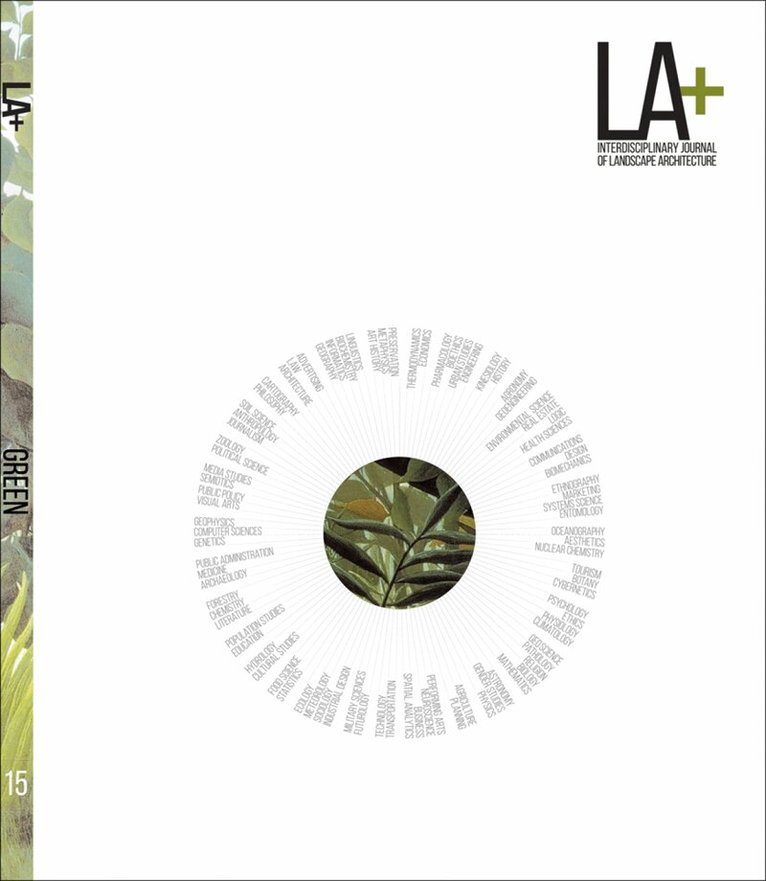
LA+ Green explores the green spectrum from plants to politics and from art to science. Includes an interview with Noam Chomsky.
206 kr
Skickas inom 5-8 vardagar
In this moment of seemingly compounding global crises and existential concerns about the future of the planet, LA+ pauses to consider the values and implications of speculation. How are speculative acts understood differently within specific disciplinary structures versus broader cultural perceptions? Whether employed as a means of influence, a method of production, a form of practice, a manner of inquiry, a way of seeing, or a motivating ideology, LA+ Speculation engages speculation and the speculative as world-shaping concepts worthy of deep and critical reflection. Guest edited by Christopher Marcinkoski with Javier Arpa Fernandez, and other contributors include: Merve Bedir, Casey Lance Brown, Stuart Candy, Paul Dobraszyk, Aroussiak Gabrielian, Daisy Ginsberg, Adrian Hawker, Souhei Imamu, Karen Lewis, Min Kyung Lee, Mpho Matsipa, Alexandra Sankova, Jonah Susskind, Ytasha Womak.
242 kr
Skickas inom 5-8 vardagar
As well as showcasing the award-winning designs and a comprehensive Salon des Refusés, LA+ INTERRUPTION features interviews with jurors Fiona Raby, Martin Rein-Cano, Mark Raggatt, Rania Ghosn, and Jason Zhisen Ho, and an essay by Katya Crawford, coauthor of the The Design Competition in Landscape Architecture (forthcoming).
213 kr
Skickas inom 5-8 vardagar
Drawing from diverse disciplines including philosophy, history, cultural criticism, visceral geography, urban studies, gender studies, and racial aesthetics, the 18th Issue of LA+ explores the elusive and enigmatic theme BEAUTY in relation to landscape architecture and the constructed environment. Rather than arrive at any one singular definition of beauty, within its pages, contributors challenge readers with alternative views through deep and critical reflection. What is a “beautiful” landscape today? Is there such a thing as “natural beauty”? Why do humans across the cultural spectrum concern themselves so much with the beautification of themselves, their objects, and their surroundings? Is beautification benevolent or nefarious? Is there value — economic or otherwise — in beauty, and whose interests do ideals of beauty serve? In the end, why does beauty matter at all?LA+ BEAUTY is guest-edited by Colin Curley, a New York-based landscape architect and architect whose work navigates the complex environmental and socio-political dimensions of disturbed, contaminated industrial landscapes, and seeks to expand the range of their aesthetic and experiential potential.
213 kr
Skickas inom 5-8 vardagar
LA+ Botanic explores our evolving relationship with plants with contributions that reflect on the many natures and relations that are being materialised in plant conservation, botanic gardens, and botanic art today. A wide range of topics is covered, including plant conservation efforts and the challenges posed by global heating and extinction, the limited plant choices imposed by the horticultural industry, and the many representations of plants found in visual, material, textual, and architectural works. Edited by Karen M’Closkey, contributors include Giovanni Aloi, Irus Braverman, Patrick Blanc, Xan Sarah Chacko, Sonja Dümpelmann, Jared Farmer, Annette Fierro, Matthew Gandy, Ursula K. Heise, Andrea Ling, Janet Marinelli, Beronda L. Montgomery, Catherine Mosbach, Katja Grötzner Neves and Bonnie-Kate Walker.
206 kr
Skickas inom 5-8 vardagar
Issue 20 of LA+ journal brings you the results of our fifth international design ideas competition. LA+ EXOTIQUE asked entrants to redesign the forecourt of the Museum of Natural History in Paris. The Museum—founded in 1793—sits within the Jardin des Plantes grounds, which include themed gardens, a zoo, and five themed galleries. In addition to its collections, the Museum is an active research institution studying the evolution of life on this planet. LA+ EXOTIQUE showcases the award-winning designs and a comprehensive Salon des Refusés. The issue will also feature an essay by LA+ creative director Catherine Seavitt and interviews with jurors Julia Czerniak, Sonja Dümpelmann, Catherine Mosbach, Signe Nielsen, and Marcel Wilson.
206 kr
Skickas inom 5-8 vardagar
Ever more technologies are being created to sense our environment, and much is being learned about how animals and plants sense theirs. We often think of these tools as extending our capacity for sensing what is not available through natural human perception. But what is “natural” about human perception? Not as much as was once believed, it turns out. Many of the contributors to LA+ SENSE consider how our senses have become naturalised, and our bodies and experiences standardised. Topics also include sense and surveillance, sense of place, and whether we can even trust our senses.
282 kr
Skickas
The idea of “environment” is foundational to landscape architecture – as backdrop, as surround, as something to help save. But what is the environment, or an environment? First and foremost, it is a word that is so pervasive - and its meaning taken for granted - that it is easily forgotten how recently the term has proliferated, particularly as a qualifier for myriad disciplines, institutions, and activities: environmental history, environmental studies, environmental science, environmental justice, environmental art, environmental planning, environmental protection, environmentalism. In our upcoming issue, LA+ Environment, designers and scholars illuminate the wide range of interpretations, histories, and projects that engage with this elusive idea.
345 kr
Kommande
The word “media”—the plural of “medium”—is from the Latin medius, meaning “middle.” Since the 19th century, the term has pertained broadly to anything that is a means of transmission or communication; however, media are not simply neutral channels that transmit content created through other means, as the contributors to this issue demonstrate. Authors from a wide array of disciplines explore the “middleness” of media by considering how its various forms influence our knowledge, shape our understanding, and affect our interpretation of the world around us.We end with a tribute to the late Richard Weller, co-founder with Tatum Hands of this journal.