Keith VanDerSys - Böcker
Visar alla böcker från författaren Keith VanDerSys. Handla med fri frakt och snabb leverans.
5 produkter
5 produkter
2 806 kr
Skickas inom 10-15 vardagar
Dynamic Patterns explores the role of patterns in designed landscapes. Patterns are inherently relational, and the search for and the creation of patterns are endemic to many scientific and artistic endeavors. Recent advances in optical tools, sensors, and computing have expanded our understanding of patterns as a link between natural and cultural realms. Looking beyond the surface manifestation of pattern, M’Closkey and VanDerSys delve into a multifaceted examination that explores new avenues for engagement with patterns using digital media. Examining the theoretical implications of pattern-making, they probe the potential of patterns to conjoin landscape’s utilitarian and aesthetic functions. With full color throughout and over one hundred and twenty images, Dynamic Patterns utilizes work from a wide range of artists and designers to demonstrate how novel modes of visualization have facilitated new ways of seeing patterns and therefore of understanding and designing landscapes.
777 kr
Skickas inom 10-15 vardagar
Dynamic Patterns explores the role of patterns in designed landscapes. Patterns are inherently relational, and the search for and the creation of patterns are endemic to many scientific and artistic endeavors. Recent advances in optical tools, sensors, and computing have expanded our understanding of patterns as a link between natural and cultural realms. Looking beyond the surface manifestation of pattern, M’Closkey and VanDerSys delve into a multifaceted examination that explores new avenues for engagement with patterns using digital media. Examining the theoretical implications of pattern-making, they probe the potential of patterns to conjoin landscape’s utilitarian and aesthetic functions. With full color throughout and over one hundred and twenty images, Dynamic Patterns utilizes work from a wide range of artists and designers to demonstrate how novel modes of visualization have facilitated new ways of seeing patterns and therefore of understanding and designing landscapes.
217 kr
Skickas inom 7-10 vardagar
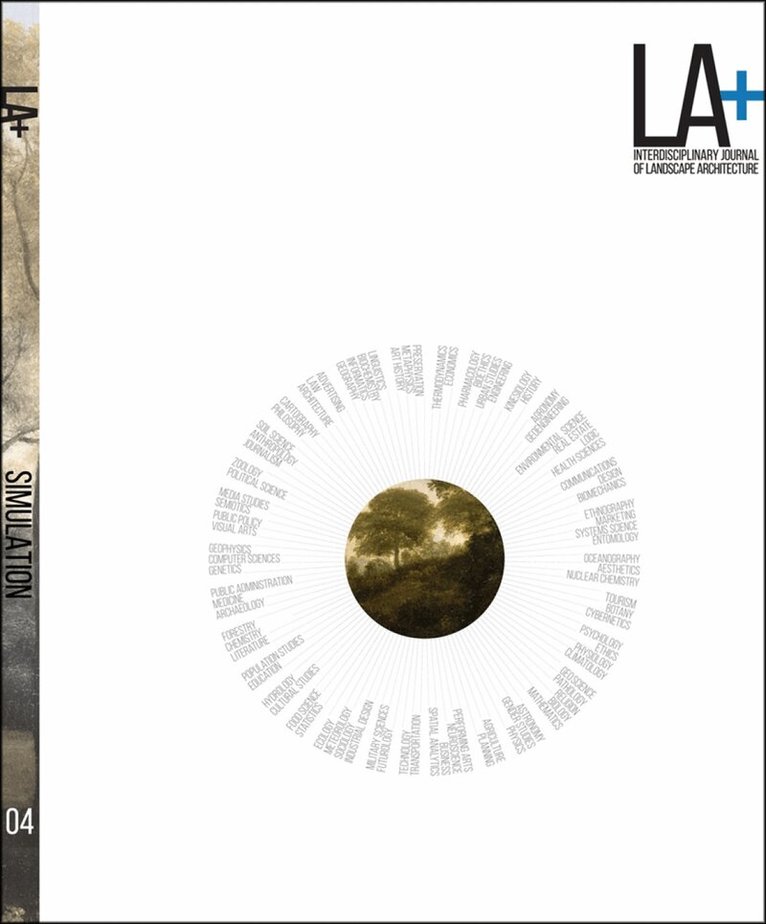
Our epoch has been dubbed the Anthropocene Era to mark the significance of human activities as the greatest force of environmental change. The distinctions between biology/technology, organic/synthetic, and natural/artificial are increasingly impossible to maintain. Cloned sheep, climate models, digitally-printed tissue and lab-grown meat this is not the nature of our predecessors. This issue of LA+ addresses the theme of SIMULATION in terms of how recent technologies have changed how we understand the nature of nature. From Plato's Cave to Baudrillard's "Simulacrum," simulations were historically understood as counterfeits or facsimiles and were based on the distinction between a model and its copy. Simulations remain central to mediations between reality and its representation; however, the latest forms of simulation - whether genetic manipulation or computer modelling - are not seen as impediments to truth and knowledge but as tools to uncover the complexities of nature. A diverse list of contributors critically investigates the theme through a myriad of lenses including biology, computer sciences, engineering, environmental science, industrial design, philosophy, and planning, among other fields. LA+ Simulation is guest-edited by Karen M'Closkey and Keith VanDerSys.
198 kr
Skickas inom 7-10 vardagar
GEO - Earth - is a word that simultaneously signifies something vast and elemental. It refers to both the planet on which we live and the soil that sustains us. GEO is the physical and representational bedrock of landscape architecture - the foundation of many disciplines from which we draw our knowledge. Geography, Geology, and Geometry, in particular, are fundamental to our discipline’s intellectual core. And now, we seem ever more entangled in GEO as some scholars across the sciences and humanities argue that humans should be recognised as agents of change at geologic time scales. LA+ GEO includes interviews with the celebrated author of After the Map, William Rankin, author and citizensensing visionary Jennifer Gabrys, and New Zealand based media artist and author Janine Randerson with guest editors Karen M’Closkey and Keith VanDerSys explore site surveying and sensing technologies as part of an expanded toolkit for landscape architects to bring environmental patterns down to earth and into view.Other notable points are from Designer Robert Gerard Pietrusko who reveals the covert militaristic agendas of early aerial land cover interpretation, Geographer Matthew W. Wilson revisits the rise of critical cartography within geography in the 1980s and ‘90s.Media scholar Lisa Parks describes the politics of vertical mediation by recounting the importance of activists’ use of drone-captured video to document both the protests against the construction of an oil pipeline through tribal lands, as well as the aggressive countermeasures taken by law enforcement to squelch the protests.Jeffrey S. Nesbit and David Salomon, rocket launch pads provide a vehicle to unpack the relationship between terrestrial and extra-terrestrial territories. Geographers Douglas Robb and Karen Bakker caution against the voyeuristic tendencies enabled by the satellite gaze.Through illustrated “Geostories,” Rania Ghosn imaginatively engages the “global commons” of outer space and oceans. Designer Matthew Ransom examines the tension between grassroots organisations and fracking industries in Pennsylvania. Author and activist Lucy R. Lippard takes us on an aerial journey across the United States. Historian and geographer B.W. Higman traces our modern predilections towards flatness.Through a remaking of Eugène Violletle Duc’s Mont Blanc studies, landscape architect Aisling O’Carroll exposes the imposition of geometric rationalisation on nature. Noah Heringman revisits the sublime in 18th-century landscape design, offering parallels to today’s Anthropocene discourses about environmental depletion and Shannon Mattern examines how rocks are collected, examined, and displayed as objects of spectacular brilliance – objects that ultimately reflect back on us by illuminating the histories of oppression embedded in their extraction.
366 kr
Skickas
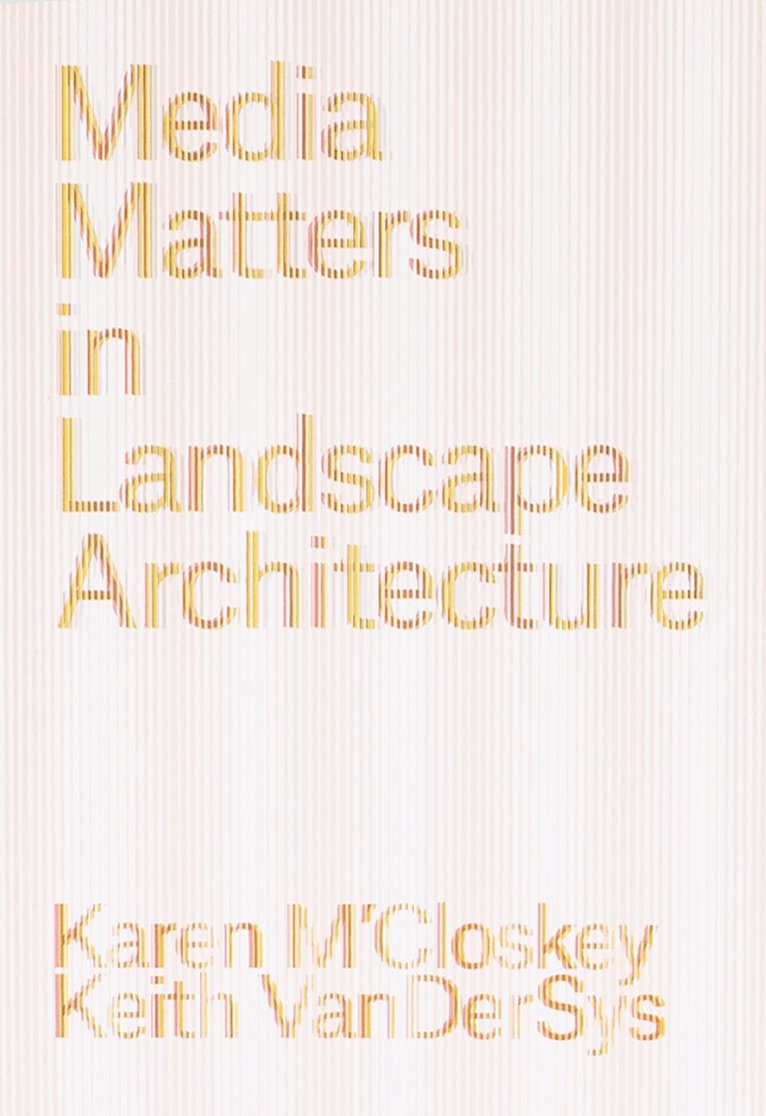
Media Matters in Landscape Architecture makes a unique contribution to landscape architectural praxis for its explicit framing of “environmental media” in terms of its dual meaning within our discipline. In the sciences, environmental media are the materials of the natural world—soils, air, water, plants, microbes. Within STS and media studies, “environmental media” refers broadly to the relationship between environmental issues—such as pollution, biodiversity loss, climate change—and the creation and application of the tools, interfaces, and images, through which information about these issues is conveyed. This book focuses on how these two distinct understandings of environmental media coalesce within the discipline of landscape architecture and other spatial design fields. Authors from a wide-range of disciplines—landscape architecture, media studies, history of science, civil engineering, ecology, planning, and architecture—examine how the creation and use of data, images, and models acts as intermediaries—the mediums through which a particular understanding of “environment” or “landscape” arises. This framing of environmental media emphasises the relationships among various design media and the specific material and social environments within which they operate.