Menahem Stern Jerusalem Lectures - Böcker
Visar alla böcker i serien Menahem Stern Jerusalem Lectures. Handla med fri frakt och snabb leverans.
8 produkter
8 produkter
331 kr
Skickas inom 7-10 vardagar
In this wide-ranging consideration of intellectual diasporas, historian Peter Burke questions what distinctive contribution to knowledge exiles and expatriates have made. The answer may be summed up in one word: deprovincialization. Historically, the encounter between scholars from different cultures was an education for both parties, exposing them to research opportunities and alternative ways of thinking. Deprovincialization was in part the result of mediation, as many émigrés informed people in their “hostland” about the culture of the native land, and vice versa. The detachment of the exiles, who sometimes viewed both homeland and hostland through foreign eyes, allowed them to notice what scholars in both countries had missed. Yet at the same time, the engagement between two styles of thought, one associated with the exiles and the other with their hosts, sometimes resulted in creative hybridization, for example, between German theory and Anglo-American empiricism. This timely appraisal is brimming with anecdotes and fascinating findings about the intellectual assets that exiles and immigrants bring to their new country, even in the shadow of personal loss.
217 kr
Kommande
371 kr
Skickas inom 5-8 vardagar
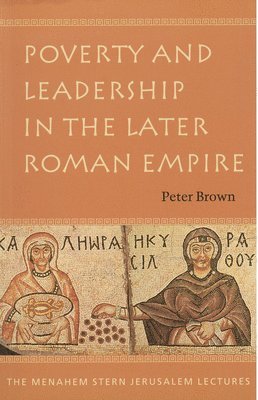
In three magisterial essays, Peter Brown, one of the world's foremost scholars of the society and culture of late antiquity, explores the emergence in late Roman society of "the poor" as a distinct social class, one for which the Christian church claimed a special responsibility. It is the story of how a society came to see itself as responsible for the care of a particular class of people -- a class that had not previously been cared for -- and of who benefited from that shift in interests.In his characteristically elegant and lucid prose, Brown seeks to recover the pre-Christian status of poor people, the actual nature of the relations between the Christian church and the poor, and the true motivations -- sometimes sincere, sometimes self-serving -- behind Christian rhetoric of love for the poor. He draws not only on the standard Greek and Latin sources for the later Roman Empire, but also on Jewish sources to document the interactions between Middle Eastern provincial societies and classical Roman traditions. Brown gracefully illuminates a crucial transition from classical to Christian culture: the emergence of a new understanding of what society -- and the Church -- owes to the poor that continues to resonate.
454 kr
Skickas inom 3-6 vardagar
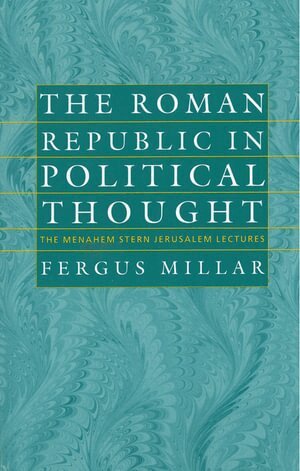
It is a fact that the very long-lived Roman Republic has consistently played a surprisingly slight role in political theory and discussions about the nature of democracy, forms of government, and other matters, particularly when compared to the enormous attention paid to fifth-century BCE Athenian democracy. Fergus Millar re-opens the issue of how the Roman Republic was understood and used by political thinkers from the Ancient World to the present. Describing both the reality of the late Roman Republic and showing how its nature was distorted even by contemporary sources, he tracks its treatment (or absence) in political discourse from Thomas Aquinas, Machiavelli, Montesquieu, and Rousseau, and in debates surrounding the creation of the American constitution, particularly in the Federalist papers. In brief, clear prose, with quotations in English from important works, and economical use of endnotes, he reinforces his unconventional thesis about the significance of direct democracy in the late Roman Republic. In the process, he also provides an unprecedented tour through 2000 years of Western political theory from the point of view of the Roman Republic, in general, and theories of direct democracy and the balance of power, in particular.
291 kr
Skickas inom 7-10 vardagar
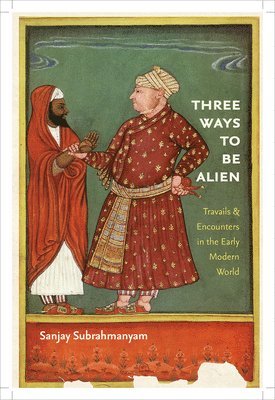
Sanjay Subrahmanyam's Three Ways to Be Alien draws on the lives and writings of a trio of marginal and liminal figures cast adrift from their traditional moorings into an unknown world. The subjects include the aggrieved and lost Meale, a "Persian" prince of Bijapur (in central India, no less) held hostage by the Portuguese at Goa; English traveler and global schemer Anthony Sherley, whose writings reveal a surprisingly nimble understanding of realpolitik in the emerging world of the early seventeenth century; and Nicolò Manuzzi, an insightful Venetian chronicler of the Mughal Empire in the later seventeenth century who drifted between jobs with the Mughals and various foreign entrepôts, observing all but remaining the eternal outsider. In telling the fascinating story of floating identities in a changing world, Subrahmanyam also succeeds in injecting humanity into global history and proves that biography still plays an important role in contemporary historiography.
334 kr
Skickas inom 5-8 vardagar
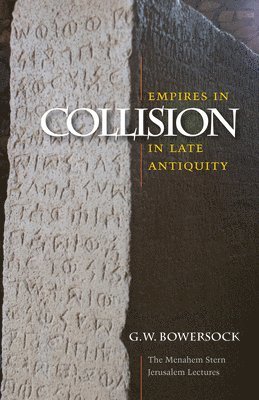
In this book, based on lectures delivered at the Historical Society of Israel, the famed historian G. W. Bowersock presents a searching examination of political developments in the Arabian Peninsula on the eve of the rise of Islam. Recounting the growth of Christian Ethiopia and the conflict with Jewish Arabia, he describes the fall of Jerusalem at the hands of a late resurgent Sassanian (Persian) Empire. He concludes by underscoring the importance of the Byzantine Empire's defeat of the Sassanian forces, which destabilized the region and thus provided the opportunity for the rise and military success of Islam in the seventh century. Using close readings of surviving texts, Bowersock sheds new light on the complex causal relationships among the Byzantine, Ethiopian, Persian, and emerging Islamic forces.
964 kr
Kommande
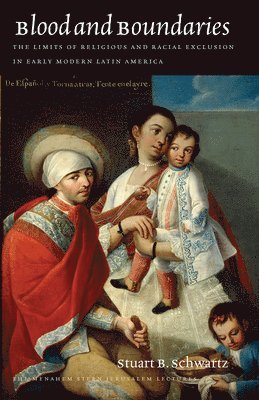
Blood and Boundaries – The Limits of Religious and Racial Exclusion in Early Modern Latin America
Häftad, Engelska, 2020
282 kr
Skickas inom 7-10 vardagar
In Blood and Boundaries, Stuart B. Schwartz takes us to late medieval Latin America to show how Spain and Portugal’s policies of exclusion and discrimination based on religious origins and genealogy were transferred to their colonies in Latin America. Rather than concentrating on the three principal divisions of colonial society—Indians, Europeans, and people of African origins—as is common in studies of these colonial societies, Schwartz examines the three minority groups of moriscos, conversos, and mestizos. Muslim and Jewish converts and their descendants, he shows, posed a special problem for colonial society: they were feared and distrusted as peoples considered ethnically distinct, but at the same time their conversion to Christianity seemed to violate stable social categories and identities. This led to the creation of “cleanliness of blood” regulations that explicitly discriminated against converts. Eventually, Schwartz shows, those regulations were extended to control the subject indigenous and enslaved African populations, and over time, applied to the growing numbers of mestizos, peoples of mixed ethnic origins. Despite the efforts of civil and church and state institutions to regulate, denigrate, and exclude, members of these affected groups often found legal and practical means to ignore, circumvent, or challenge the efforts to categorize and exclude them, creating in the process the dynamic societies of Latin America that emerged in the nineteenth century.