Religion by Region - Böcker
Visar alla böcker i serien Religion by Region. Handla med fri frakt och snabb leverans.
11 produkter
11 produkter
Del 9 - Religion by Region
One Nation, Divisible
How Regional Religious Differences Shape American Politics
Inbunden, Engelska, 2008
875 kr
Skickas inom 10-15 vardagar
From the evangelical South to Catholic New England to the 'unchurched' Pacific Northwest, regional religious differences have a dramatic impact on public life not only in the regions themselves but also in the United States as a whole. As the interplay between religion and politics continues to dominate public discussion, understanding regional similarities and differences is key to understanding the debate around such national issues as health care, immigration, and the environment. For the first time, One Nation, Divisible shows how geographical religious diversity has shaped public culture in eight distinctive regions of the country and how regional differences influence national politics. Examining each region in turn, Mark Silk and Andrew Walsh provide historical context, stories that reveal the current cultural dynamics, and analyses of current politics to create rounded portraits of each region. They then present a compelling new account of the evolution of national religious politics since World War II. In doing so, they suggest that the regional religious forces that have fueled recent culture wars may be giving way to a less confrontational style rooted in different regional realities.
One Nation, Divisible
How Regional Religious Differences Shape American Politics
Häftad, Engelska, 2011
528 kr
Skickas inom 10-15 vardagar
From the evangelical South to Catholic New England to the 'unchurched' Pacific Northwest, regional religious differences have a dramatic impact on public life not only in the regions themselves but also in the United States as a whole. As the interplay between religion and politics continues to dominate public discussion, understanding regional similarities and differences is key to understanding the debate around such national issues as health care, immigration, and the environment. For the first time, One Nation, Divisible shows how geographical religious diversity has shaped public culture in eight distinctive regions of the country and how regional differences influence national politics. Examining each region in turn, Mark Silk and Andrew Walsh provide historical context, stories that reveal the current cultural dynamics, and analyses of current politics to create rounded portraits of each region. They then present a compelling new account of the evolution of national religious politics since World War II. In doing so, they suggest that the regional religious forces that have fueled recent culture wars may be giving way to a less confrontational style rooted in different regional realities.
994 kr
Tillfälligt slut
When asked their religious identification, more people answer 'none' in the Pacific Northwest than in any other region of the United States. But this does not mean that the region's religious institutions are without power or that Northwesterners who do attend no place of worship are without spiritual commitments. With no dominant denomination, Evangelicals, Mainline Protestants, Catholics, Jews, adherents of Pacific Rim religious traditions, indigenous groups, spiritual environmentalists, and secularists must vie or sometimes must cooperate with each other to address the regions' pressing economic, environmental, and social issues. One cannot understand this complex region without understanding the fluid religious commitments of its inhabitants. And one cannot understand religion in Oregon, Washington, and Alaska without Religion and Public Life in the Pacific Northwest.
434 kr
Skickas inom 10-15 vardagar
When asked their religious identification, more people answer 'none' in the Pacific Northwest than in any other region of the United States. But this does not mean that the region's religious institutions are without power or that Northwesterners who do attend no place of worship are without spiritual commitments. With no dominant denomination, Evangelicals, Mainline Protestants, Catholics, Jews, adherents of Pacific Rim religious traditions, indigenous groups, spiritual environmentalists, and secularists must vie or sometimes must cooperate with each other to address the regions' pressing economic, environmental, and social issues. One cannot understand this complex region without understanding the fluid religious commitments of its inhabitants. And one cannot understand religion in Oregon, Washington, and Alaska without Religion and Public Life in the Pacific Northwest.
387 kr
Tillfälligt slut
Huge mountain ranges and vast uninhabited areas characterize the Mountain West. The region is home to several dense urban centers, but there is enough space between cities for three very distinct religious cultures to develop. Arizona and New Mexico's religious public life is still dominated by the Catholic church which was in place three centuries before these areas became U.S. states. Mormons came to Utah and Idaho in the 19th century to set up their own church-state and only later were admitted to the Union. Religious minorities from Native Americans to "mainstream" Protestants must contend with these religious establishments. In the third subregion of Colorado, Wyoming, and Montana no one religious body dominates and many inhabitants claim no religious affiliation at all. Religion and Public Life in the Mountain West explores these three distinct religious regions but then goes on to see how they work together and what they have in common.
532 kr
Tillfälligt slut
Although stoical New Englanders may not be showy about it, religion continues to play a powerful role in their culture. In fact, their very reticence to discuss religion may stem from long-standing religious divisions in the region. Beginning in the 1840s, Catholics flocked to the region and soon challenged the Protestant establishment. Tensions between the powerful mainline Protestant minority and the Catholic majority continues to today. This third volume in the Religion by Region series devotes many of its pages to these two dominant groups. Yet the roles of Conservative Protestants, African Americans & Jews are not overlooked. Religion and Public Life in New England also imagines the long-term effects of recent developments such as the arrival of non-Judeo-Christian religions to the region and the Catholic priest sexual abuse scandal. Religion and Public Life in New England provides a very readable account of religion in this most regional of U.S. regions.
670 kr
Tillfälligt slut
Not just in the middle geographically, the Midwest represents the American average in terms of beliefs, attitudes, and values. The region's religious portrait matches the national religious portrait more closely than any other region. But far from making the Midwest dull, "average" means most every religious group and religious issue are represented in this region. Unlike other volumes in the series, Religion and Public Life in the Midwest includes a chapter devoted to a single city (Chicago), a chapter on a single Mainline Protestant denomination (Lutherans), and a chapter on religious variations in urban, surburan, and rural settings. This fourth book in the Religion by Region series does not neglect the pervasive image of the "typical" Midwesterner, but it does let the region's marbled religious diversity come through.
1 242 kr
Tillfälligt slut
In July 2002 chief justice of the Alabama Supreme Court had a two-ton monument of the Ten Commandments placed into the rotunda of the Montgomery state judicial building. But this action is only a recent case in the long history of religiously inspired public movements in the American South. From the Civil War to the Scopes Trial to the Moral Majority, white Southern evangelicals have taken ideas they see as drawn from the Christian Scriptures and tried to make them into public law. But blacks, women, subregions, and other religious groups too vie for power within and outside this Southern Religious Establishment. Religion and Public Life in the South gives voice to both the establishment and its dissenters and shows why more than any other region of the country, religion drives public debate in the South.
486 kr
Tillfälligt slut
In July 2002 chief justice of the Alabama Supreme Court had a two-ton monument of the Ten Commandments placed into the rotunda of the Montgomery state judicial building. But this action is only a recent case in the long history of religiously inspired public movements in the American South. From the Civil War to the Scopes Trial to the Moral Majority, white Southern evangelicals have taken ideas they see as drawn from the Christian Scriptures and tried to make them into public law. But blacks, women, subregions, and other religious groups too vie for power within and outside this Southern Religious Establishment. Religion and Public Life in the South gives voice to both the establishment and its dissenters and shows why more than any other region of the country, religion drives public debate in the South.
1 019 kr
Tillfälligt slut
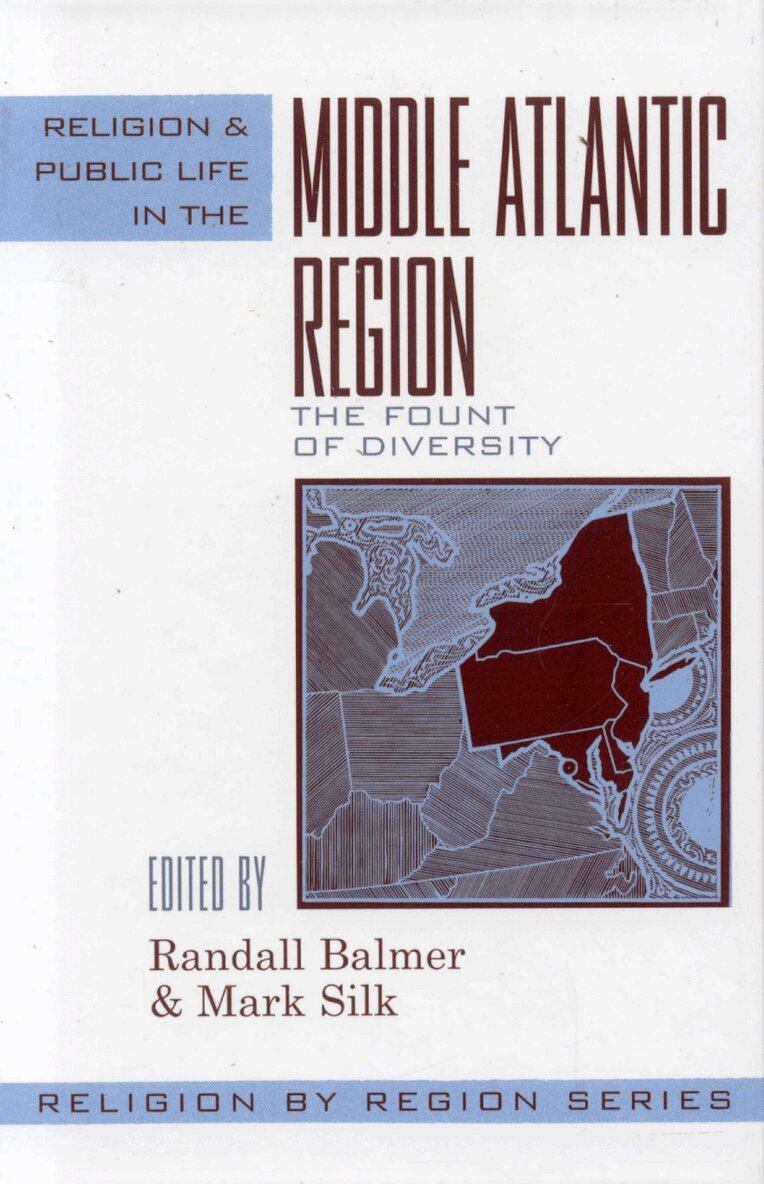
The Middle Atlantic region's religious diversity began in the 17th century and continues today. European religious minorities recognized the need to tolerate other faiths if they themselves were to be tolerated. From Quaker Pennsylvania to English Catholic Maryland to New York with no state religion, the Middle Atlantic colonies inspired the framers of the Constitution to keep a wall of separation between religion and government. But the religious diversity of the region is tempered by the many religious institutions that have centers in the area, especially in Washington, DC and New York City. The diversity here is due less to fluid identities and emerging religions than to many established religious institutions recognizing and tolerating each other. Protestant, Catholic and Jewish traditions function alongside each other here and they make room for the religions of new immigrants.
434 kr
Skickas inom 10-15 vardagar
'Pretty much like the rest of the country, only more so.' This quip from Wallace Stegner well-represents the Pacific region's religious culture. California, Nevada, and Hawaii emerged more recently, more quickly and with more diversity and fluidity than the other United States. Although influenced by Mexican Catholicism, Native Traditions, Asian Religions, and Euro-American Christianity, no religious tradition dominates, and a secular ethos usually reigns. But this very religious indifference makes California and the rest of the region open to all sorts of missionary movements and religious innovations. New organizational forms, new spiritual therapies, and new religious hybrids all compete for residents' attention along with secular ways for making meaning. With all these options, residents of the region mix, match, and move between religious identities more than other Americans. Without ignoring its diversity, Religion and Public Life in the Pacific Region highlights the key aspects of the region's fluctuating religions and its spirituality's impact on political life.