Studies in Law and Economics - Böcker
Visar alla böcker i serien Studies in Law and Economics. Handla med fri frakt och snabb leverans.
8 produkter
8 produkter
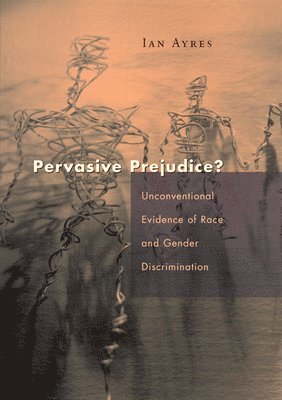
Pervasive Prejudice?
Unconventional Evidence of Race and Gender Discrimination
Inbunden, Engelska, 2001
672 kr
Tillfälligt slut
If you're a woman shopping for a new car, will you really get the best deal? If you're a man, will you fare better? If you're a black man waiting to receive an organ transplant, will you have to wait longer than a white man? In "Pervasive Prejudice?" Ian Ayres confronts these questions and more. In a series of important studies he finds overwhelming evidence that in a variety of markets - retail car sales, bail bonding, kidney transplantation and FCC licensing - blacks and females are consistently at a disadvantage. For example, when Ayres sent out agents of different races and genders posing as potential buyers to more than 200 car dealerships in Chicago, he found that dealers regularly charged blacks and women more than they charged white men. Other tests revealed that it is commonly more difficult for blacks than whites to receive a kidney transplant because of federal regulations. Moreover, Ayres found that minority male defendants are frequently required to post higher bail bonds than their Caucasian counterparts. Traditional economic theory predicts that free markets should drive out discrimination, but Ayres's startling findings challenge that position.Along with empirical research, Ayres offers game-theoretic and other economic methodologies to show how prejudice can enter the bargaining process even when participants are supposedly acting as rational economic agents. He also responds to critics of his previously published studies included here. These studies suggest that race and gender discrimination are neither a thing of the past nor merely limited to the handful of markets that have been the traditional focus of civil rights laws.
540 kr
Tillfälligt slut
With "Skepticism and Freedom", Richard A. Epstein provides a spirited and systematic defence of classical liberalism against critiques mounted against it over the past 30 years. One of the most distinguished and provocative legal scholars writing today, Epstein here explains his controversial ideas in what should quickly come to be considered one of his cornerstone books. He begins by laying out his own vision of the key principles of classical liberalism: respect for the autonomy of the individual, a strong system of private property rights, the voluntary exchange of labour and possessions, and prohibitions against force or fraud. Nonetheless, he not only recognizes but insists that state coercion is crucial to safeguarding these principles of private ordering and supplying the social infrastructure on which they depend. Within this framework, Epstein then shows why limited government is much to be preferred over the modern interventionist welfare state. Many of the modern attacks on the classical liberal synthesis seek to undermine the moral, conceptual, cognitive and psychological foundations on which the system rests.Epstein rises to the challenge by carefully rebutting each of these objections in turn. For instance, Epstein demonstrates how our inability to judge the preferences of others means we should respect their liberty of choice regarding their own lives. And he points out the flaws in behavioural economic arguments which, overlooking strong evolutionary pressures, claim that individual preferences are unstable and that people are unable to adopt rational means to achieve their own ends. Freedom, Epstein ultimately shows, depends upon a skepticism that rightly shuns making judgements about what is best for individuals, but that also avoids the relativistic trap that all judgements about our political institutions have equal worth. A brilliant defence of classical liberalism, "Skepticism and Freedom" should be seen as an intellectual landmark.
244 kr
Skickas inom 7-10 vardagar
With this book, Richard A. Epstein provides a spirited and systematic defense of classical liberalism against the critiques mounted against it over the past thirty years. One of the most distinguished and provocative legal scholars writing today, Epstein here explains his controversial ideas in what will quickly come to be considered one of his cornerstone works.He begins by laying out his own vision of the key principles of classical liberalism: respect for the autonomy of the individual, a strong system of private property rights, the voluntary exchange of labor and possessions, and prohibitions against force or fraud. Nonetheless, he not only recognizes but insists that state coercion is crucial to safeguarding these principles of private ordering and supplying the social infrastructure on which they depend. Within this framework, Epstein then shows why limited government is much to be preferred over the modern interventionist welfare state.Many of the modern attacks on the classical liberal system seek to undermine the moral, conceptual, cognitive, and psychological foundations on which it rests. Epstein rises to this challenge by carefully rebutting each of these objections in turn. For instance, Epstein demonstrates how our inability to judge the preferences of others means we should respect their liberty of choice regarding their own lives. And he points out the flaws in behavioral economic arguments which, overlooking strong evolutionary pressures, claim that individual preferences are unstable and that people are unable to adopt rational means to achieve their own ends. Freedom, Epstein ultimately shows, depends upon a skepticism that rightly shuns making judgments about what is best for individuals, but that also avoids the relativistic trap that all judgments about our political institutions have equal worth.A brilliant defense of classical liberalism, Skepticism and Freedom will rightly be seen as an intellectual landmark.
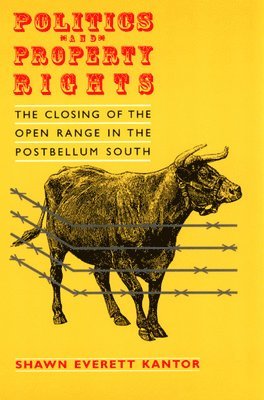
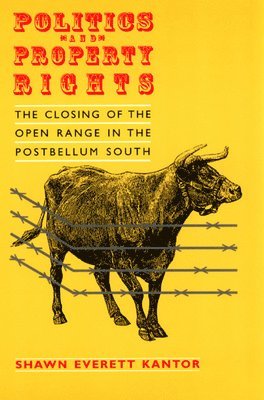
Politics and Property Rights
The Closing of the Open Range in the Postbellum South
Inbunden, Engelska, 1998
1 204 kr
Skickas
After the American Civil War, agricultural reformers in the South called for an end to unrestricted grazing of livestock on unfenced land. They advocated the stock law, which required livestock owners to fence in their animals, arguing that the existing system (in which farmers built protective fences around crops) was outdated and inhibited economic growth. The reformers steadily won their battles, and by the end of the century the range was on the way to being closed. In this study Shawn Kantor uses economic analysis to assert that contrary to traditional historical interpretation, this conflict was centered on anticipated benefits from fencing livestock rather than on class, cultural or ideological differences. The text seeks to show that the stock law brought economic benefits; and at the same time analyzes why the law's adoption was hindered in many areas where it would have increased wealth. Kantor's argument illuminates the dynamics of real-world institutional change, where transactions are often costly and where some inefficient institutions persist while others give way to economic growth.
Politics and Property Rights
The Closing of the Open Range in the Postbellum South
Häftad, Engelska, 1998
309 kr
Skickas inom 7-10 vardagar
After the American Civil War, agricultural reformers in the South called for an end to unrestricted grazing of livestock on unfenced land. They advocated the stock law, which required livestock owners to fence in their animals, arguing that the existing system (in which farmers built protective fences around crops) was outdated and inhibited economic growth. The reformers steadily won their battles, and by the end of the century the range was on the way to being closed. In this study Shawn Kantor uses economic analysis to assert that contrary to traditional historical interpretation, this conflict was centered on anticipated benefits from fencing livestock rather than on class, cultural or ideological differences. The text seeks to show that the stock law brought economic benefits; and at the same time analyzes why the law's adoption was hindered in many areas where it would have increased wealth. Kantor's argument illuminates the dynamics of real-world institutional change, where transactions are often costly and where some inefficient institutions persist while others give way to economic growth.
406 kr
Skickas inom 7-10 vardagar
Predatory pricing has long been a contentious issue among lawmakers and economists. Legal actions are continually brought against companies. But the question remains: how likely are firms to cut prices in order to drive rivals out of business? Predatory firms risk having to keep prices below cost for such an extended period that it would become cost-prohibitive. Recently, economists have turned to game theory to examine circumstances under which predatory tactics could be profitable. John R. Lott, Jr. provides empirical analysis in this book. By examining firms accused of or convicted of predation over a 30-year period of time, he shows that these firms are not organized as the game-theoretic or other models of predation would predict. In contrast, what evidence exists for predation suggests that government enterprises are more of a threat. Lott presents data and analysis, attacking an issue of major legal and economic importance.
702 kr
Tillfälligt slut
In this introduction to Japanese law, J. Mark Ramseyer and Minoru Nakazato present an economic approach to the law, to challenge commonly held ideas about the law. Where many studies assume that Japanese law differs fundamentally from law in the United States, this work shows the essential similarity between the two. Arguing against the idea that law plays only a trivial role in Japan or is culturally determined, the authors demonstrate that standard economic models in fact explain fundamental facets of the way Japanese manipulate the law. This study covers almost all the basic areas of Japanese law: property, contracts, torts, corporate, civil procedure, criminal law, administrative procedure, and tax. Ramseyer and Nakazato draw liberally from case law, and after outlining legal doctrine, they use economic theory and empirical data to sketch the implications the law poses for human behaviour.
434 kr
Skickas
In this introduction to Japanese law, J. Mark Ramseyer and Minoru Nakazato present an economic approach to the law, to challenge commonly held ideas about the law. Where many studies assume that Japanese law differs fundamentally from law in the United States, this work shows the essential similarity between the two. Arguing against the idea that law plays only a trivial role in Japan or is culturally determined, the authors demonstrate that standard economic models in fact explain fundamental facets of the way Japanese manipulate the law. This study covers almost all the basic areas of Japanese law: property, contracts, torts, corporate, civil procedure, criminal law, administrative procedure, and tax. Ramseyer and Nakazato draw liberally from case law, and after outlining legal doctrine, they use economic theory and empirical data to sketch the implications the law poses for human behaviour.