Themes in Global Social Change - Böcker
Visar alla böcker i serien Themes in Global Social Change. Handla med fri frakt och snabb leverans.
15 produkter
15 produkter
Theory of Global Capitalism
Production, Class, and State in a Transnational World
Häftad, Engelska, 2004
299 kr
Skickas inom 11-20 vardagar
In this book, sociologist William I. Robinson offers a theory of globalization that follows the rise of a new capitalist class and a transnational state. Growing beyond national boundaries, this new class comprises a global system in which Japanese capitalists are just as comfortable investing in Latin America as North Americans are in Southeast Asia. Their development of global, interconnected industries and businesses make them drivers of world capitalism. Robinson explains how global capital mobility has allowed capital to reorganize production worldwide in accordance with a whole range of considerations that allow for maximizing profit making opportunities. As a result, production systems that were once located in a single country have been fragmented and integrated externally into new globalized circuits of accumulation. What this means, however, is not simply that factories are located overseas where labor might be cheaper, but rather that the whole production process is broken down into smaller parts and each of those parts moved to a different country, depending on where investment might be highest.Yet at the same time, this worldwide decentralization and fragmentation of the production process has taken place alongside the centralization of command and control of the global economy in transnational capital. In turn, this economic organization finds a political counterpart in the rise of a transnational state. The leaders of global businesses and industries think about themselves and how they live in new ways. Hegemony in the twenty-first century, Robinson argues, will be exercised not by a particular nation-state but by this new global ruling class through the machinery of this transnational state. Robinson observes, for example, that global elites, regardless of their nationality, increasingly tend to share similar lifestyles and interact through expanding networks of the transnational state. Globalization is in this way unifying the world into a single mode of production and a single global system and bringing about the integration of different countries and regions into a new global economy and society. But the new global capitalism is rife with contradictions, such as the growing rift between the global rich and the global poor, concludes Robinson.The twenty-first century is likely to harbor ongoing conflicts and disputes for control between the new transnational ruling group and the expanding ranks of the poor and the marginalized. Sure to stir controversy and debate, A Theory of Global Capitalism will be of interest to sociologists and economists alike.
241 kr
Tillfälligt slut
Globalization may offer modern feminism its greatest opportunity and greatest challenge. Allowing communication and information exchange while also exacerbating economic and social inequalities, globalization has fostered the growth of transnational feminist networks (TFNs). These groups have used the Internet to build coalitions, lobby governments, and advance the goals of feminism. Globalizing Women explains how the negative and positive aspects of globalization have helped to create transnational networks of activists and organizations with common agendas. Sociologist Valentine M. Moghadam discusses six such feminist networks to analyze the organization, objectives, programs, and outcomes of these groups in their effort to improve conditions for women throughout the world. Moghadam also examines how "globalizing women" are responding to and resisting growing inequalities, the exploitation of female labor, and patriarchal fundamentalisms. This book is an important addition to literature exploring feminism as well as to the broader discussion of the impact of transnational social movements and organizations in the globalized world.
594 kr
Tillfälligt slut
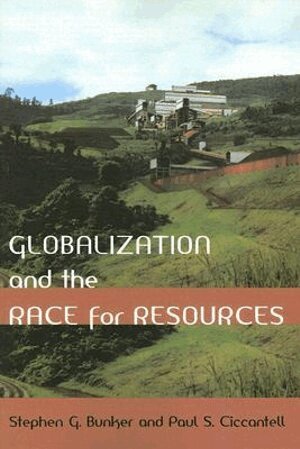
Globalization and the Race for Resources explores how five nations-Portugal, the Netherlands, Britain, the United States, and Japan-achieved trade dominance by devising technologies, social and financial institutions, and markets to enhance their access to raw materials. Through ecological and economic explanation of resource extraction and production, Stephen G. Bunker and Paul S. Ciccantell reveal globalization as the result of the progressive extension of systematically integrated material processes across cumulatively greater space. Drawing from extensive historical research into how economic and environmental dynamics interacted in the extraction of different materials in the Amazon, especially in the development of the iron mine of Carajas, the authors also illustrate the profound connection between global dominance and control of natural resources.
387 kr
Skickas inom 5-8 vardagar
Globalization and the Race for Resources explores how five nations-Portugal, the Netherlands, Britain, the United States, and Japan-achieved trade dominance by devising technologies, social and financial institutions, and markets to enhance their access to raw materials. Through ecological and economic explanation of resource extraction and production, Stephen G. Bunker and Paul S. Ciccantell reveal globalization as the result of the progressive extension of systematically integrated material processes across cumulatively greater space. Drawing from extensive historical research into how economic and environmental dynamics interacted in the extraction of different materials in the Amazon, especially in the development of the iron mine of Carajas, the authors also illustrate the profound connection between global dominance and control of natural resources.
574 kr
Tillfälligt slut
This groundbreaking study sheds new light on the struggle to define the course of globalization. Synthesizing extensive research on transnational activism, Social Movements for Global Democracy shows how transnational networks of social movement activists-democratic globalizers-have worked to promote human rights and ecological sustainability over the predominant neoliberal system of economic integration. Using case studies of recent and ongoing campaigns for global justice, Jackie Smith provides valuable insight into whether and how these activists are succeeding. She argues that democratic globalizers could be more effective if they presented a united front organized around a global vision that places human rights and ecological stability foremost and if they were to directly engage governments and the United Nations. Illuminating the deep-seated struggles between two visions of globalization, Smith reveals a network of activists who have long been working to democratize the global political system.
293 kr
Tillfälligt slut
This groundbreaking study sheds new light on the struggle to define the course of globalization. Synthesizing extensive research on transnational activism, Social Movements for Global Democracy shows how transnational networks of social movement activists-democratic globalizers-have worked to promote human rights and ecological sustainability over the predominant neoliberal system of economic integration. Using case studies of recent and ongoing campaigns for global justice, Jackie Smith provides valuable insight into whether and how these activists are succeeding. She argues that democratic globalizers could be more effective if they presented a united front organized around a global vision that places human rights and ecological stability foremost and if they were to directly engage governments and the United Nations. Illuminating the deep-seated struggles between two visions of globalization, Smith reveals a network of activists who have long been working to democratize the global political system.
604 kr
Tillfälligt slut
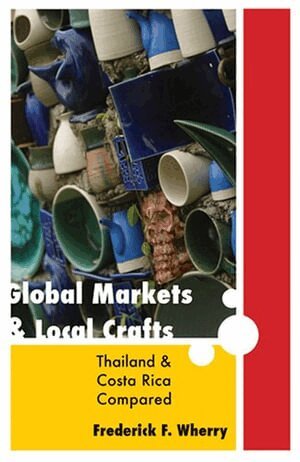
Today it is not uncommon to find items in department stores that are hand-crafted in countries like Thailand and Costa Rica. These "traditional" crafts now make up an important part of a global market. They support local and sometimes national economies and help create and solidify cultural identity. But these crafts are not necessarily indigenous. Whereas Thailand markets crafts with a long history and cultural legacy, Costa Rica has created a local handicraft tradition where none was known to exist previously. In Global Markets and Local Crafts, Frederick F. Wherry compares the handicraft industries of Thailand and Costa Rica to show how local cultural industries break into global markets and, conversely, how global markets affect the ways in which artisans understand, adapt, and utilize their cultural traditions. Wherry develops a new framework for studying globalization by considering the phenomenon from the perspective of the supplier instead of the market.Drawing from interviews and extensive fieldwork shadowing artisans and exporters in their daily dealings, Wherry offers a rare account of globalization in motion-and what happens when market negotiations do not proceed as planned. Considering economic and political forces, flows of people and materials, and frames that define cultural and market situations as they play out in the artisan communities of these two countries, Wherry uncovers how authentic folk tradition is capitalized or created.
351 kr
Skickas inom 7-10 vardagar
With one of the world's fastest-growing economies and a population quickly approaching two billion, China holds substantial sway over global financial, social, and cultural networks. This volume explains China's economic rise and liberalization and assesses how this growth is reshaping the structure and dynamics of global capitalism in the twenty-first century. China has historically been the center of Asian trade, economic, and financial networks, and its global influence continues to expand in the twenty-first century. In exploring the causes for and effects of China's resurging power, this volume takes a broad, long-term view that reaches well beyond economics for answers. Contributors explore the vast web of complex issues raised by China's ascendancy. The first three chapters discuss the global and historical origins of China's shift to a market economy and that transformation's impact on the international market system.Subsequent essays explore the ability of large Chinese manufacturers to counter the might of transnational retailers, the effect of China's rise on world income distribution and labor, and the consequences of a stronger China for its two most powerful neighbors, Russia and Japan. The concluding chapter questions whether China's growth is sustainable and if it will ultimately shift the center of global capitalism from the West to the East. This cutting-edge collection of works by leading global political economists links current events to long-term trends in global capitalist development to provide a comprehensive analysis of China's impact on the world. Scholars of China, world systems and globalization, international relations, and political economy will find this assessment worthy of study and an important starting point for further research. Contributors: Richard P. Appelbaum, Giovanni Arrighi, Edna Bonacich, Jozsef Borocz, Paul S. Ciccantell, John Gulick, Ho-Fung Hung, Stephanie Luce, Beverly J. Silver, Alvin Y. So, and Lu Zhang.
633 kr
Tillfälligt slut
This analysis of the United States and energy security examines the close relationship between US military supremacy in oil-rich regions and America's maintenance of global power. Energy security generally evokes thoughts of American intervention in the Middle East to protect US interests in that region's oil-rich fields. Doug Stokes and Sam Raphael move beyond that framework to consider US actions in Latin America, Central Asia, and Africa. Drawing on State and Defense Department records and other primary sources and previous scholarship, they show how US foreign policy since World War II has sought to maintain a global energy security regime that supports the nation's allies while maintaining American hegemony. Stokes and Raphael explain how US intervention in energy-rich states insulates and stabilizes those nations' transnationally oriented actors and political economies and why American oil diversification strategy strengthens the country's position against rivals in the global capitalist system.They argue that counterinsurgency aid and other types of coercive US statecraft protect the recipient states from an array of potentially revolutionary armed and unarmed internal social forces, thereby securing the energy supplies of nations deemed strategically important to the United States or its allies. Clear and accessible, this cutting-edge contemporary policy analysis will engage scholars of US foreign policy and international relations as well as policymakers grappling with the importance of energy security in today's world.
326 kr
Tillfälligt slut
This analysis of the United States and energy security examines the close relationship between US military supremacy in oil-rich regions and America's maintenance of global power. Energy security generally evokes thoughts of American intervention in the Middle East to protect US interests in that region's oil-rich fields. Doug Stokes and Sam Raphael move beyond that framework to consider US actions in Latin America, Central Asia, and Africa. Drawing on State and Defense Department records and other primary sources and previous scholarship, they show how US foreign policy since World War II has sought to maintain a global energy security regime that supports the nation's allies while maintaining American hegemony. Stokes and Raphael explain how US intervention in energy-rich states insulates and stabilizes those nations' transnationally oriented actors and political economies and why American oil diversification strategy strengthens the country's position against rivals in the global capitalist system.They argue that counterinsurgency aid and other types of coercive US statecraft protect the recipient states from an array of potentially revolutionary armed and unarmed internal social forces, thereby securing the energy supplies of nations deemed strategically important to the United States or its allies. Clear and accessible, this cutting-edge contemporary policy analysis will engage scholars of US foreign policy and international relations as well as policymakers grappling with the importance of energy security in today's world.
507 kr
Tillfälligt slut
Women's bodies have become a battleground. Around the world, people argue about veiling, schooling for Afghan girls, and "SlutWalk" protests, all of which involve issues of women's sexuality and freedom. Globalization, with its emphasis on human rights and individuality, heats up these arguments. In "Of Virgins and Martyrs", David Jacobson takes the reader on a fascinating tour of how self-identity developed throughout history and what individualism means for Muslim societies struggling to maintain a sense of honor in a globalized twenty-first century. Some patriarchal societies have come to see women's control of their own sexuality as a threat to a way of life that goes back thousands of years. Many trace their lineage to tribal cultures that were organized around the idea that women's virginity represents the honor of male relatives and the good of the community at large. Anyone or anything that influences women to the contrary is considered a corrupting and potentially calamitous force. Jacobson analyzes the connection between tribal patriarchy and Muslim radicalism through an innovative tool-the tribal patriarchy index.This index helps to illuminate why women's sexuality, dress, and image so compel militant Muslim outrage and sometimes violent action, revealing a deeper human story of how women's status defines competing moral visions of society and why this present clash is erupting with such ferocity.
321 kr
Skickas inom 7-10 vardagar
Women's bodies have become a battleground. Around the world, people argue about veiling, schooling for Afghan girls, and "SlutWalk" protests, all of which involve issues of women's sexuality and freedom. Globalization, with its emphasis on human rights and individuality, heats up these arguments. In Of Virgins and Martyrs, David Jacobson takes the reader on a fascinating tour of how self-identity developed throughout history and what individualism means for Muslim societies struggling to maintain a sense of honor in a globalized twenty-first century. Some patriarchal societies have come to see women's control of their own sexuality as a threat to a way of life that goes back thousands of years. Many trace their lineage to tribal cultures that were organized around the idea that women's virginity represents the honor of male relatives and the good of the community at large. Anyone or anything that influences women to the contrary is considered a corrupting and potentially calamitous force. Jacobson analyzes the connection between tribal patriarchy and Muslim radicalism through an innovative tool-the tribal patriarchy index.This index helps to illuminate why women's sexuality, dress, and image so compel militant Muslim outrage and sometimes violent action, revealing a deeper human story of how women's status defines competing moral visions of society and why this present clash is erupting with such ferocity.
685 kr
Skickas inom 7-10 vardagar
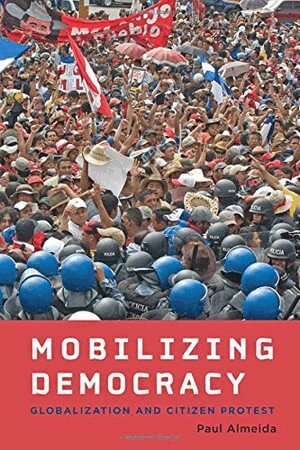
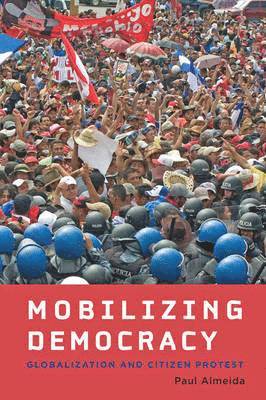
Paul Almeida's comparative study of the largest social movement campaigns that existed between 1980 and 2013 in every Central American country (Costa Rica, El Salvador, Guatemala, Honduras, Nicaragua, and Panama) provides a granular examination of the forces that spark mass mobilizations against state economic policy, whether those factors are electricity rate hikes or water and health care privatization. Many scholars have explained connections between global economic changes and local economic conditions, but most of the research has remained at the macro level. Mobilizing Democracy contributes to our knowledge about the protest groups "on the ground" and what makes some localities successful at mobilizing and others less successful. His work enhances our understanding of what ingredients contribute to effective protest movements as well as how multiple protagonists-labor unions, students, teachers, indigenous groups, nongovernmental organizations, women's groups, environmental organizations, and oppositional political parties-coalesce to make protest more likely to win major concessions.Based on extensive field research, archival data of thousands of protest events, and interviews with dozens of Central American activists, Mobilizing Democracy brings the international consequences of privatization, trade liberalization, and welfare-state downsizing in the global South into focus and shows how persistent activism and network building are reactivated in these social movements. Almeida enables our comprehension of global and local politics and policy by answering the question, "If all politics is local, then how do the politics of globalization manifest themselves?" Detailed graphs and maps provide a synthesis of the quantitative and qualitative data in this important study. Written in clear, accessible prose, this book will be invaluable for students and scholars in the fields of political science, social movements, anthropology, Latin American studies, and labor studies.
302 kr
Tillfälligt slut
Paul Almeida's comparative study of the largest social movement campaigns that existed between 1980 and 2013 in every Central American country (Costa Rica, El Salvador, Guatemala, Honduras, Nicaragua, and Panama) provides a granular examination of the forces that spark mass mobilizations against state economic policy, whether those factors are electricity rate hikes or water and health care privatization. Many scholars have explained connections between global economic changes and local economic conditions, but most of the research has remained at the macro level. Mobilizing Democracy contributes to our knowledge about the protest groups "on the ground" and what makes some localities successful at mobilizing and others less successful. His work enhances our understanding of what ingredients contribute to effective protest movements as well as how multiple protagonists-labor unions, students, teachers, indigenous groups, nongovernmental organizations, women's groups, environmental organizations, and oppositional political parties-coalesce to make protest more likely to win major concessions.Based on extensive field research, archival data of thousands of protest events, and interviews with dozens of Central American activists, Mobilizing Democracy brings the international consequences of privatization, trade liberalization, and welfare-state downsizing in the global South into focus and shows how persistent activism and network building are reactivated in these social movements. Almeida enables our comprehension of global and local politics and policy by answering the question, "If all politics is local, then how do the politics of globalization manifest themselves?" Detailed graphs and maps provide a synthesis of the quantitative and qualitative data in this important study. Written in clear, accessible prose, this book will be invaluable for students and scholars in the fields of political science, social movements, anthropology, Latin American studies, and labor studies.
383 kr
Skickas inom 7-10 vardagar
In America and the Politics of Insecurity, Andrew Rojecki assesses the response of citizens and politicians to a series of crises that confronted the United States during the first decade of the twenty-first century. This period brought Americans face to face with extraordinarily difficult problems that were compounded by their origin in seemingly uncontrollable global forces. Rojecki establishes a theoretical framework for understanding how these new uncertainties contribute to increasingly polarized political discourse. Analyzing three domains of American insecurity-economic, environmental, and existential-Rojecki examines responses to the Great Recession by groups like the Tea Party and Occupy Wall Street; considers why the growing demand for fossil fuels makes people disregard global warming; and explores the desire for security measures that restrict personal freedom in the age of terrorism. Ultimately, he explains why the right has thus far held an edge over the left in the politics of insecurity. Rojecki concludes that in order to address these broad-scale political problems, we must reframe domestic issues as reactions to undiagnosed global conditions.Bringing the psychology of uncertainty together with contemporary case studies, this book is a sweeping diagnostic for-and antidote to-ineffective political discourse in a globalized world that imports bads as well as goods.