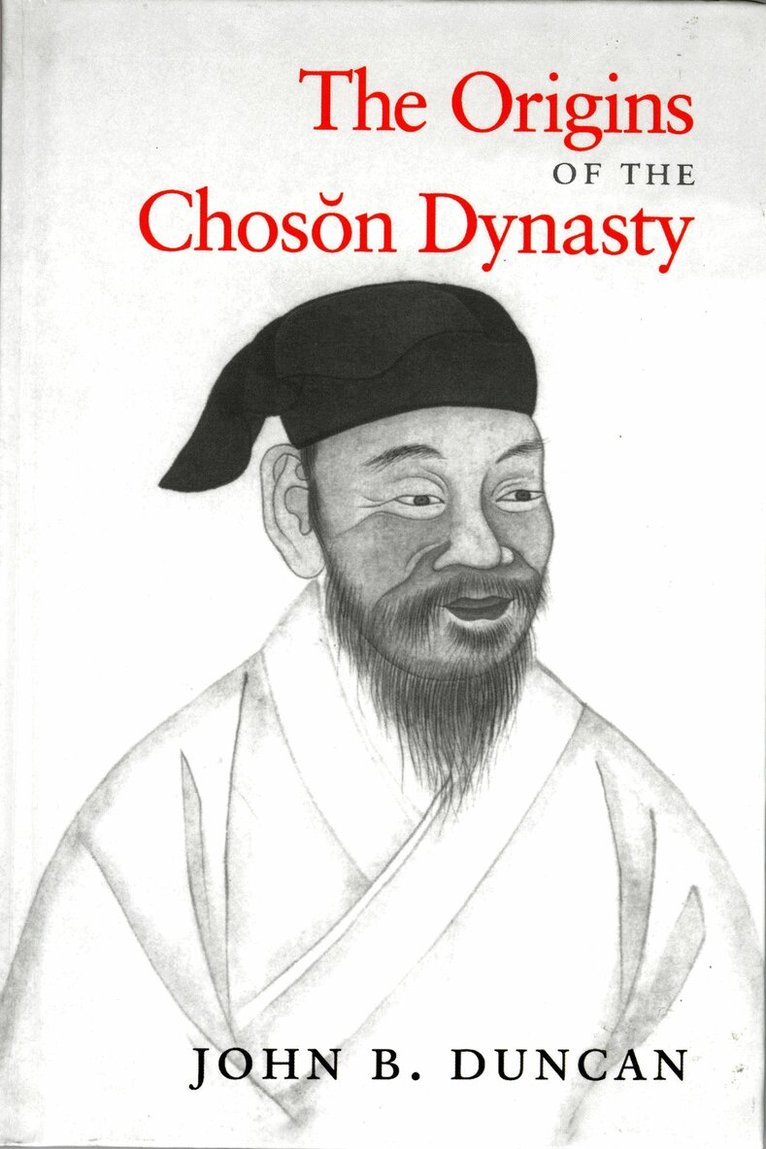
The Origins of the Choson Dynasty provides an exhaustive analysis of the structure and composition of Korea's central officialdom during the transition from the Koryo dynasty (918-1392) to the Choson dynasty (1392-1910) and offers a new interpretation of the history of traditional Korea.
John Duncan is professor of pre-modern Korean history and director of the Center for Korea Studies at UCLA.
Recensioner i media
"A work of profound scholarship and meticulous research, this book is an extremely important study on an important subject and should be indispensable reading for anyone interested in the history of the Koryo and Choson dynasties. It is also an excellent comparative study of aspects of East Asian history and institutions."
Innehållsförteckning
List of Tables List of Genealogical Charts Acknowledgments Introduction1. The Koryo Political System 2. The Rise of a Central Bureaucratic Aristocracy 3. The Yangban in the Change of Dynasties 4. Institutional Crisis in the Late Koryo 5. Reform and Dynastic Change 6. The Ideology of Reform 7. Some Final Considerations Notes Korean Dynasties and Kings Glossary of Korean, Chinese, and Japanese Terms Bibliography Index Tables1.1 Concurrent Appointments, 981–1069 and 1070–1146 2.1 Descent Structure of the Central Bureaucracy, 981–1146 2.2 Most Powerful Descent Groups, 981–1146 2.3 Descent Groups with Multiple Sons in Office, 1070–1146 2.4 Comparison of Descent Groups, 981–1069 and 1070–1146 2.5 Descent Structure of the Central Bureaucracy, 1260–1392 2.6 Most Powerful Descent Groups of the Late Koryo 2.7 Examination-Graduate Officials, 1260–1392 3.1 Grade Structure at the Beginning of the Choson 3.2 Distribution of Officials by Branch and Grade, 1392–1400 3.3 Descent Structure of the Central Bureaucracy, 1392–1400 3.4 Most Powerful Descent Groups under T’aejo and Chongjong 3.5 Descent Structure of the Central Bureaucracy, 1401–5 3.6 Most Powerful Descent Groups under T’aejong, 1401–5 3.7 Most Powerful Descent Groups, 1392–1405 3.8 Status of Powerful Choson Descent Groups in the Late Koryo 3.9 Descent Groups New to the Central Bureaucracy, Late Koryo–Early Choson 3.10 Status of Fallen Late Koryo Great Descent Groups 3.11 Intermarriage among the Top Ten Descent Groups, Late Thirteenth and Fourteenth Centuries 3.12 Descent Structure of the Central Bureaucracy, 1430–32 3.13 Descent Structure of the Central Bureaucracy, 1455–57 3.14 Most Powerful Descent Groups, 1430–32 and 1455–57 3.15 Descent Groups with the Most Examination Graduates, 1392–1592 4.1 Levels of Todang Activity, 1279–1351 4.2 Levels of Todang Activity, 1351–88 5.1 Consolidated Army Command Officials, 1393–98 TablesGenealogical ChartsHwangnyo Min Andong Kwon P’ap’yong Yun Munhwa Yu Andong Kim Chuksan Pak Kyongju Yi P’yongyang Cho Ch’ongju Han Chonju Ch’oe