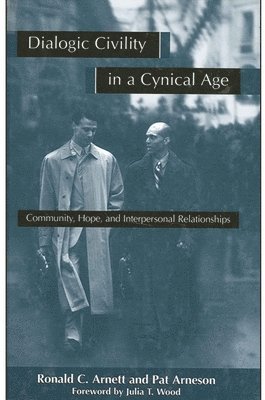
Dialogic Civility in a Cynical Age
Community, Hope, and Interpersonal Relationships
AvRonald C. Arnett,Pat Arneson
Del i serien SUNY series in Communication Studies
397 kr
Tillfälligt slut
Beskrivning
Produktinformation
- Utgivningsdatum:1999-09-30
- Mått:150 x 228 x 19 mm
- Vikt:481 g
- Format:Häftad
- Språk:Engelska
- Serie:SUNY series in Communication Studies
- Antal sidor:352
- Förlag:State University of New York Press
- Medarbetare:Wood,JuliaT.
- ISBN:9780791443262
Utforska kategorier
Mer om författaren
Ronald C. Arnett is Chair and Professor of the Affiliated Departments of Communication and English at Duquesne University. He is the author of three books: Dwell in Peace: Applying Nonviolence to Everyday Relationships; Communication and Community: Implications of Martin Buber's Dialogue, for which he received the 1988 Book Award by the Religious Speech Association; and Dialogic Education: Conversations About Ideas and Between People. He is also the coeditor of The Further Reach of Dialogue and Community Ethics in an Age of Diversity. Pat Arneson is Associate Professor of Communication at Duquesne University.
Recensioner i media
"It is a rare pleasure to read a scholarly book that offers a realistic basis for hope about the possibilities for enriched communication. In their book the authors offer hope—hope for human thought and action and, most especially, for human communication praxis." — From the Foreword by Julia T. Wood"Dialogic Civility in a Cynical Age provides a dialogue with some common sense voices of reason, civility, caring, and interpersonal relations. It is truly a praxis—applying theories of dialogic communication and civility to our moment in history. How timely in this age, which places emphasis on recognition of diversity and yet also includes skinheads and hate groups. The book doesn't give a naïve view of the world. It takes a realistic look at dialogic communication and its possible role in countering much of today's unenlightened, unreflective cynicism about our communities and the future of our society." — T. Dean Thomlison, University of Evansville, Indiana
Innehållsförteckning
- Foreword Acknowledgments Part I. Interpersonal Praxis: From Communicative Crisis To Narrative Action 1. Introduction: Beginning the Conversation An OverviewHorizon of SignificanceThe Conceptual Key 2. Voices of Cynicism and Hope Routine CynicismInterpersonal SuspicionLanguage Disconnected from ActionListening to Two Sides of CynicismRoutine Cynicism as DebilitatingCynicism as Survival ToolThe Wedding of Cynicism and HopePain and JoyHope within Limits 3. Historicality and Presence A Foundation for Communicative ChangeHistoricalityMissing the Historical MomentMeeting the Historical MomentDialogic LimitsA Dialogic PerspectiveA Practical DialecticInterpersonal Praxis as Historical Common SenseInterpersonal Commonplaces 4. Common Ground: Interpersonal Narrative Opening Narrative StructuresNarrative BackgroundFrom Metanarrative to Therapeutic CultureHistorical Mismatch—The Therapeutic MetaphorAn Overextended MetaphorWalter Lippmann's WarningA Narrative Ethic for Interpersonal Discourse Part II. Interpersonal Voices Section 1. Narrative Decline: Interpersonal Dialogue and Self 5. Carl Rogers: A Voice of Pragmatic Optimism IntroductionSignificance of Carl Rogers's Life and PracticeA Founding VoiceScope of Carl Rogers's InfluenceThe Quiet RevolutionaryCommunicative FocusHistorical GroundingAn Optimistic ListenerCentral Concepts in Carl Rogers's WorkSelfInnate Wisdom of the Human OrganismRelationshipHistoricality and Dialogic Civility 6. Abraham Maslow: Science, Values, and Additive Change IntroductionSignificance of Abraham Maslow's Science/Values ProjectAdditive Approach to ScienceAdditive EducationSelf in Service to the OtherCentral Concepts in Abraham Maslow's WorkA Science of Interpersonal HealthHuman ValuesSelf-Actualization and Earned Self-EsteemPeak-ExperiencesHistoricality and Dialogic Civility Section 2. Narrative Confrontation: Interpersonal Dialogue and Crisis 7. Martin Buber: Attending and Response Between Persons IntroductionMartin Buber's Common Center: The BetweenHorizon of the BetweenThe Existential-Phenomenological Nature of the BetweenAmbiguity, Story, and GuidanceA Communicative PoeticCentral Concepts in Martin Buber's WorkThe Great CharacterDialogueFocus of AttentionAuthenticityHistoricality and Dialogic Civility 8. Carol Gilligan: Gender and Moral Voice IntroductionHistorical Context: A Window for CynicismMoral VoicesCentral Concepts in Carol Gilligan's WorkFemale AdolescenceDisconnectionRe-Connection and CareResponsibility in Relationship-Grounded CaringA Dialectical DanceA Morality of CareVoice and InclusionHistoricality and Dialogic Civility 9. Paulo Freire: Dignity and the Limits of Inclusion IntroductionInterpersonal PedagogyHumilityPraxisAffirming the OtherThe Limits of InclusionCentral Concepts in Paulo Freire's WorkRejecting a Culture of SilenceNarrative SicknessCritical ConsciousnessDialogueHistoricality and Dialogic Civility 10. Sissela Bok: Crisis and Ethical Imagination IntroductionEthics and PostmodernityCommunication without Ethical CoherenceCentral Concepts in Sissela Bok's WorkLyingSecretsPeaceCommon ValuesHistoricality and Dialogic Civility 11. Viktor Frankl: Meaning, Displacement, and Courage IntroductionLived Life as Thoughtful ActionCentral Concepts in Viktor Frankl's WorkPragmatic SpiritualismMeeting Disappointment and SufferingDiscovering MeaningTripod of MeaningTragic TriadFreedomProblematic AssumptionsSelf-ActualizationContrary to the Pleasure PrincipleChoosing MeaningHistoricality and Dialogic Civility Section 3. Narrative Construction: Interpersonal Dialogue and Story 12. Nel Noddings: Re-Storying an Ethic of Care IntroductionRe-Storying EthicsMissing StoriesCaring as StoryMoral EducationCentral Concepts in Nel Noddings's WorkReducing EvilAn Ethic of CaringCaring in RelationRisks of CaringIntuition and Interpersonal ReasoningIntuitive CapacitiesComplementary to ReasonMeaning and StoryHistoricality and Dialogic Civility 13. Robert Bellah: Re-Storying Broken Covenants IntroductionThe Practices of IdentityIndividualismTherapeutic LimitsCharacters of Modern LifeCentral Concepts in Robert Bellah's WorkBroken CovenantsTacit Understanding of a Problematic StoryCommunicative Background—The Common GoodInviting CommunityHistoricality and Dialogic Civility Part III. Dialogic Civility 14. The Interpersonal Praxis of Dialogic Civility From Privatized to Public DiscourseA Minimal Foundation for Dialogic CivilityRespect and CivilityCivility and the OtherA Call for Dialogic CivilityFrom Unreflective Practice to PraxisOur Historical ProblematicPractical Philosophy of Dialogic CivilityConclusion—Dialogic Civility Works Cited Index
Mer från samma författare
Communication and Learning in an Age of Digital Transformation
David Kergel, Birte Heidkamp-Kergel, Ronald C. Arnett, Susan Mancino
561 kr
Communication and Learning in an Age of Digital Transformation
David Kergel, Birte Heidkamp-Kergel, Ronald C. Arnett, Susan Mancino
2 053 kr