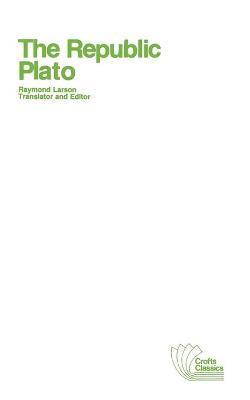
Del 11 i serien Crofts Classics
143 kr
Beställningsvara. Skickas inom 7-10 vardagar. Fri frakt över 249 kr.
Fler format och utgåvor
Beskrivning
This highly regarded volume features a modern translation of all ten books of The Republic along with a synoptic table of contents, a prefatory essay, and an appendix on The Spindle of Necessity by the translator and editor, Raymond Larson. Also included are an introduction by Eva T. H. Brann, a list of principal dates in the life of Plato, and a bibliography.
Produktinformation
- Utgivningsdatum:2012-07-26
- Mått:125 x 189 x 16 mm
- Vikt:308 g
- Format:Häftad
- Språk:Engelska
- Serie:Crofts Classics
- Antal sidor:338
- Förlag:John Wiley and Sons Ltd
- ISBN:9780882951188
- Översättare:Larson, Raymond, Larson, Raymond (Saint John's University, Collegeville, Minnesota)
Utforska kategorier
Mer om författaren
Plato was a philosopher in Classical Greece and the founder of the Academy in Athens, the first institution of higher learning in the Western world. He is widely considered the pivotal figure in the development of Western philosophy.Raymond Larson is the translator of The Republic, published by Wiley.
Innehållsförteckning
- Preface and background to the Republic xiiiIntroduction xxiiiPrincipal Dates xlviiCurrent Opinions of Justice Refuted (Book 1) 1Introductory Dialogue (Socrates and Cephalus, 328c-331d) 2First Definition (Cephalus, 331a-d) 5Refutation (332c-335d) 6Third Definition (Thrasymachus, 338c-343a) 13Refutation (339b-e) 14Redefinition of Ruler (340d-341a) 15Refutation (341c-343a) 16New Argument (343a-348a) 18Refutations of (a): i) 345b-348a) 20Refutation of (b), 352d-354a 28Conclusion (354a-c) 30Justice Reexamined, in the State and in the Individual (Books 2-4) 31Adeimantus (362d-367e) 35The Problem Examined and Solved (368c-445e) 40Second State of the State (372d-427c) 44Elementary Education of the guardians (376c-415d) 48Gymnastics (physical education), 403c-412b 73Instilling and testing patriotism and leadership, 412c-415d 81Living arrangements of guardians and auxiliaries (415d-427c) 85Conclusion (427c-434d) 94Wisdom = the knowledge of the guardians (428a-429a) 95Courage = the auxiliaries’ opinion of “what is and is not to be feared” (429a-30c) 96Temperance = agreement of all three classes about who should rule and be ruled (430d-432b) 97Justice = each of the three classes “tending its own business” and not preempting the work of another (432b-434d) 99Composition of the Soul (434d-441c) 101Conclusion (441d-444e) 109Degeneration Regimes and Souls, Interrupted (445b-449a) 113Digression: The Best Regime and Men (Books 5-7) 114Organization of the Best Regime (451c-461e) 116Women and children will not be private possessions but common to all of the men. Marriage arrangements, eugenics (457c-461e) 122The Superiority and Possibility of Such a City (462a-473e) 126Excursus: regulations for warfare (466e-471c) 131Such a city is not impossible (471e-473c) 136Reminder that the best state is only a model, not completely realizable in practice (472b-473b). It is possible only if philosophers become kings or kings philosophers (473c-3), 138The Best Men: Philosopher Kings (Guardians), Book 5, 474b-Book 7 139The Philosophic Nature (485a-503e) 147Higher Education of the Guardians (504a-535a) 165The Simple of the Sun (506e-509b) 168The Simile of the Divided Line (509d-511e) 171The Simile of the Cave (514a-521b) 174Curriculum (521c-535a) 181Plane geometry, 526c-527c 186Harmonics, 530d-531c 190Selection of the Guardians (535a-540c) 195Brief Excursus (540d-541b) 200Degenerate Regimes and Souls, Resumed From Book 5 (Books 8 and 9) 201Cause of Change or Decline in a State: Civil War (545c-547c) 203Degenerate Regimes and Men, Described and Compared (547c-592b) 205Oilgarchy (rule of the wealthy few) and the oligarchic man (550c-555b) 208Democracy (rule of the people) and the democratic man (555b-562a) 213Tyranny (dictatorship) and the tyrannical man (562a-580a) 220The five types are judged for their goodness and happiness and ranked in the order in which they were presented: Aristocracy and the aristocratic man are the best and happiness; tyranny and the tyrant are the worst and most miserable (580a-588a) 237Conclusion: The aristocrat is just, the tyrant unjust. Therefore justice makes a man happy, injustice makes him unhappy (588b-592b) 247Denunciation of Imitative Poetry (Book 10, 595a-608b) 251Imitative poetry appeals to the emotions rather than to the mind (602c-605c) 259Imitative poetry deforms character (605c-608b) 263Immortality and the Rewards of Justice (608b-End) 265Rewards of Justice and Punishments of Injustice in This Life (612b-614a) 269Rewards and Punishments After Death (614a-621d) 271Appendix: The Spindle of Necessity 279Bibliography 283
Hoppa över listan


Mer från samma serie
Selections from The Federalist
Alexander Hamilton, James Madison, John Jay, Henry Steele Commager
Häftad
131 kr