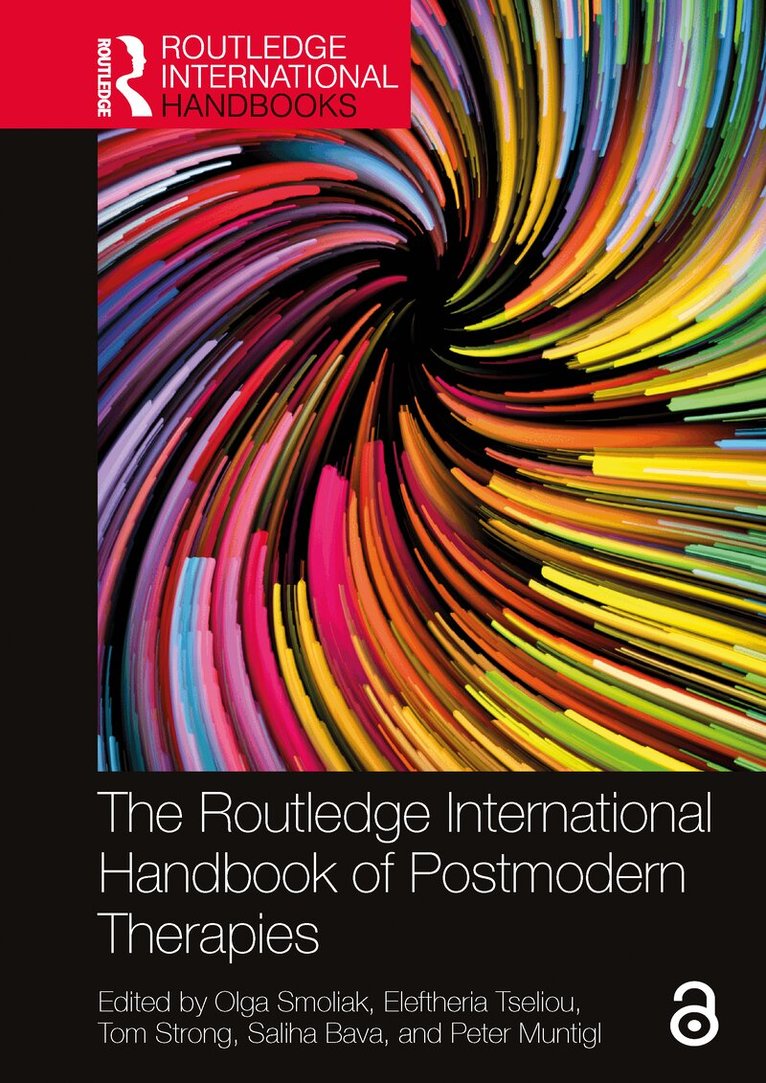
Routledge International Handbook of Postmodern Therapies
AvOlga Smoliak,Eleftheria Tseliou
Del i serien Routledge International Handbooks
3 200 kr
Beställningsvara. Skickas inom 10-15 vardagar. Fri frakt över 249 kr.
Beskrivning
Produktinformation
- Utgivningsdatum:2025-11-14
- Mått:174 x 246 x 42 mm
- Vikt:1 460 g
- Format:Inbunden
- Språk:Engelska
- Serie:Routledge International Handbooks
- Antal sidor:674
- Förlag:Taylor & Francis Ltd
- ISBN:9781032452661
Utforska kategorier
Mer om författaren
Olga Smoliak, PhD, C. Psych, RMFT, is Professor of Family Relations and Applied Nutrition at the University of Guelph, Canada. She is interested in advancing critical and discursive perspectives and inquiry in counseling/psychotherapy and family therapy.Eleftheria Tseliou, PhD, is Professor of Research Methodology and Qualitative Methods at the University of Thessaly (Greece) and a systemic therapist. She is also President of the Association of European Qualitative Researchers in Psychology (EQuiP). She is interested in discursive qualitative methodologies and systemic/postmodern therapies, and counseling/psychotherapy process research.Tom Strong, PhD, is Professor and Counselor-Educator who recently retired from the University of Calgary, Canada. He writes on the collaborative, critical, and practical potentials of discursive approaches to psychotherapy.Saliha Bava, PhD, LMFT, is Program Director and Professor of Marriage and Family Therapy at Mercy University, United States. She is the Cofounding Board Member of the International Certificate Program in Collaborative-Dialogic Practices (ICCP) and Board Member of Taos Institute. Her scholarship and consultation focus on critical discursive change practices in psychotherapy, educational, organizational and social context.Peter Muntigl, PhD, is Staff Scientist in the Department of Translation, Interpreting and Communication at Ghent University (Belgium) and Adjunct Professor in the Faculty of Education at Simon Fraser University (Canada). His recent publications include Interaction in Psychotherapy (2024).
Recensioner i media
“The Routledge International Handbook of Postmodern Therapies offers an exciting, much needed, in-depth exploration of postmodern thought and its impact on therapeutic approaches, research, and education. Established and emerging leaders provide multiple perspectives across contexts, creating an invigorating, complex, yet accessible discussion, moving in and out of theoretical and practical considerations. This book provides foundational insights and is a must read for anyone seeking to better understand and broaden their ability to work from postmodern approaches!”Teresa McDowell, EdD, Professor emerita, Lewis & Clark College, Co-author of Socioculturally Attuned Family Therapy: Guidelines for Equitable Theory and Practice“How fortunate are we to have within one book the wide and diverse range of papers that go under the rubric of postmodern therapies. There is nothing quite like this!”David Epston, Co-originator with Michael White of Narrative Therapy“The Routledge International Handbook of Postmodern Therapies remaps the landscape of postmodern therapies, making it an essential resource for contemporary practitioners, researchers, and educators. Top scholars from around the globe share how they have successfully used postmodern theories and practices to bringer greater humanity and justice to psychotherapy and beyond. Readers will find that each chapter enables them to envision fresh and liberating ways to advance their professional and personal development.”Diane R. Gehart, PhD, Therapy that Works Institute, California State University, Northridge“Written by the top thinkers and clinicians in the field of postmodern therapies, this is an excellent resource for teaching, research and clinical practice.”Peter Rober, Professor, KU Leuven, Belgium
Innehållsförteckning
- PART IIntroduction to postmodern therapies 1 We have always been postmodern: A new past for a future postmodern psychotherapyPaul Stenner and Maria Nichterlein 2 Theoretical underpinnings of therapeutic practice after modernismKenneth Gergen and Sheila McNamee 3 What can postmodern therapies learn from dang-ki healing about the cultural ontology of the self?Boon-Ooi Lee 4 Happiness at work in the context of growing precariousness and labor instabilityEdgar Cabanas and Daniel Nehring 5 Postmodernism, decolonial critiques, and liberatory praxisRhea Almeida and J. Corey Williams 6 Publishing and postmodern therapy: Delphi responses from the editors of five family therapy journalsJim Duvall, Glenn Larner, Jay Lebow, Philip Messent, and Rachel TamblingWith after reflections from Harlene Anderson and Del LoewenthalPART IIKey postmodern approaches 7 Collaborative-dialogic practiceHarlene Anderson 8 Narrative therapyTom Stone Carlson and Sanni Paljakka9 Solution focused brief therapyPeter De Jong, Jennifer Gerwing, and Sara Healing 10 The reflecting teamAnna Sidis 11 Open dialogueTomi Bergström, Mia Kurtti, Andrew Duthie, Kari Valtanen, and Jaakko Seikkula 12 Socio-emotional relationship therapyCarmen Knudson-Martin 13 Bringforthist therapyKarl Tomm, Faye Gosnell, Emily Doyle, Marc Ross, and Joaquín Gaete-Silva14 Systemic-dialogical therapyPaolo Bertrando and Claudia Lini15 Social therapy and social therapeutics Lois Holzman16 Post-existential therapySimon Wharne 17 Pluralistic therapyChristine Kupfer and John McLeod18 Integrative systemic therapyLennart Lorås and Kristoffer J. Whittaker 19 Integrative community therapyMarilene Grandesso and Emerson F. RaseraPART IIISocio-cultural context20 Re-worlding therapy’s narrative: A demodern and decolonial reconstitution of healingmarcela polanco, Christian Beraud Fernández, Carlos Chico Ramos, Elizabeth Barajas, Nihan Eryonucu, Ingrid Guerrieri, and Yasmine Willis Fernandez21 Structures of feeling in gender, bodies, and technologySarah Riley and Adrienne Evans 22 Systemic racism and the differential racializations of Black and non-Black people of color in white spaceWilliam Ming Liu and Rossina Zamora Liu23 The deconstruction of monologic spaces: When white meta-narrativity silencesGeorge Yancy24 Queering therapeutic conversations: More than “affirmative” and not just for queersJulie Tilsen, Kristen E. Benson, and David Nylund 25 Cripping and thickening therapy: Making space for bodymind differenceMeredith Bessey, Elisabeth Harrison, Sonia Meerai, Kaley Roosen, Allison Taylor, and Carla Rice26 Postmodern therapies in a neoliberal worldGene Combs and Jill Freedman 27 Therapeutic practice as transmaterial worldingLeah Salter and Gail SimonPART IVResearch28 Methodological foundations and innovations in postmodern therapy researchRonald J. Chenail, Dan Wulff, Sally St. George, and Dragana Ilic29 Using narrative inquiry and qualitative research to support postmodern psychotherapy practiceJohn McLeod 30 Professional development for counselors, psychologists, and therapists by using Reflective Interventionist Conversation AnalysisMichelle O’Reilly, Nikki Kiyimba, and Jessica Lester 31 Poststructuralism: A preface to post qualitative inquiryElizabeth A. St.Pierre 32 Contributions of dialogical self theory to psychotherapy theory, research and practiceMiguel M. Gonçalves, Hubert H. J. M. Hermans, João Batista, and João T. Oliveira33 If it’s all socially constructed, how do we do research? Powering together in action research for transformationsHilary Bradbury 34 Performative social science: Linking art, science, and societyGünter Mey and Rainer Winter PART VEducation and training 35 Clinical supervision: Making products or a profession?Joaquín Gaete-Silva, Jeff Chang, and Inés Sametband 36 Pedagogy for practitioners: Post-oppositional teaching tactics for transformationEileen Chung and AnaLouise Keating 37 Training and supervision of psychotherapists with the focus on dialogical skills: The Finnish caseAarno Laitila, Pekka Borchers, Ilpo Kuhlman, and Eija-Liisa Rautiainen 38 Postmodern pedagogy and the ongoing development of teaching and sustaining skills of critical reflection on practiceLaura Béres, Stephanie L. Baird, Jane E. Sanders, and Rosemary Vito39 Indigenizing the classroom: Bringing critical kinship to family studiesSarina Perchak, Andrea V. Breen, and Kim AndersonPART VIApplications 40 The witness to witness program: Evolving curricula to serve social justice principles Kaethe Weingarten, Pamela Secada-Sayles, and Jessica Calderón41 Listening: An everyday expectationDan Wulff and Sally St. George 42 Grief therapy as meaning reconstruction: From symptoms to significanceRobert A. Neimeyer and Carolyn Ng 43 Co-creating public valuesDina von Heimburg, Ottar Ness, Jacob Storch, and Tom Strong 44 The justness of collaborative-dialogic practices in child protectionRocío Chaveste, Khadija Al-Sarhi, Henrike van der Hoeven, Anne Vijverberg, and Otto Sestak45 Re-centering silenced disaster trauma and healing in neoliberal context: Integrating social constructionist and decolonization approachesKumar Ravi Priya, Shilpi Kukreja, and Neha Jain46 Imbeleko approach to counseling: Developing culturally resonant talking therapy servicesNcazelo Ncube-Mlilo 47 Empowering families and networks struggling with substance use and addictions through an open dialogue approachPavel Nepustil and Tanya Mudry
Du kanske också är intresserad av
Routledge International Handbook of Innovative Qualitative Psychological Research
Eleftheria Tseliou, Carolin Demuth, Eugenie Georgaca, Brendan Gough
721 kr
Routledge International Handbook of Innovative Qualitative Psychological Research
Eleftheria Tseliou, Carolin Demuth, Eugenie Georgaca, Brendan Gough
3 295 kr
Empirical Approaches to Discourse Analysis Empirieorientierte Ansaetze in Der Diskursanalyse
Helmut Gruber, Martin Kaltenbacher, Peter Muntigl
671 kr
Discursive Perspectives in Therapeutic Practice
Andy Lock, Tom Strong, Andy Lock, Tom Strong
1 150 kr