- Nyhet
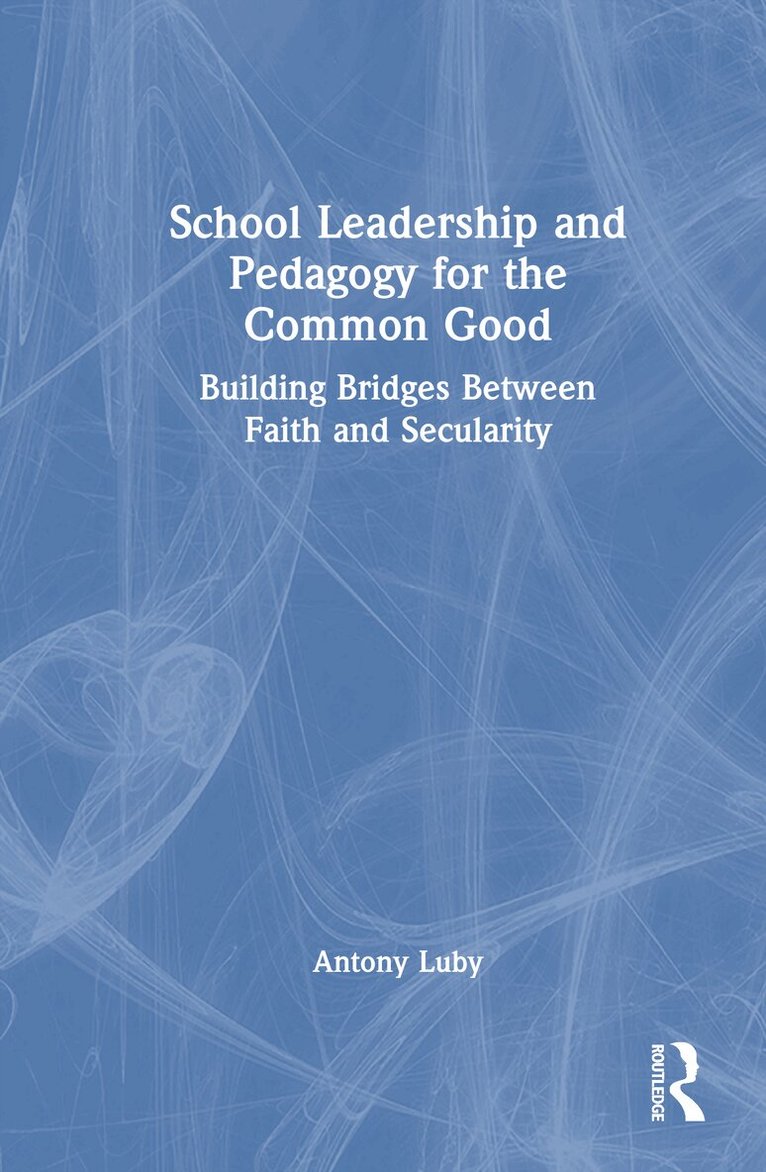
School Leadership and Pedagogy for the Common Good
Building Bridges Between Faith and Secularity
2 049 kr
Beställningsvara. Skickas inom 10-15 vardagar. Fri frakt över 249 kr.
Fler format och utgåvor
Beskrivning
Produktinformation
- Utgivningsdatum:2026-04-29
- Mått:156 x 234 x 11 mm
- Vikt:470 g
- Format:Inbunden
- Språk:Engelska
- Antal sidor:148
- Förlag:Taylor & Francis Ltd
- ISBN:9781041031024
Utforska kategorier
Mer om författaren
Antony Luby teaches Educational Leadership and Management at the University of Glasgow, UK. An award-winning writer, he holds a PhD in Education Studies and multiple master’s degrees (MPhil, MTh, and MSc) from Glasgow, Strathclyde, Aberdeen, and Oxford, respectively. A Founding Fellow of the Chartered College of Teaching, he is also a Fellow of the College of Teachers and the Higher Education Academy.
Recensioner i media
"In this attractively written book, Anthony Luby draws upon many years of teaching and research to propose ways forward for Catholic education in a secular context. How do we best serve our children? Luby's approach neither reduces education to direct evangelisation nor erases the Catholic "thing". He recognises the need for the Church to adopt a measure of self-limitation in a pluralist culture. He develops St Thomas' notion of valid "secondary ends" and carefully distinguishes the secular realm, where the common good can be pursued by believers of different persuasions or none, from the profane where any public presence of religion is arbitrarily vetoed. Responding to a complex, delicate, ever-fluctuating social context, Luby's contribution is a thoughtful and thought-provoking one. It deserves to be taken seriously."Hugh Gilbert, Bishop of Aberdeen."What can a (non-Catholic) Christian senior lecturer from a liberal university in Amsterdam, a Jewish head teacher at a secular state school in Nottinghamshire, a Glaswegian Catholic teacher (the author of this book), and a practising Muslim head teacher of a Catholic school in Rotterdam teach us about leadership and pedagogy in Catholic schools operating in a pluralist culture in today’s world? Written in an elegant and winning manner, Antony Luby’s book offers a surprising and well-thought-out answer."Rev. Tony Schmitz, Deacon, St Mary's Cathedral, Aberdeen, UK."School Leadership and Pedagogy for the Common Good is an exceptional and timely contribution to contemporary educational leadership studies. I have used a chapter of this book as a core text in a postgraduate course on education in diversity, and the results have been consistently positive: it has stimulated deep reflection, rigorous debate, and a renewed sense of purpose among experienced educators and emerging leaders alike.What makes this book particularly powerful is its refusal to frame faith and secularity as opposing forces. Instead, through rich, carefully narrated case studies, it demonstrates how deeply held values—whether rooted in religious traditions, humanistic philosophy, or community ethics—can serve as legitimate and constructive sources of educational leadership. The stories from Rotterdam and England illustrate leadership that is relational rather than bureaucratic, grounded in trust rather than control, and oriented toward the common good rather than narrow performance metrics.For postgraduate students, especially those working in culturally and religiously diverse contexts, the book offers both conceptual clarity and practical insight. It provides concrete examples of how leaders translate values into daily practices: empowering teachers, co-creating shared norms with communities, and maintaining high expectations without sacrificing dignity or inclusion. These narratives resonate strongly with students, who often recognize similar tensions in their own professional settings.Antony Luby’s guiding voice adds intellectual depth and ethical coherence. His ability to connect lived experience, scholarly reflection, and moral inquiry makes the book accessible without being simplistic, and reflective without losing analytical rigor.I strongly recommend this book for postgraduate programs in educational leadership, diversity and inclusion, ethics in education, and policy studies. It is not only an academic resource, but also a formative text—one that invites educators to rethink leadership as a moral, communal, and profoundly human endeavor."Prof. Dr. Daniel Ernesto Stigliano, Global Head for Scholas Chairs Program, The Pontifical Foundation Scholas Occurrentes."What a superb book - more than a book, an engagement, a reflection, an honest reflective but well researched piece of work. It made me laugh, especially when the author, Antony Luby, wrote with honesty, "27 pairs of eyes, 27, all looking at me, for help, for guidance: what am I to do?” (chapter 5), I know exactly what he meant; or as some bright child pointed out, "there's more evidence for the existence of UFO's than God" (chapter 6). Oh, how true that is, from many a young person’s point of view; and so it was throughout the book, the author’s brilliant, honest and humble rhetoric about his past experiences - now that is really refreshing.I thoroughly enjoyed reading the varying points, from Aziem especially, but also Chris Wilson and of course the emphasis on dialogue as well as to be found in chapter nine, the emphasis on the ‘sacred, secular, profane’. I must confess I had not known of "Scholas Occurrentes" and having now explored Pope Francis’s innovative non-profit organisation which he set up in 2013, I have found something that is both very interesting and so relevant in today’s troubled educational world. In my opinion, the author has a lot to contribute to this organisation, and I hope he has considered this as part of his mission.Antony is so right when he points out there is a huge problem with liberal secularism although, having now discovered “Flying High” in his book, and still trying to get a handle on this, I have great hope that this may be the way forward in education.Yes, ‘listening and dialogue’ is the key to the future educational program, I absolutely agree, but the question is how do we reach out to those who devise the state curriculum and integrate Antony’s excellent research into the curriculum for the benefit of all? How do we dispose of the emphasis on so-called educational and material subject matter that does not benefit the young person in any way but contradicts family and societal values thus causing confusion?Antony Luby’s book gives much to think about. I thoroughly recommend it to anyone stepping into any educational setting and who seeks to delve into a holistic approach in developing the student. I know it will be a success because it is alive, it is action research, it is funny, it is identifiable, it is profound and inclusive."Dr Sylvia A. Hoskins, PhD, MEd, BSc (Hons), FHEA."Tony Luby’s School Leadership and Pedagogy for the Common Good is a thoughtful and timely look at how Catholic education can continue to thrive in societies that feel increasingly secular and, at times, unsettled. Rather than dwelling on what’s been lost in terms of traditional religious identity, Luby takes a more hopeful view. He suggests Catholic schools are evolving—moving away from being defined by outward signs of faith, and instead becoming communities shaped by values, dialogue, and a strong commitment to the common good. Drawing on examples from Rotterdam to Nottinghamshire, he brings this shift to life through the people and schools leading the way.A lot of what Luby explores really resonated with me. The focus on the common good, the unique contribution Catholic schools make, the importance of leadership, and the role of evidence and research in improving schools—all of these are ideas I feel strongly about. They give the book a real sense of purpose and make it feel grounded in what actually matters for the future of education.One of the key messages running through the book is that Catholic schools can still do incredibly well—even in contexts where traditional religious practices like prayer or sacramental life are less visible. Their strength, Luby argues, comes not from trying to convert, but from helping young people learn how to live well together. In that sense, schools become values-based spaces where trust, respect, and high expectations bring people together across differences. The example of the Catholic schools in Rotterdam really stood out to me—particularly how many Muslim families choose them because of the values they live by. Luby describes this as a kind of “subordinate end”—a way of living out the Catholic mission that fits the context, focusing first on the common good.Dialogue is another big theme. Luby makes a strong case for the power of talk in the classroom—not just for learning, but for helping young people navigate disagreement in a healthy way. At a time when public debate can feel quite toxic and polarised, this feels especially important. Teachers, in this sense, act less like defenders of a position and more like bridge-builders—creating space for listening, empathy, and understanding. It’s a vision of education that feels both grounded and quietly radical.Leadership comes through strongly too, particularly in the examples of individual leaders. At Ramsden Primary, for instance, Chris Wilson’s Jewish faith shapes a simple but powerful philosophy: leave the world better than you found it, and do right by the people in front of you. There’s a similar humility in Rotterdam, where principal Aziem Jarmohamad talks about becoming “number zero” so others can shine. What comes across clearly is that culture isn’t something you can manufacture through a set of steps—it grows over time through relationships, values, and shared purpose.Luby also offers a helpful challenge around evidence-informed practice. While he values research, he’s clear that schools can’t just lift what works somewhere else and expect it to land in the same way. Good judgement matters. Schools are complex places, and decisions need to be shaped by what’s right and meaningful in a particular context—not just what looks effective on paper. The work of the Flying High Partnership is a strong example of this, showing how professional learning, collaboration, and coaching can connect classroom practice with wider system leadership in a really coherent way.I did find parts of the book quite challenging, especially where the theological discussion became more detailed. At times, it slowed things down a bit. But what kept me engaged were the practical examples—they really ground the theory and make the ideas feel usable, not just abstract.In the later chapters, Luby steps back and looks at the bigger picture. He argues that rebuilding society depends on creating a stronger culture of dialogue—one rooted in humility, encounter, and shared purpose. Interestingly, he suggests that Catholic schools may sometimes need to “self-limit” how explicitly religious they appear, in order to better serve the wider good. Drawing on thinkers like Habermas, Benedict XVI, and Aquinas, he frames this not as a loss, but as a realistic and even necessary response to the world we’re in. Schools, in this sense, become a bridge—helping young people navigate both faith and a secular society with confidence and compassion.The final chapters bring everything together in a way that feels both practical and hopeful. Luby’s view that the Holy Spirit is at work in all educational settings—not just Catholic ones—is particularly striking. He describes leadership built on trust as something that can flatten hierarchies and create more collaborative, human-centred environments. Teaching, then, becomes a genuine encounter—something shared between teacher and learner, where both are changed in the process.Overall, I found this to be a thoughtful, hopeful, and very relevant book. It challenges us—whether we’re working in Catholic or secular contexts—to think again about what education is really for. At its heart is a clear message: that values-led leadership, rooted in community and expressed through dialogue, has the potential to rebuild not just schools, but society more widely. While parts of it are quite weighty, its alignment with the common good, servant leadership, and a holistic approach to improvement made it a genuinely worthwhile read."Isabelle Boyd CBE FRSA, Past President Catholic Headteachers’ Association of Scotland, 28 March 2026.
Innehållsförteckning
- 1. A Catholic, a Jew, and a Protestant walk into a Catholic School…and find that bridges are being built by a Muslim 2. Bridge Building, Dialogue and Encounter: School as a Locus for Creating a New Society 3. Rotterdam to the Stars: Exceptional expectations, distributed leadership and Aristotle 4. Politics, Education and Subsidiarity 5. The Common Good and the Classroom 6. Fraternal humanism and dialogue: classroom and society 7. Teachers as prophets and the three realms of society 8. Leadership and Pedagogy at a Rolls Royce of schools: A Judaic Perspective? 9. Bridging Faith and Secularity: Flying High and The RVKO 10. Rebuilding Culture through Dialogue
Du kanske också är intresserad av
- Nyhet
- Signerad!
- Nyhet
- -30%
- -30%
- -22%
- Nyhet
Tsaren i egen hög person : hur Vladimir Putin lurade oss alla
Roman Badanin, Michail Rubin
349 kr