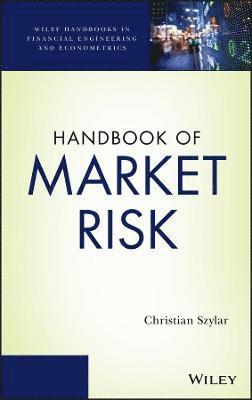
1 822 kr
Beställningsvara. Skickas inom 7-10 vardagar. Fri frakt över 249 kr.
Beskrivning
Produktinformation
- Utgivningsdatum:2014-01-21
- Mått:160 x 236 x 25 mm
- Vikt:726 g
- Format:Inbunden
- Språk:Engelska
- Serie:Wiley Handbooks in Financial Engineering and Econometrics
- Antal sidor:432
- Förlag:John Wiley & Sons Inc
- ISBN:9781118127186
Utforska kategorier
Mer om författaren
CHRISTIAN SZYLAR, PHD, is Global Head of Risk at Marshall Wace, LLP. Dr. Szylar has over eighteen years of working experience with international financial organizations and has advised numerous financial institutions on how best to implement efficient risk management in banking as well as in both UCITS and hedge fund markets. Dr. Szylar has taught multiple master's-level courses on market risk and speaks regularly at international conferences.
Innehållsförteckning
- Foreword xvAcknowledgments xviiAbout the Author xixIntroduction xxi1 Introduction to Financial Markets 11.1 The Money Market 41.2 The Capital Market 51.2.1 The Bond Market 61.2.1.1 The Present Value Concept 71.2.1.2 Types of Bonds 101.2.2 The Stock Market 161.3 The Futures and Options Market 191.4 The Foreign Exchange Market 221.5 The Commodity Market 22Further Reading 262 The Efficient Markets Theory 272.1 Assumptions behind a Perfectly Competitive Market 282.2 The Efficient Market Hypothesis 302.2.1 Strong EMH 312.2.2 Semi-Strong EMH 322.2.3 Weak-Form EMH 322.3 Critics of Efficient Markets Theory 332.4 Development of Behavioral Finance 352.5 Beating the Market: Fundamental versus Technical 352.5.1 Fundamental Methods 362.5.1.1 Price Earnings Ratio 372.5.1.2 Price to Book 372.5.1.3 Price to Cash Flow 382.5.1.4 Return on Equity 382.5.1.5 Price to Earnings to Growth Ratio 382.5.2 Technical Analysis 392.5.2.1 Average True Range 392.5.2.2 Rate of Change 392.5.2.3 Relative Strength Index 402.5.2.4 Money Flow Index 412.5.2.5 Moving Averages 41Further Reading 423 Return and Volatility Estimates 443.1 Standard Deviation 473.2 Standard Deviation with a Moving Observation Window 483.3 Exponentially Weighted Moving Average (EWMA) 503.4 Double (Holt) Exponential Smoothing Model (DES) 533.5 Principal Component Analysis (PCA) Models 533.6 The VIX 543.7 Geometric Brownian Motion Process 553.8 GARCH 563.9 Estimator Using the Highest and Lowest 563.9.1 Parkinson Estimator 563.9.2 Rogers Satchell Estimator 573.9.3 Garman–Klass Estimator 57Further Reading 584 Diversification, Portfolios of Risky Assets, and the Efficient Frontier 594.1 Variance and Covariance 614.2 Two-Asset Portfolio: Expected Return and Risk 614.3 Correlation Coefficient 634.3.1 Correlation Coefficient and Its Impact on Portfolio Risk 634.3.1.1 Zero Correlation Case 654.3.1.2 Perfect Negative Correlation Case 654.3.1.3 Perfect Positive Correlation Case 654.3.2 The Number of Assets in a Portfolio and Its Impact on Portfolio Risk 664.3.3 The Effect of Diversification on Risk 684.4 The Efficient Frontier 694.5 Correlation Regime Shifts and Correlation Estimates 804.5.1 Increased Correlation 804.5.2 Severity of Correlation Changes 844.6 Correlation Estimates 884.6.1 Copulas 904.6.2 Moving Average 914.6.3 Correlation Estimators in Matrix Notation 924.6.4 Bollerslev’s Constant Conditional Correlation Model 934.6.5 Engle’s Dynamic Conditional Correlation Model 944.6.6 Estimating the Parameters of the DCC Model 954.6.7 Implementing the DCC Model 97Further Reading 1005 The Capital Asset Pricing Model and the Arbitrage Pricing Theory 1015.1 Implications of the CAPM Assumptions 1025.1.1 The Same Linear Efficient Frontier for All Investors 1025.1.2 Everyone Holds the Market Portfolio 1025.2 The Separation Theorem 1055.3 Relationships Defined by the CAPM 1075.3.1 The Capital Market Line 1075.3.2 The Security Market Line 1095.4 Interpretation of Beta 1105.5 Determining the Level of Diversification of a Portfolio 1125.6 Investment Implications of the CAPM 1125.7 Introduction to the Arbitrage Pricing Theory (APT) 115Further Reading 1196 Market Risk and Fundamental Multifactors Model 1206.1 Why a Multifactors Model? 1226.2 The Returns Model 1246.2.1 The Least-Squares Regression Solution 1246.2.1.1 Assumptions of the Least-Squares Solution 1256.2.1.2 Solving the Problem of Heteroskedasticity 1256.2.1.3 Outliers 1286.2.1.4 Robust Regression 1296.2.2 Statistical Approaches 1316.2.2.1 Principal Components 1316.2.2.2 Asymptotic Principal Components 1326.2.2.3 Maximum-Likelihood Estimation 1336.2.3 Hybrid Solutions 1346.3 Estimation Universe 1346.4 Model Factors 1356.4.1 Market Factor or Intercept 1356.4.2 Industry Factors 1356.4.2.1 Thin Industries 1366.4.2.2 Treatment of Thin Industries 1376.4.3 Style Factors 1386.4.3.1 Standardization of Style Factors 1386.4.4 Country Factors 1406.4.5 Currency Factors 1406.4.6 The Problem of Multicollinearity 1426.5 The Risk Model 1436.5.1 Factor Covariance Matrix 1436.5.2 Autocorrelation in the Factor Returns 145Further Reading 1477 Market Risk: A Historical Perspective from Market Events and Diverse Mathematics to the Value-at-Risk 1487.1 A Brief History of Market Events 1497.2 Toward the Development of the Value-at-Risk 1587.2.1 Diverse Mathematics 1597.2.1.1 Safety-First Principle 1597.2.1.2 Condorcet 1607.2.1.3 Tetens 1607.2.1.4 Actuarial Works 1617.2.1.5 Laplace 1627.2.1.6 Lacroix 1637.2.1.7 Political Economy 1647.2.1.8 1930s England 1667.2.1.9 Financial Theory 1667.2.1.10 The VaR Concept 1677.3 Definition of the Value-at-Risk 1697.4 VaR Calculation Models 1717.4.1 Variance–Covariance 1717.4.1.1 The Standard Normal Distribution or Z Distribution 1737.4.1.2 Skew and Kurtosis 1747.4.1.3 Standard Deviation and Correlation 1757.4.1.4 VaR Calculation Using Variance-Covariance 1787.4.2 Historical Simulation 1807.4.3 Monte Carlo Simulation 1857.4.4 Incremental VaR 1887.4.5 Marginal VaR 1887.4.6 Component VaR 1897.4.7 Expected Shortfall 1897.4.8 VaR Models Summary 1907.4.9 Mapping of Complex Instruments 1917.4.10 Cornish–Fisher VaR 1927.4.11 Extreme Value Theory (EVT) 193Further Reading 1938 Financial Derivative Instruments 1958.1 Introducing Financial Derivatives Instruments 1958.1.1 Swap 1958.1.1.1 Total Return Swap (TRS) 1968.1.1.2 Credit-Default Swap (CDS) 1978.1.1.3 First to Default (FTD) 1998.1.1.4 Collateralized Debt Obligation (CDO) 2008.1.1.5 Credit Linked Note (CLN) 2018.1.1.6 Currency Swap 2018.1.1.7 Swaption 2028.1.1.8 Variance Swap 2038.1.1.9 Contract for Difference (CFD) 2038.1.2 The Forward Contract 2048.1.3 The Futures Contract 2058.1.3.1 Currency Future 2058.1.3.2 Interest Rate Future 2058.1.3.3 Bond Future 2068.1.4 Options 2068.1.4.1 Currency Option 2078.1.4.2 Equity Option 2078.1.4.3 Interest Rate Option 2078.1.5 Warrant 2088.2 Market Risk and Global Exposure 2088.2.1 Global Exposure 2098.2.2 Sophisticated versus Nonsophisticated UCITS 2108.2.3 The Commitment Approach with Examples on Some Financial Derivatives 2118.2.4 Calculation of Global Exposure Using VaR 2168.3 Options 2188.3.1 Different Strategies Using Options 2188.3.2 Black Scholes Formula 2188.3.3 The Greeks 2218.3.3.1 Delta 2218.3.3.2 Delta Hedging 2228.3.3.3 Gamma 2248.3.3.4 Vega 2258.3.3.5 Theta 2268.3.4 Option Value and Risk under Monte Carlo Simulation 2278.3.5 Evaluating Options and Taylor Expansion 2288.3.6 The Binomial and Trinomial Option Pricing Models 228Further Reading 2339 Fixed Income and Interest Rate Risk 2359.1 Bond Valuation 2369.2 The Yield Curve 2369.3 Risk of Holding a Bond 2409.3.1 Duration 2409.3.2 Modified Duration 2409.3.3 Convexity 2419.3.4 Factor Models for Fixed Income 2419.3.5 Hedge Ratio 2429.3.6 Duration Hedging 246Further Reading 24610 Liquidity Risk 24710.1 Traditional Methods and Techniques to Measure Liquidity Risk 24910.1.1 Average Traded Volume 24910.1.2 Bid–Ask Spread 25010.1.3 Liquidity and VaR 25110.2 Liquidity at Risk 25310.2.1 Incorporation of Endogenous Liquidity Risk into the VaR Model 25410.2.2 Incorporation of Exogenous Liquidity Risk into the VaR Model 25910.2.3 Exogenous and Endogenous Liquidity Risk in VaR Model 26110.3 Other Liquidity Risk Metrics 26310.4 Methods to Measure Liquidity Risk on the Liability Side 264Further Reading 26711 Alternatives Investment: Targeting Alpha, Idiosyncratic Risk 26911.1 Passive Investing 26911.2 Active Management 27111.3 Main Alternative Strategies 27211.4 Specific Hedge Fund Metrics 27311.4.1 Market Factor versus Multifactor Regression 27411.4.2 The Sharpe Ratio 27511.4.3 The Information Ratio 27511.4.4 R-Square (R2) 27611.4.5 Downside Risk 276Further Reading 28812 Stress Testing and Back Testing 28912.1 Definition and Introduction to Stress Testing 29012.2 Stress Test Approaches 29412.2.1 Piecewise Approach 29412.2.2 Integrated Approach 29612.2.3 Designing and Calibrating a Stress Test 29812.3 Historical Stress Testing 30012.3.1 Some Examples of Historical Stress Test Scenarios 30112.3.2 Other Stress Test Scenarios 30212.3.2.1 Interest Rate Scenarios 30212.3.2.2 Relative FX Scenarios 30212.3.2.3 Dynamic FX Scenarios 30212.3.2.4 Progression Scenarios 30212.4 Reverse Stress Test 30312.5 Stress Testing Correlation and Volatility 30312.6 Multivariate Stress Testing 30412.7 What is Back Testing? 30612.7.1 VaR is Not Always an Accurate Measure 30812.8 Back Testing: A Rigorous Approach is Required 31012.8.1 Test of Frequency of Tail Losses or Kupiec’s Test 31112.8.2 Conditional Coverage of Frequency and Independence of Tail Losses 31212.8.3 Clean and Dirty Back Testing 313Further Reading 31413 Banks and Basel II/III 31513.1 A Brief History of Banking Regulations 31613.2 The 1988 Basel Accord 31713.2.1 Definition of Capital 31813.2.2 Credit Risk Charge 31913.2.3 Off-Balance Sheet Items 32013.2.4 Drawbacks from the Basel Accord 32313.2.5 1996 Amendment 32413.3 Basel II 32513.3.1 The Credit Risk Charge 32613.3.1.1 The Standardized Approach 32613.3.1.2 The Internal Ratings-Based (IRB) Approach 32813.3.2 Operational Risk Charge 32913.3.2.1 The Basic Indicator Approach 32913.3.2.2 The Standardized Approach 33013.3.2.3 The Advanced Measurement Approach 33013.3.3 The Market Risk Charge 33113.3.3.1 The Standardized Method 33213.3.3.2 The Internal Models Approach 35213.4 Example of the Calculation of the Capital Ratio 36413.5 Basel III and the New Definition of Capital; The Introduction of Liquidity Ratios 365Further Reading 37114 Conclusion 373Index 378
Mer från samma serie
Handbook of Volatility Models and Their Applications
Luc Bauwens, Christian M. Hafner, Sebastien Laurent
1 943 kr
Handbook of Modeling High-Frequency Data in Finance
Frederi G. Viens, Maria Cristina Mariani, Ionut Florescu
1 886 kr
Fundamental Aspects of Operational Risk and Insurance Analytics
Marcelo G. Cruz, Gareth W. Peters, Pavel V. Shevchenko
1 872 kr
Handbook of High-Frequency Trading and Modeling in Finance
Ionut Florescu, Maria Cristina Mariani, H. Eugene Stanley, Frederi G. Viens
1 651 kr
Du kanske också är intresserad av
Handbook of High-Frequency Trading and Modeling in Finance
Ionut Florescu, Maria Cristina Mariani, H. Eugene Stanley, Frederi G. Viens
1 651 kr
Handbook of Volatility Models and Their Applications
Luc Bauwens, Christian M. Hafner, Sebastien Laurent
1 943 kr
Fundamental Aspects of Operational Risk and Insurance Analytics
Marcelo G. Cruz, Gareth W. Peters, Pavel V. Shevchenko
1 872 kr
Fundamental Aspects of Operational Risk and Insurance Analytics and Advances in Heavy Tailed Risk Modeling: Handbooks of Operational Risk Set
Marcelo G. Cruz, Gareth W. Peters, Pavel V. Shevchenko
3 178 kr