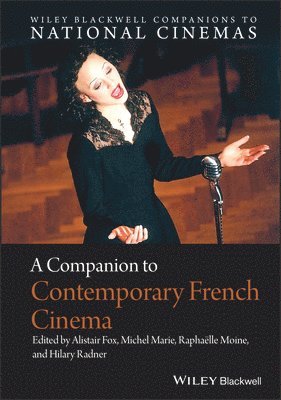
Del i serien Wiley Blackwell Companions to National Cinemas
2 524 kr
Beställningsvara. Skickas inom 11-20 vardagar. Fri frakt över 249 kr.
Beskrivning
Produktinformation
- Utgivningsdatum:2015-01-30
- Mått:178 x 246 x 33 mm
- Vikt:1 315 g
- Format:Inbunden
- Språk:Engelska
- Serie:Wiley Blackwell Companions to National Cinemas
- Antal sidor:712
- Förlag:John Wiley and Sons Ltd
- ISBN:9781444338997
Mer om författaren
Alistair Fox is Professor Emeritus at the University of Otago. His books include Jane Campion: Authorship and Personal Cinema (2011), New Zealand Cinema: Interpreting the Past (2011), and an English edition and translation of Anne Gillain’s François Truffaut: The Lost Secret (2013). Michel Marie is Professor Emeritus at l’Université Sorbonne Nouvelle Paris 3. His publications include The French New Wave: An Artistic School (1998, translated into English in 2002), Aesthetics of Film (with Jacques Aumont and Alain Bergala, 1983, translated into English in 2002), and Les Grands Pervers au cinéma (2009). Raphaëlle Moine is Professor of Cinema and Media Studies at l’Université Sorbonne Nouvelle Paris 3. Her publications include Cinema Genre (2002; translated into English in 2008), Remakes: les films Français à Hollywood (2007), and Les Femmes d’action au cinéma (2010). Hilary Radner is Professor of Film and Media Studies in the Department of History and Art History at the University of Otago. Her publications include Neo-Feminist Cinema: Girly Films, Chick Flicks and Consumer Culture (2011) and Feminism at the Movies: Understanding Gender in Contemporary Popular Culture (2011).
Recensioner i media
"The Companion is divided into five parts with 27 chapters or essays, newly written, from different hands. The academics involved are from the UK, the USA, New Zealand and nearly half from France. There is a list of all the films cited in the volume (18 pages) and an extensive bibliography (24 pages), as well as an index." (Reference Reviews 2016)
Innehållsförteckning
- List of Contributors xii Acknowledgments xviiiEditorial Practice xxIntroduction: Contemporary French Cinema – Continuity and Change in a Global Context 1Alistair Fox, with Michel Marie, Raphaëlle Moine, and Hilary RadnerContexts: Institutional, Political, Cultural, and Economic 4Characteristics of Contemporary French Cinema 4Thematic Preoccupations 7Trends, Developments, and the Future of French Cinema 10Part I Economic, Institutional, and Political Contexts 151 The Political Economy of French Cinema: Attendance and Movie Theaters 17Laurent CretonChanging Patterns of Cinema Attendance 20Cinematic Production and Its Outcomes 23The Competitiveness of French Cinema and Market Share 25Concentration and Diversity 30The Transformation of the Pool of Theaters 32The Future of Cinematic Theaters 352 “Do We Have the Right to Exist?” French Cinema, Culture, and World Trade 45Jonathan BuchsbaumFrance 49Europe: Television Without Frontiers 51Cultural Exception: GATT 56Cultural Diversity: MAI/UNESCO 623 Historicizing Contemporary French Blockbusters 74Charlie MichaelA Tentative Typology 75“Cultural Diversity” or Cultural Crisis? 77The Second Lang Plan (1989–1993) 79The Maturation of a “Forced Marriage” 82StudioCanal in the Crosshairs 84A New Oligopoly? 874 Moving Between Screens: Television and Cinema in France, 1990–2010 96Guillaume SoulezThe Role of Television in the Financing of Cinema 97Arte as a Stimulus and Sponsor of the New Cinema 98A Cinema of Collections 98Realism and Television 100The Revival of Documentary 101Films/Telefilms: A Play of Mirrors 103“Television Films” and Cinema Formatting 104From Comic Television to Comedy in Cinemas 106Cinema and Televised Series 1095 Contemporary Political Cinema 117Martin O’ShaughnessyTaking Stock: Working-Class Histories and the Exit from Fordism 118Outsiders and Victims, Ethics and Politics 125Political Effectiveness 131New Departures? 1336 Diasporic and Postcolonial Cinema in France from the 1990s to the Present 136Will HigbeeAuteur-led Productions and the “Return” of the Political in Diasporic and Postcolonial Cinema Since the 1990s 139From Margins to the Mainstream: Postcolonial Comedy and the Mainstreaming of Maghrebi-French Filmmakers in the 2000s 144Memorializing Colonial History: From Neo-Colonial to “Counter-Heritage” Cinema 148Return Narratives in Diasporic Cinema of the 2000s 153Beyond Ethnicity? Reconfiguring Difference in Diasporic Cinema 154Part II Auteurs and Auteurism 1617 The Veterans of the New Wave, Their Heirs, and Contemporary French Cinema 163Michel MarieThe Extraordinary Fecundity of the Veterans of the New Wave 163The Quartet of Founding Members: Chabrol, Rohmer, Rivette, Godard 166The “Left Bank” of the New Wave 173A Problematical Legacy 177Epilogue: The Enduring Influence of Bresson and Pialat 1818 Was There a Young French Cinema? 184Jacqueline NacacheTo What Does the Term “Young French Cinema” Refer? 185The Arrival of the New Cinema 187The Counter-Attack of Positif 190Maturity and Defining Parameters 192New Appraisals, New Perspectives 195Consensus and Uncertainties 197What Remains of the Young French Cinema? 1989 Auteurism, Personal Cinema, and the Fémis Generation: The Case of François Ozon 205Alistair FoxCharacteristics of Auteur Cinema 206Categories of Auteur Directors 207Auteurist Styles 208Cinephilia and Its Influence 209The Personal Dimension 210The Functions of Personal Cinema 213François Ozon: A Case Study 216Symbolic Figuration and Ozon’s Personal Myth 217The Common Denominator of the Cinéma d’Auteur 225Part III Genres, Cycles, and Cinematic Forms 23110 Contemporary French Comedy as Social Laboratory 233Raphaëlle MoinePopular, Local, and Starved of Affection 236Bienvenue chez les Ch’tis, a Popular French Comedy 239Comic Misadventures of Masculinity 243The Emergence of Auteur Comedy 245The Ambivalence of Auteur Comedy: Variations on Personal Relationships and Middle-Class Navel-Gazing 24711 Between Tradition and Innovation: French Crime Films During the 2000s 256Thomas PillardThe Paradoxes of the American-style Thriller: Desire for a Globalized Cinema and Rejection of the “New Europe” 257The Invention of a New Type of Transnational Crime Film 258The “Last Combatant”: Defending French Identity in the Context of Globalization 260The Ideological Conservatism and Pessimism of the “Old-style” Film Noir: Cinematic Nostalgia and Suffering Men 262The Perils of Modern Capitalism and Supermodernity in the Social Crime Film: Between Documentary and (Masculine) Tragedy 26612 Contemporary French Horror Cinema: From Absence to Embodied Presence 275Guy AustinThe Place of Genre in French Cinema 276French Horror since 2000 277Horror and the Body 279Historicizing Horror 280The Cutting Edge of Horror Spectatorship 28413 The Historical Film and Contemporary French Cinema: Representing the Past in the Present 289Hilary RadnerGenre, the Historical Film, and Historical Thinking 290The New History Film 292From Heritage Film to Biopic 293The Historical Film: Moving into the Twenty-First Century 295Sensationalism: The Spectacle of History 297The Age of Individual Moral Choice 301Collective Memory and Twentieth-Century History 302The Biopic and the Cult of the Individual 30514 Major Stars, the Heritage Film, and Patrimonial Values in Contemporary French Cinema 314Gwénaëlle Le GrasFrench Heritage Stars: Trends and Parameters 315Responding to the Contemporary Sense of Crisis 319Bridging the Gap between Auteur Cinema and Commercial Cinema 322A Reaction to the Disappearance of the Classical Star System 324Countering the Supremacy of Hollywood 325The Younger Generation and the Uncertain Future of the Heritage Solution 32815 French Animated Cinema, 1990 to Present 333Richard NeupertMichel Ocelot’s Model for Feature Film Production 334Toward a “New Wave” of French Animation 340French Animation: 2011–2012 34616 Contemporary French Documentary: A Renaissance, 1992–2012 356Alison J. Murray LevineWhat is a Documentary? 357The Market for French Documentary: A Deceptive Renaissance? 359Recent French Documentaries: People, Subjects, Forms 361Webdocs and the Future of Documentary 370Part IV Gender and Sexuality 37717 Pitiful Men, Instrumental Women: The Reconfiguration of Masculine Domination in Contemporary Popular French Cinema 379Geneviève SellierAt the Top of the Box Office, a Gendered Asymmetry 3801994: Women Become Visible, But at What Price? 3822010: The Diversity of the Masculine, the Archaism of the Feminine 38618 French Women Directors Since the 1990s: Trends, New Developments, and Challenges 399Brigitte RolletWomen’s Access to Filmmaking in France: Old and New Trends 400Agnès Varda and The New Wave 402The Generation of 1968 403The Fémis Generation 406Generation 2000 408An(other) French Exception? Auteur Cinema / Popular Cinema 408“New” Genres: Rom-Com 410Queens of Comedy: The “Millionnaires” of the 2000 s 411First Films: And After? 41219 Modes of Masculinity in Contemporary French Cinema 419Tim PalmerCreating/ive Masculinity: The Artistic Agency of Emmanuel Mouret and Romain Duris 421In the Wilderness: Atavistic Masculinity and the Cinéma du corps 424The Refracted Man: Representations of Masculinity in Films by Women 42920 Hors milieu: Queer and Beyond 439Nick Rees-RobertsVisible 442Invisible 445Relational 448Cruising and Disorientation 450Male Space 45321 Sexually Explicit French Cinema: Genre, Gender, and Sex 461Kelley ConwayRomance (Catherine Breillat, 1999) 465Baise-moi (Virginie Despentes and Carolie Trinh Thi, 2000) 470Choses secrètes ( Jean-Claude Brisseau, 2002) 474Part V Continuities and Emerging Trends 48122 Booking Passages: Adventures in Adaptation in Recent French Cinema 483T. Jefferson KlineAdaptations of Historical Novels 484Adaptations of Foreign Novels 491Adaptations of Recent Best-Selling French Novels 49723 The Return of Theatricality in French Cinema of the 1990s: A New Imbrication of Comedy and Melodrama 507Marguerite ChabrolThe Theatrical “Revival” 507Context, Successes, Strategies: The Spectacular 508Value Judgments: The Mingling of Categories 510A Typology of Theatrical Films: Continuities and Innovations 512The Place of the Spectator: Identification and Detachment 516On “Pop” Cinema 517Stereotypes and Performance 520An American Approach? 52424 Soundscapes of Loss: Songs in Contemporary French Cinema 527Phil PowrieThe Contemporary Musical 528Songs in Contemporary Non-Musical Films: Theoretical and Methodological Issues 530French-Language Songs 532English-Language Songs 535The Final Song in French 53925 From the Margins to the Center: French Stardom and Ethnicity 547Ginette VincendeauGlobalization and Diversity in Twenty-First Century French Stardom 547Ethnic Casting: From the Margins to the Center 551The “Trojan Horse” of Comedy 556Trans-Ethnic to Color-Blind Casting: Erasure or Integration? 560The Power of Global Celebrity Culture 56526 An Invention with a Future: French Cinema After the End of Cinema 570Martine BeugnetVintage Cinema 571Only the Cinema 573Animation Retro-Style 577Twilight Visions 58027 The Amateur in Cinema, in France, Since 1990: Definitions, Issues, and Trends 590Roger OdinFamilial Space: The End of the Family Film 591The Space of “Amateur Cinema” 594The Space of “Different” Cinema 597Amateur Cinema Recognized at Last: The Space of the Document 601The Space of Everyday Communication: Beyond “Cinema,” the Language of Images and Sounds 606List of Contemporary French Films Since 1990 Cited in this volume 612Bibliography 631Index 655
Du kanske också är intresserad av
Companion to Hong Kong Cinema
Esther M. K. Cheung, Gina Marchetti, Esther C. M. Yau, Esther M. K. Cheung, Gina Marchetti, Esther C. M. Yau
512 kr