Häftad, Engelska, 2011
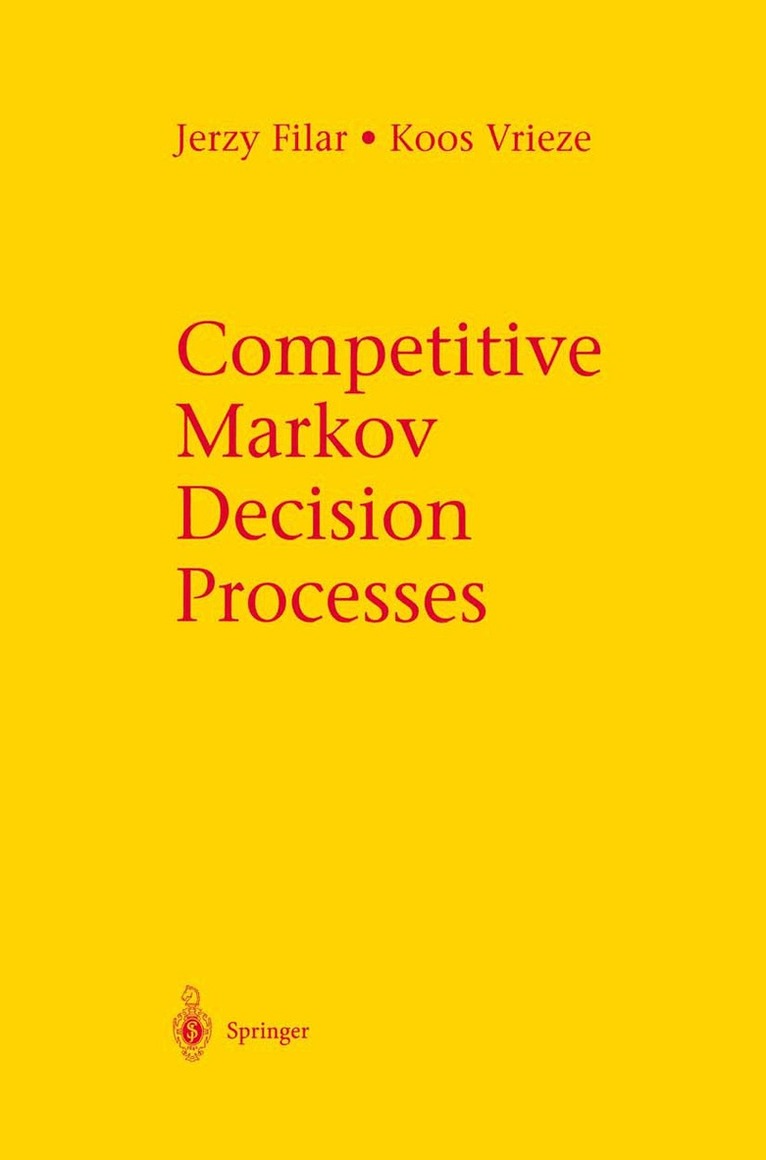
Competitive Markov Decision Processes
2399 kr
Beställningsvara. Skickas inom 10-15 vardagar. Fri frakt över 249 kr.
Beskrivning
This book is intended as a text covering the central concepts and techniques of Competitive Markov Decision Processes. It is an attempt to present a rig orous treatment that combines two significant research topics: Stochastic Games and Markov Decision Processes, which have been studied exten sively, and at times quite independently, by mathematicians, operations researchers, engineers, and economists. Since Markov decision processes can be viewed as a special noncompeti tive case of stochastic games, we introduce the new terminology Competi tive Markov Decision Processes that emphasizes the importance of the link between these two topics and of the properties of the underlying Markov processes. The book is designed to be used either in a classroom or for self-study by a mathematically mature reader. In the Introduction (Chapter 1) we outline a number of advanced undergraduate and graduate courses for which this book could usefully serve as a text. A characteristic feature of competitive Markov decision processes - and one that inspired our long-standing interest - is that they can serve as an "orchestra" containing the "instruments" of much of modern applied (and at times even pure) mathematics. They constitute a topic where the instruments of linear algebra, applied probability, mathematical program ming, analysis, and even algebraic geometry can be "played" sometimes solo and sometimes in harmony to produce either beautifully simple or equally beautiful, but baroque, melodies, that is, theorems.
Produktinformation
- Utgivningsdatum: 2011-09-17
- Mått: 155 x 235 x 23 mm
- Vikt: 616 g
- Format: Häftad
- Språk: Engelska
- Antal sidor: 394
- Förlag: Springer-Verlag New York Inc.
- ISBN: 9781461284819
Utforska kategorier
Betyg & recensioner
0 recensioner
Inga recensioner tillgängliga.