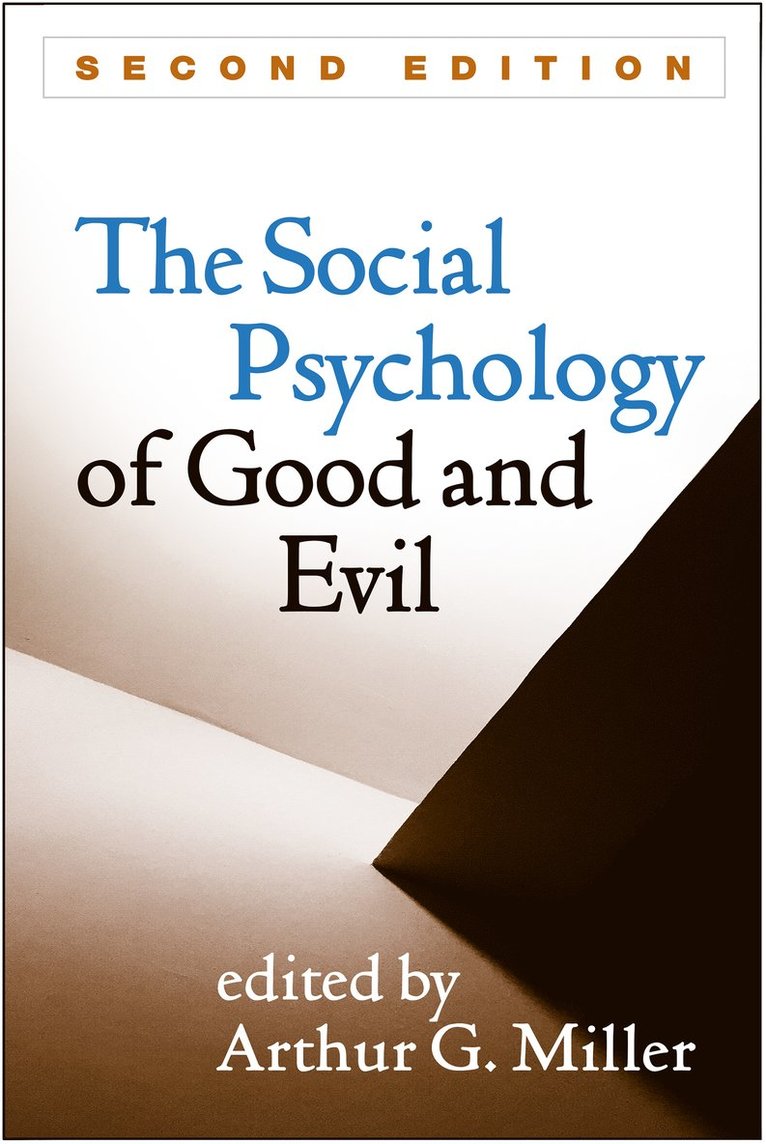
795 kr
Beställningsvara. Skickas inom 7-10 vardagar. Fri frakt över 249 kr.
Beskrivning
Produktinformation
- Utgivningsdatum:2016-07-22
- Mått:155 x 234 x 23 mm
- Vikt:772 g
- Format:Häftad
- Språk:Engelska
- Antal sidor:542
- Upplaga:2
- Förlag:Guilford Publications
- ISBN:9781462525393
Utforska kategorier
Mer om författaren
Arthur G. Miller, PhD, is Professor Emeritus of Psychology at Miami University in Oxford, Ohio. Dr. Miller’s research and publications have focused on stereotyping and stigma, biases in attribution and social judgment, and judgmental reactions to diverse explanations of evil and violence. He recently coedited a special issue of the Journal of Social Issues: "Milgram at 50: Exploring the Enduring Relevance of Psychology's Most Famous Studies."
Recensioner i media
“In this timely book, preeminent social psychologists illuminate humanity's devilish and angelic actions, and suggest how we might transform today’s closed fists into tomorrow’s open arms. For social science students and for those working to create a more just and peaceful world, these pages offer compelling, state-of-the-art insights into the roots and fruits of our human capacity for good and evil.”--David G. Myers, PhD, Department of Psychology, Hope College"This edition, like its predecessor, sends a clear message: the social psychology of moral thought, action, and relationships is intellectually compelling, theoretically sophisticated, and empirically persuasive. The chapters are not just summaries of what is known about the good and the bad of human social behavior, but theoretical masterpieces by experts who write with impressive depth, clarity, and insight. The theme of the first edition--that social psychology holds the key to understanding why people act in ways that are sometimes commendable, but sometimes reprehensible--is reaffirmed in this edition, and amplified by the addition of groundbreaking chapters dealing with important issues, including terrorism, dehumanization, objectification, and victimization. I plan to use this book as a reference, as a source of inspiration for research, and as the text in my course on good and evil."--Donelson R. Forsyth, PhD, Jepson School of Leadership Studies, University of Richmond"Psychology has sometimes shied away from the empirical study of concepts with clear moral implications--and no concepts are more fraught in this regard than good and evil. This remarkable volume attests to the fact that anxiety about examining good and evil in an empirical light is abating. Miller has assembled a stellar cast of contemporary scholars to provide an up-to-the minute account of academically and clinically relevant phenomena, from the self-concept to dehumanization to media violence. This exceptional volume belongs on the shelves of students, scholars, and practitioners in both the applied and the basic branches of psychological science."--Robert F. Krueger, PhD, Distinguished McKnight University Professor, Department of Psychology, University of Minnesota"A splendid volume with an all-star cast of contributors. This book offers a balanced and provocative exploration of the worst--and best--of our inclinations and actions."--Lee D. Ross, PhD, Department of Psychology, Stanford University"The first edition of this text rapidly became a go-to reference for students and scholars. Addressing issues of pressing importance across the social sciences and society as a whole, the book proved to be enormously influential, and I thought it would be hard to improve on. The second edition has proved me wrong. Thoroughly revised and updated, the chapters now have an even broader reach and wider relevance. Even if you have the first edition on your shelves, you must buy, read, teach, and talk about this landmark contribution to the field."--Alexander Haslam, PhD, School of Psychology, University of Queensland, Australia"What an outstanding volume! This book brings together what is known and understood regarding goodness, forgiveness, evil, callousness, cruelty, and kindness, authored by leading theorists and investigators from diverse professional perspectives. Clinicians and students will find this book truly fascinating reading. I can’t recommend it more highly."--Thomas A. Widiger, PhD, Department of Psychology, University of Kentucky -An outstanding collection of chapters examining the good and bad behavior that people exhibit toward one another--both human virtue and abject cruelty are represented well in this second edition….Researchers and teachers can use this book to enliven their empirical work or classroom discussions. Graduate students will find inspiration and direction. This book will be an excellent resource for organizing undergraduate or graduate seminars on good and evil. Highly recommended. Upper-division undergraduates through professionals.--Choice Reviews, 2/1/2017Æ’Æ’ Miller has corralled a refreshing mix of social psychological voices to examine the nature of kindness and cruelty. A classical social psychological emphasis on situational influences forms a common thread that blends standard approaches, theories, and findings with less expected, but welcome, contributions….Graduate students and advanced undergraduates will find helpful literature reviews and discussions of conceptual approaches. Instructors will find several essays that are especially accessible to students. Those teaching interdisciplinary courses on the topic of good and/or evil will find a broad representation of social psychological perspectives. For seasoned scholars conducting research on good and evil, this book offers some new empirical evidence, but perhaps more valuable still are the unexpected insights generated by relating classic topics to the theme of good and evil. (on the first edition)--Journal of Social and Clinical Psychology, 4/4/2008Æ’Æ’ A fine book, rich in scholarship and argument, rarely tendentious and often stimulating, clear and perceptive. It is to be recommended to scholars and the interested reader alike. (on the first edition)--Metapsychology Online Reviews, 2/2/2006Æ’Æ’ Anyone who is interested in the social psychological literature on these topics could not find a better compilation. (on the first edition)--Journal of Nervous and Mental Disease, 4/1/2006Æ’Æ’ Includes chapters from renowned researchers and will be widely read by followers of experimental social psychology....A useful resource. (on the first edition)--British Journal of Sociology, 10/1/2006
Innehållsförteckning
- 1. Introduction and Overview, Arthur G. MillerI. Conceptual Perspectives on Good and Evil2. The Evolution of Good and Evil, Joshua D. Duntley and David M. Buss3. Free Will Evolved for Morality and Culture, Andrew E. Monroe, Kathleen D. Vohs, and Roy F. Baumeister4. Categories, Intent, and Harm, Susan T. Fiske5. “The Devil Made Me Do It”: The Deification of Consciousness and the Demonization of the Unconscious, John A. BarghII. Harming Others: Contexts, Causes, and Implications6. Racism among the Well Intentioned: Bias without Awareness, John F. Dovidio, Samuel L. Gaertner, and Adam R. Pearson7. Understanding Media Violence Effects, Sara Prot, Craig A. Anderson, Muniba Saleem, Christopher L. Groves, and Johnie J. Allen8. How Dehumanization Promotes Harm, Nick Haslam and Steve Loughnan9. The Social Psychology of Genocide and Mass Atrocities, Johanna Ray Vollhardt and Maggie Campbell-Obaid10. Why Are the Milgram Experiments Still So Extraordinarily Famous—and Controversial?, Arthur G. Miller11. A Social Interaction Approach to Objectification: Implications for the Social-Psychological Study of Sexual Violence, Sarah J. GervaisIII. The Self-Concept in Relation to Good and Evil Acts12. False Moral Superiority, David Dunning13. Making Relationship Partners Good: A Model of the Interpersonal Consequences of Compassionate Goals, Jennifer Crocker and Amy Canevello14. Evil Persons or Evil Deeds?: What We’ve Learned about Incarcerated Offenders, June P. Tangney, Dan V. Blalock, Johanna B. Folk, and Jeffrey Stuewig15. Dishonesty Explained: What Leads Moral People to Act Immorally, Francesca Gino and Dan ArielyIV. Group Perspectives on Good and Evil16. Bystanders and Emergencies: Why Understanding Group Processes Is Key to Promoting Prosocial Behavior, Mark Levine and Neil Wilson17. Remembering Historical Victimization: Potential for Intergroup Conflict Escalation and Conflict Reduction, Nyla R. Branscombe, Michael J. A. Wohl, and Ruth H. Warner18. Organizations Matter, Arthur P. Brief and Kristin Smith-Crowe19. Globalization and Terrorism: The Primacy of Collective Processes, Fathali M. Moghaddam, Victoria Heckenlaible, Madeleine Blackman, Sarah Fasano, and Daniel J. DufourV. The Possibilities for Kindness20. Benefits and Liabilities of Empathy-Induced Altruism: A Contemporary Review, C. Daniel Batson, Nadia Y. Ahmad, and E. L. Stocks21. Volunteerism: Multiple Perspectives on Benefits and Costs, Mark Snyder, Allen M. Omoto, and Patrick C. Dwyer22. The Psychology of Heroism: Extraordinary Champions of Humanity in an Unforgiving World, Zeno E. Franco and Philip G. ZimbardoIndex
Du kanske också är intresserad av
- Nyhet
- -30%
- Signerad!
- Signerad!
- Signerad!
- Nyhet
- Nyhet
Hjärnans akilleshälar : hur din hjärna lurar dig, och vad du kan göra åt det
Anders Hansen
289 kr