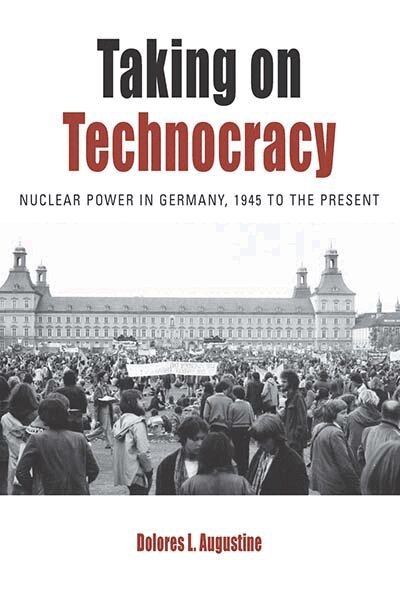
Taking on Technocracy
Nuclear Power in Germany, 1945 to the Present
Del i serien Protest, Culture & Society
1 956 kr
Beställningsvara. Skickas inom 3-6 vardagar. Fri frakt över 249 kr.
Fler format och utgåvor
Beskrivning
Produktinformation
- Utgivningsdatum:2018-05-22
- Mått:152 x 229 x 21 mm
- Vikt:594 g
- Format:Inbunden
- Språk:Engelska
- Serie:Protest, Culture & Society
- Antal sidor:304
- Förlag:Berghahn Books
- ISBN:9781785336454
Utforska kategorier
Mer om författaren
Dolores L. Augustine was until her retirement a Professor of History at St. John’s University, New York. She received her doctorate from the Free University of Berlin. Her publications include Patricians and Parvenus: Wealth and High Society in Wilhelmine Germany and Red Prometheus: Engineering and Dictatorship in East Germany, 1945-1990.
Recensioner i media
“Augustine’s broad coverage of the scientific and emotional stakes of nuclear power in both German states amid the Cold War make this a vital read for historians interested in environmentalism and new social movements. Engagingly written, it is accessible to advanced undergraduates as well.” • American Historical Review“Augustine’s book provides probably the best overview of the history of nuclear energy and society in Germany.” • NTM Journal of the History of Science, Technology and Medicine“Augustine’s thoughtful history contains useful chapter introductions and conclusions… [It offers an] engaging and important story at the heart of the book. As Augustine reminds readers, the story she tells has an open ending. In the era of climate change, as governments struggle to lower greenhouse gas emissions, the future of nuclear power in Germany remains undecided.” • German History“Taking on Technocracy covers a broad range of developments in the domains of technology, policy, and protest, analyzing them with nuance in the different contexts of East and West Germany. For those wanting to understand why the issue of nuclear power has remained such an important factor in German politics for half a century or more, Dolores Augustine has delivered an excellent study of the long-running debates on the topic and their many twists and turns.” • German Studies Review“Augustine makes a major contribution to our understanding of Germany’s path to the abandonment of nuclear power. She reveals not only the ability of citizens to participate in high-level scientific debates, but also how their interventions can cause dramatic political change. Such success stories are in short supply—and high demand—in the climate-change era.” • History: Reviews of New Books“Augustine conveys how Germans on both sides of the Iron Curtain related to the “Atomic Age” in the 1950s and 1960s….[and] offers a fascinating discussion of safety regimes and nuclear accidents in both German states, showing each side as being closely tied to their respective Cold War superpower.” • Environmental History“All in all, Augustine does not only provide a fascinating, well-written and insightful integrated history of Germany's variegated engagement with nuclear power. She also makes important contributions to cultural history, the transnational history of (counter-)expertise, the history of (new) social movements as well as the history of science and "public technology.”…the book deserves a wide readership.” • Sehepunkte“In her combined analyses of social history, popular culture, social movement theory, and the history of science and technology, Dolores L. Augustine offers an outstanding and extremely recommendable narrative of a key episode in recent history—not only German, but by definition, also European.” • Technology and Culture“Her book is the result of in-depth archival research, especially in newspaper and TV archives. It thus looks at changing public opinion through the lens of published opinions (including editorials), while also reviewing the developing discourse on nuclear safety among activists and scientists…[Her] book will hopefully help spur a renewed discussion about nuclear power.” • German Politics & Society“An exceptionally well-written and comprehensive book on the history of nuclear power in Germany in the second half of the twentieth century. Scholars of antinuclear activism and citizen science, regardless of regional specialty, would find it especially interesting, as Augustine digs into what makes the German case unique but also considers what it has in common with other movements in Europe and the United States. This would also be a useful text for classroom use, as it provides good coverage of a number of aspects of nuclear power controversies.” • Isis Journal“Impressively up-to-date, this volume’s attention to media and public opinion makes it a valuable analysis of the interrelationship between science and social protest.” • Timothy Scott Brown, Northeastern University“This study of utopian visions, scientific expertise, state power, and public protest is a crucial contribution to the history of nuclear power – and public concerns about science generally. Focusing on a divided Germany after the war until unification and the present, Augustine explores surprising similarities in the embrace of nuclear power in capitalism and socialism, including transnational aspects of the two German programs under American and Soviet influence, and unquestioned state support. If at first state- and industry-supported notions of technological progress and a higher standard of living prevailed, then criticism burst forth over worries of catastrophic accidents, even before Three Mile Island and Chernobyl. In West Germany, many citizens rejected the nuclear alliance between the political authorities, the nuclear industry, and technical-scientific experts un-democratic and even authoritarian. They insisted that safety issues were not only technical but normative. Eventually, violent protest shook the nation. Even in the East, brave citizens also came to worry about nuclear power. Ultimately, Germany has rejected nuclear power, and readers will understand why.” • Paul Josephson, Colby College
Innehållsförteckning
- List of IllustrationsAcknowledgmentsList of Abbreviations and Acronyms/GlossaryIntroductionChapter 1. Nuclear Dreams and Radioactive Nightmares: Popular Culture and the Quest for Nuclear Consensus in East and West Germany, 1945-1970Chapter 2. On the Brink of Disaster?: Safety Regimes and Nuclear Accidents in the Two GermanysChapter 3. Dissenting Voices: The Emergence of Counter-Experts in West GermanyChapter 4. From Local Roots to National Prominence: The Struggle over WyhlChapter 5. Environmentalism as Civil War: Brokdorf—and the ConsequencesChapter 6. The Shock of Chernobyl and the Environmentalist Breakthrough in West GermanyChapter 7. Not Immune to Error: Chernobyl’s Impact in the GDRChapter 8. Abandoning Nuclear Power—Or Not?ConclusionBibliographyIndex
Mer från samma serie
Changing the World, Changing Oneself
Belinda Davis, Wilfried Mausbach, Martin Klimke, Carla MacDougall
511 kr
Between Prague Spring and French May
Annette Vowinckel, Marcus M. Payk, Thomas Lindenberger
583 kr
Du kanske också är intresserad av
Rethinking Social Movements after '68
Belinda Davis, Friederike Brühöfener, Stephen Milder
2 229 kr
Nuclear Crisis
Christoph Becker-Schaum, Philipp Gassert, Martin Klimke, Wilfried Mausbach
654 kr
Between Prague Spring and French May
Annette Vowinckel, Marcus M. Payk, Thomas Lindenberger
583 kr