Beställningsvara. Skickas inom 10-15 vardagar. Fri frakt över 249 kr.
Beskrivning
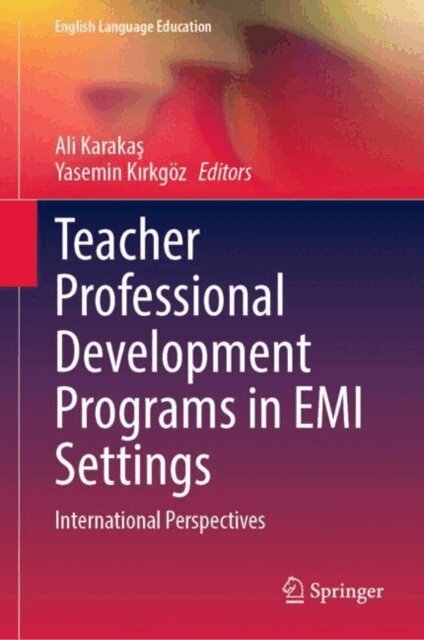
This book showcases a range of professional development activities in English medium instruction (EMI) from diverse international contexts. The book also provides new insights into the challenges and opportunities of EMI in different contexts and contributes to the development of new theoretical frameworks for understanding EMI.
Ali Karakas is Associate Professor at Burdur Mehmet Akif Ersoy University, Turkey. He has a PhD in Applied Linguistics from Southampton University, UK. He is also a postdoctoral member of the Centre for Global Englishes at Southampton University. His main research interests include Global Englishes, English as a lingua franca, language policy and planning, language ideologies and pre-service and in-service language teacher education.Yasemin Kırkgöz is Professor in the English Language Teacher Education department of Çukurova University, Turkey. Her main research interests include language policy and practices particularly in primary and higher education, curriculum design and innovation management, problem-based learning in ELT, English medium instruction in higher education, and pre-service and in-service teacher education. She has received various awards, including the Third Annual David E. Eskey Memorial Award for Curricular Innovation for her publication Innovation as a Curriculum Renewal Process in a Turkish University in 2006, and the Leadership and Management Special Interest Group (SIG) award from IATEFL in 2013.
Innehållsförteckning
Part I: Policy Implementation for EMI: Reflections from the field.- Chapter 1: Policy implementation for EMI: Lessons from thecontext of Higher Education (HE) in Pakistan, Palwasha Sajjad.- Chapter 2: Considering the Implementation of English as aMedium of Instruction in the Algerian Higher Education: Between Ambitions and Risks, Amira Benabdelkader.- Chapter 3: EMI Course process in the Turkish Higher Education Context and Pedagogical Implications - Mehmet Birgün & Yasemin Kırkgöz.- Chapter 4: Designing professional development to meet EMI assessment challenges - Olivia Mair, Amanda Murphy and Francesca Costa.- Part II: Teacher Training in EMI: Best Practices and Challenges.- Chapter 5: What makes a good EMI lecturer: A comparison between Vietnamese students’ and lecturers’ perceptions- Phuong Le Hoang Ngo.- Chapter 6: EMI Teacher Training and Learning Design: Insights from Verona University and Beyond - Sharon Hartle.- Chapter 7: Educating teachers for new roles: reconstructing the pedagogical content knowledge of Brazilian academics who teach in EMI settings - Telma Gimenez.- Chapter 8: EMI teacher training at a Korean science and engineering university: practices and challenges - Eun Gyong Kim & Mik Fanguy.- Chapter 9: Collaborative online international faculty development for English Medium Instruction - Olivia Mair.- Chapter 10: From Educators to Empowered EMI Experts: Nurturing Faculty Educators for Quality EMI - Ece Zehir-Topkaya & Orçin Karadağ.- Part III: Directions for EMIProfessional development.- Chapter 11: Future Directions for Professional Development in EMI Settings - Ali Karakaş & Yasemin Kırkgöz.