Häftad, Engelska, 2026
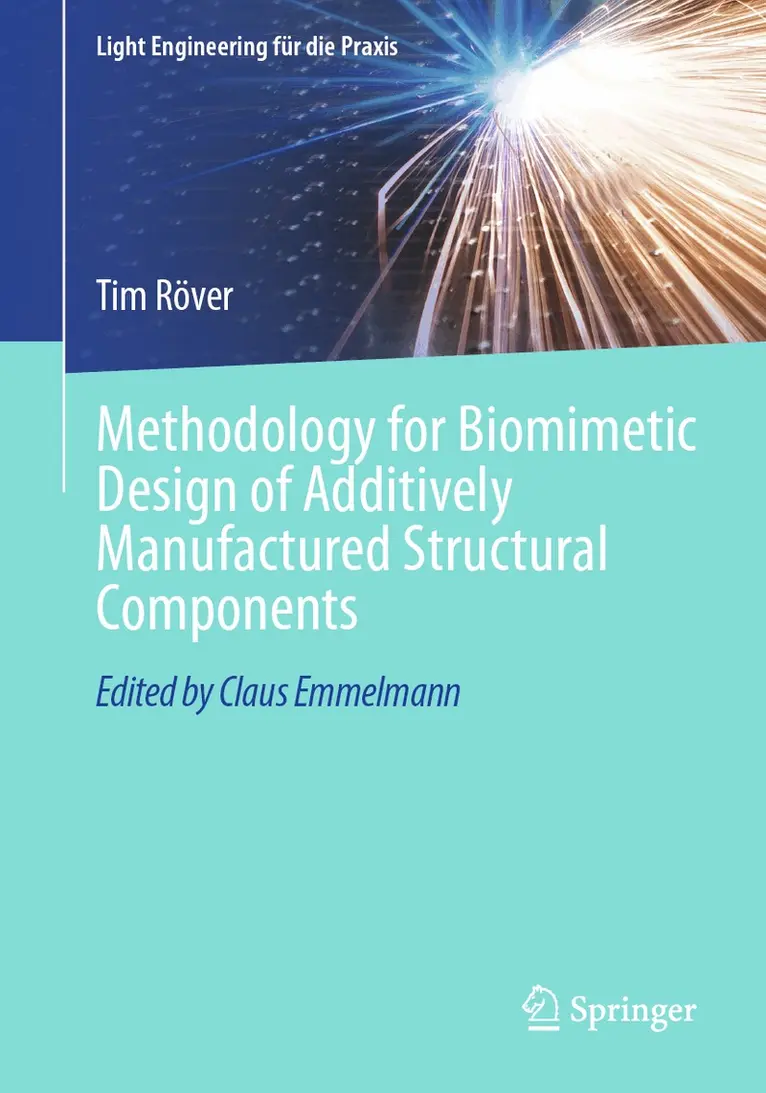
Methodology for Biomimetic Design of Additively Manufactured Structural Components
Av Tim Röver
1967 kr
Beställningsvara. Skickas inom 10-15 vardagar. Fri frakt över 249 kr.
Beskrivning
Previous research indicates that incorporating biomimetic beam‑like structures into topology optimization designs can enhance the lightweight characteristics of components such as aviation brackets that were produced by the additive manufacturing technique of powder bed fusion of metal with a laser beam. However, there is a need for detailed design methodologies to effectively implement such design modifications. The first research question of this thesis explores how a design methodology can be developed to generate biomimetic design components from density‑based topology optimization designs. The secondary research question assesses the lightweight characteristics of the outcomes generated by such a methodology, comparing them to those of the input topology optimization design. A five‑step design methodology with detailed submethodologies was developed. It takes a topology optimization design as an input and, in the first step generates an auxiliary 3D model consisting of cylindrical beams and spherical nodes that resembles the topology optimization design. A skeletonization approach is used for abstraction. In the second step, a finite element analysis of the auxiliary model is performed to evaluate the internal forces and moments in its beams. In step three, two biomimetic parametric beam designs as well as two conventional parametric beam designs are considered for parameter optimization for each of the beam load cases from the auxiliary model. The most lightweight optimized beam is selected for each of the beams of the abstraction, respectively. Buckling analyses and re‑dimensioning of optimized beams are performed, if necessary. In step four, adapted nodes for the biomimetic component design are generated. The nodes contain a lattice infill structure to ensure powder‑removability and a lightweight design. In step five, the complete biomimetic component design is validated by finite element analysis and the mass of the component is evaluated. Thus, a complete design methodology was developed successfully. Three common topology optimization problem formulations were considered for validation of the developed biomimetic design methodology. Finite element analyses of the biomimetic designs yielded the existence of critical regions of high stress in all three of the biomimetic components. However, the locations of critical stresses have been associated with specific regions within the biomimetic designs. Mass evaluation showed that the biomimetic component designs are 12.5 % - 30.3 % lighter compared to their topology optimization counterparts. The developed methodology stands out from previously existing research as it considers the internal forces and moments in beams and closes a research gap for detailed design methodologies for biomimetic structural components. This thesis contributes to harnessing the immense potential of biomimetic design in lightweight industries, such as aerospace and automotive. Future research should refine the presented methodology and perform experimental assessment of component designs generated by it.
Produktinformation
- Utgivningsdatum: 2026-06-26
- Mått: 168 x 240 x 8 mm
- Vikt: 291 g
- Format: Häftad
- Språk: Engelska
- Serie: Light Engineering für die Praxis
- Antal sidor: 118
- Förlag: Springer Nature Switzerland AG
- ISBN: 9783032274045
Utforska kategorier
Betyg & recensioner
0 recensioner
Inga recensioner tillgängliga.