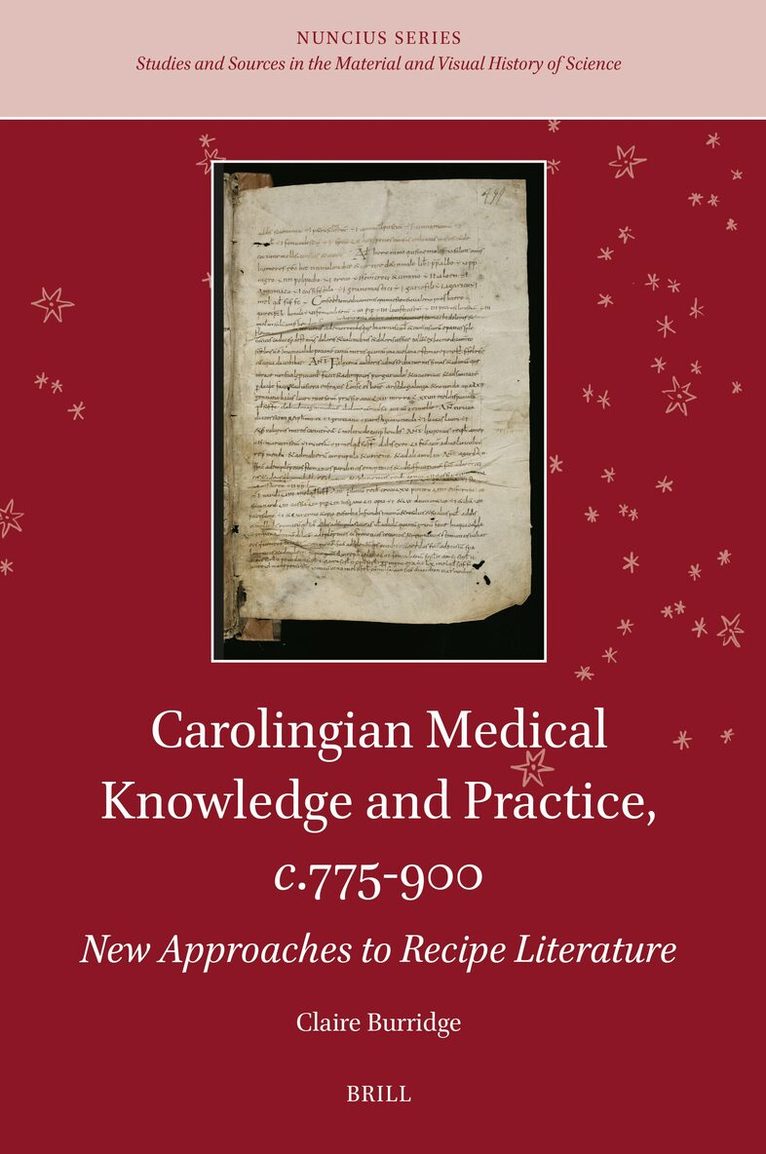
Carolingian Medical Knowledge and Practice, c.775–900
New Approaches to Recipe Literature
Inbunden, Engelska, 2024
Del 14 i serien Nuncius Series
2 344 kr
Beställningsvara. Skickas inom 5-8 vardagar. Fri frakt över 249 kr.
Beskrivning
Carolingian Medical Knowledge and Practice explores the practicality and applicability of the medical recipes recorded in early medieval manuscripts. It takes an original, dual approach to these overlooked and understudied texts by not only analysing their practical usability, but by also re-evaluating these writings in the light of osteological evidence. Could those individuals with access to the manuscripts have used them in the context of therapy? And would they have wanted to do so? In asking these questions, this book unpacks longstanding assumptions about the intended purposes of medical texts, offering a new perspective on the relationship between medical knowledge and practice.
Produktinformation
- Utgivningsdatum:2024-07-25
- Mått:155 x 235 x 33 mm
- Vikt:847 g
- Format:Inbunden
- Språk:Engelska
- Serie:Nuncius Series
- Antal sidor:414
- Förlag:Brill
- ISBN:9789004466166
Utforska kategorier
Mer om författaren
Claire Burridge is a Senior Researcher at the University of Oslo, having previously held postdoctoral fellowships at the British School at Rome and a Leverhulme Trust Early Career Fellowship at the University of Sheffield.
Innehållsförteckning
- AcknowledgementsList of Figures and TablesAbbreviationsNote on Transcription and TranslationNote on Weights, Measures, and Their SymbolsMapIntroduction1 Practicality and Applicability A Dual Approach to Carolingian Medical Knowledge and Practice1 Introduction: the Case of Terenti(an)us2 Definitions3 Foundations4 A Philological Underpinning5 Histories of Early Medieval Medicine: from Negative Stereotypes to Revisionist Approaches6 New Directions in Early Medieval Medical Research7 Summary8 The Carolingian Context9 Structuring the Dual ApproachPart 1Practicality2 Setting the Scene The Texts, Their Contexts, and the Need for a Re-examination of Practicality1 Introduction: a Mixed Picture of (Im)practicality2 Contextualising Medicine’s Place in Early Medieval Europe and the Question of Practicality3 Summary4 Outlining the Recipe Literature5 Recipes and Recipe Collections6 The Manuscript Sample3 Impossible Imports or Available Exotics? A Study of Non-local Materia Medica1 Introduction: the Exotic Ingredients of an Antidote2 Evidence for the Movement of Non-local Materia Medica3 Exotic Materia Medica4 What’s in a Name? The Challenge of Identifying Ingredients and Their Origins5 From Ambergris to Zedoary6 The Confectio Timiame: Camphor, Ambergris, and Other Non-local Materia Medica7 The Recurrent Cluster: Parallels among Incense Recipes8 Moving beyond Incense: the Spread of Knowledge9 The Practicality of Non-local Materia Medica: Putting the Case Study in Perspective10 Conclusion4 Medicine and the Mead Hall? Using Alcoholic Beverages to Explore Potentially Local Materia Medica1 Introduction: a Snapshot from cod. sang. 7522 Wine, Beer, and Mead in the Classical Mediterranea3 Changing Tastes in Late Antiquity?4 The Rise of Beer and Medus in the Early Middle Ages5 Beer6 Mead and Medus7 Summary8 Contextualising Beer and Mead in Early Medieval Europe9 Beer, Mead, and the Question of Practicality10 Conclusion5 Evidence for Practicality beyond Materia Medica1 Introduction: the Importance of Investigating Additional Elements within Recipes2 Staupus: a Vernacular ‘Intrusion’2.1 Past Studies on Staupus3 The Appearance of Staupus in the Recipe Sample4 The Absence of Staupus in Texts on Weights and Measures5 The Practicality of the Unit Staupus6 Wild versus Cultivated Rue: the Inclusion of an Ingredient Substitution7 Instructions for Ingredient Substitutions in the Recipe Sample8 Ingredient Substitution in Earlier Sources9 The Practicality of Substitution Instructions in Recipes10 ConclusionPart 2Applicability6 Reading Recipes in the Light of Skeletal Remains An Introduction to the Integration of Osteological Evidence1 Introduction: Moving from Practicality to Practice, an Investigation into Applicability2 Establishing the Framework of Part ii2.1 Why Question the Relevance of Recipes?3 Working with the Available Evidence4 The Challenges of Using Osteological Evidence to Inform Textual Analysis4.1 Intrinsic Issues with Archaeological Evidence5 Theoretical Challenges Related to the Integration of Skeletal Evidence5.1 Retrospective Diagnosis5.2 The Osteological Paradox5.3 Selection of Conditions5.4 Absence of Evidence as Evidence of Absence?6 Outlining the Analytical Approach to Chapters 7–96.1 Overview of Sites6.2 The Spectrum of Specificity7 Dental Disease From Caries to Cosmetics1 Introduction: a Monk from Lorsch2 Oral Health in the Skeletal Evidence3 Dental Disease in the Archaeological Record: an Overview4 Skeletal Evidence for Oral Pathologies in Early Medieval Europe5 Recipes to Treat Dental Disease6 Category 1: Toothache7 Categories 2–6: the Other Half of the Recipes Concerning Oral Health7.1 Category 2: Ulcers, Sores, Wounds, and Burns7.2 Category 3: Cavities and Tooth Loss7.3 Category 4: Putridity and Cosmetics7.4 Category 5: General, Unspecified Mouth Complaints7.5 Category 6: Gum Problems8 Summary9 The Applicability of the Recipe Sample to Early Medieval People10 Specific Types of Teeth11 Specific Types of People12 Cosmetics13 Possible Sources for Dental Recipes14 Conclusion8 Joint Disease Problematising Podagra1 Introduction: the Pains of Gout—and the Problems of Translation2 The Appearance of Podagra in Medical Recipes3 The Absence of Gout in Archaeological Contexts4 Moving beyond Gout: Evidence for Other Arthropathies in the Osteological Record5 The Spine6 Large Joints and limbs: Shoulders, Elbows, Hips, and Knees7 Small Joints: Hands and Feet8 Summary9 Textual Evidence for Joint Pain beyond Podagra10 General Afflictions of the Joints11 Named Joints and Joint Areas: the Back, Neck, Shoulders, Hips, Knees and Hands12 Integrating the Evidence: a Return to the Gout-Podagra Paradox and the Question of Applicability13 Gout versus Podagra: Conflicting Evidence or a Modern Misnomer?14 The Question of Applicability15 Conclusion9 Trauma and Surgery Evidence of Undocumented Medical Practices?1 Introduction: Interventions ‘Without Ron’2 Textual Evidence for Invasive Surgery and Trauma2.1 Surgery2.2 Trauma3 Osteological Evidence for Trauma and Surgery3.1 Identifying and Understanding Trauma in the Osteological Record3.2 Evidence for Trauma in Early Medieval Skeletal Remains4 Reading Recipes in the Light of Osteological Evidence for Trauma and Surgery4.1 Type of Injury: Conflicting Evidence?4.2 The Question of Surgery4.3 Evidence for Trauma beyond Medical Texts5 ConclusionConclusion10 Putting Knowledge into Practice1 Introduction: Revisiting the Case of Terenti(an)us2 Bringing Together the Case Studies3 Moving Forward: Final Remarks and Future DirectionsAppendicesAppendix 1 The Manuscript SampleAppendix 2 Recipe TranscriptionsBibliographyIndex of Materia Medica Named in RecipesGeneral Index
Hoppa över listan


Mer från samma serie
Del 11
Del 3
Del 2
Del 1
Giovanni Paolo Lomazzo’s Trattato dell’Arte della Pittura: Color, Perspective and Anatomy
Barbara Tramelli
Inbunden
2 236 kr
Del 7
Del 4
Del 6
Del 13
Del 12
Del 9
Hoppa över listan


Du kanske också är intresserad av
Del 1
Giovanni Paolo Lomazzo’s Trattato dell’Arte della Pittura: Color, Perspective and Anatomy
Barbara Tramelli
Inbunden
2 236 kr
Del 11
Del 4
Del 3
Del 6
Del 9
Del 12
Del 13
Del 2
Del 7